Manual hospital beds remain widely used in hospitals, nursing homes, and homecare settings because of their simple structure and reliable operation. However, the quality of the mechanical system determines how effectively these beds perform in daily care environments. Crank design, adjustment stability, and load capacity are key specifications buyers should evaluate before placing bulk orders.
This analysis breaks down manual bed configurations by crank count—from single-function models to three-function hi-low beds. We evaluate the core mechanics, comparing fixed versus foldaway crank designs and detailing critical procurement specifications like Safe Working Load (SWL) and adjustment angle ranges. This provides a technical baseline to help you specify equipment that is both cost-effective and safe for clinical use.
What Is a Manual Hospital Bed?

Manual hospital beds are commonly used in hospitals, clinics, nursing homes, and homecare settings where reliable mechanical adjustment and lower maintenance requirements are priorities.
Definition and Operating Principle
Simply put, a manual hospital bed is adjusted using hand-operated mechanical controls like cranks or levers, not electric motors. A caregiver turns the cranks to change the position of the backrest, leg section, and on some models, the overall bed height.
Because it doesn’t need electricity to function, it’s a dependable choice for facilities with tight budgets or in areas where power is unreliable. Buyers comparing different adjustment systems can also evaluate the differences between manual and electric hospital beds before selecting the right option for their care environment.
Common Configurations and Features
You can usually tell a bed’s functions by its number of cranks, which determine the adjustments available for the backrest, leg section, and overall height. Standard features always include side rails for patient safety and casters with locks for moving the bed.
These beds are built to handle routine care tasks, from positioning patients during recovery to assisting with transfers in hospitals and long-term care facilities.
How Hospital Bed Crank Systems Work
Manual bed cranks use a gearbox and screw system to convert simple rotation into the powerful, smooth force needed to lift or position a patient without any electricity.
The Core Mechanical Principle
When a caregiver turns the crank handle, typically found at the foot of the bed, that rotational motion powers a gearbox. The gearbox multiplies the force, allowing caregivers to adjust patient positions with controlled mechanical assistance. Many manual hospital beds use screw and gearbox mechanisms designed to maintain stable positioning after adjustment. The rotational force is transmitted down a drive shaft to a lifting screw. This screw converts the rotation into a controlled linear movement, smoothly raising or lowering the specific bed section.
Functions Controlled by Each Crank
The number of cranks on a manual bed directly corresponds to its functions. Common manual hospital beds include one-crank, two-crank, and three-crank configurations, while some advanced models provide additional positioning functions.
- Backrest Adjustment: One crank controls the head section. This allows a caregiver to raise the patient’s upper body to support feeding, improve breathing, or facilitate social interaction.
- Knee/Leg Adjustment: A second crank raises the section under the patient’s knees. This position improves circulation and, just as important, prevents the patient from sliding down when the backrest is elevated.
- تعديل الارتفاع (Hi-Lo): On three-crank models, a third crank raises or lowers the entire bed frame. This Hi-Lo function makes it easier for caregivers to provide care without straining their backs and allows patients to get in and out of bed more safely.
Source Certified Manual Hospital Beds Direct from Manufacturer
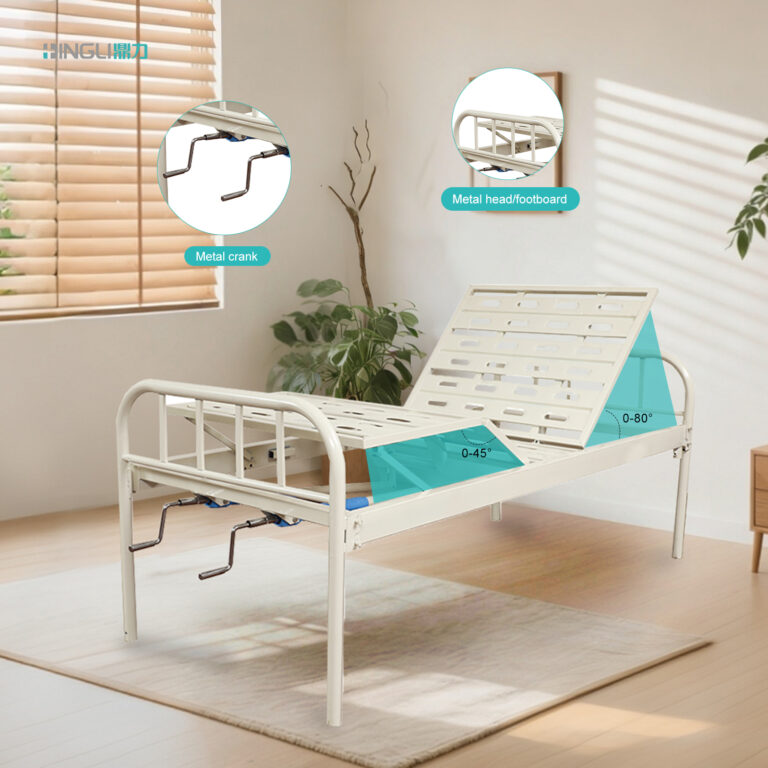
Manual Bed Crank Types and Configuration Options
The number of cranks on a manual bed isn’t just a feature; it directly maps to its capabilities, cost, and the clinical setting it’s built for.
Functional Breakdown by Crank Configuration
The functionality of a manual hospital bed scales directly with its crank count. The system is straightforward: each crank typically adds a specific, independent adjustment.
- One-Crank: Provides a single function, almost always adjusting the head and backrest section. This is the most basic configuration.
- Two-Crank: Adds a second function to adjust the knee and foot section. This creates a “knee break” that’s critical for preventing patients from sliding down when the head is elevated.
- Multi-Crank (Three or more): Includes the standard backrest and knee functions, but adds overall bed height adjustment. Advanced models use additional cranks for Trendelenburg and reverse Trendelenburg tilting.
Clinical Suitability and Ergonomic Impact
Matching the crank configuration to the care environment is essential for patient outcomes, staff safety, and operational efficiency. Understanding different types of hospital beds can also help buyers select a configuration that matches their clinical requirements.
- One-crank models are suitable for basic home care or low-acuity wards where only simple head elevation is necessary.
- Two-crank beds are the standard for most general wards and nursing homes. They offer a significant improvement in patient comfort and stable positioning over single-crank models.
- Three-crank and multi-crank beds are designed to solve practical problems. The height adjustment directly addresses caregiver ergonomics by reducing back strain, while tilting capabilities support complex clinical needs, making them suitable for facilities that require additional positioning functions without electrical adjustment systems.al alternative to electric beds.
Key Adjustment Functions and Positioning Options

Manual beds rely on mechanical cranks for patient positioning. Key adjustments include backrest, knee, and overall height, which are fundamental for both patient comfort and caregiver safety.
Core Articulation and Height Adjustments
Manual beds provide several key adjustments that are crucial for day-to-day patient care. These movements are controlled mechanically and address both clinical needs and practical ergonomics.
- Backrest elevation adjusts the head section from a flat position up to about 60–80 degrees. This is essential for respiratory support, feeding, and improving patient comfort and communication.
- Knee section elevation, or the “knee gatch,” flexes the patient’s knees up to around 30–45 degrees. This prevents them from sliding down the bed when the backrest is raised and helps relieve pressure on the lower back and heels.
- Overall bed height adjustment (hi-low) is a critical feature on some models. It allows caregivers to lower the bed for safe patient entry and exit, and then raise it to an ergonomic height to reduce back strain during care tasks.
- Some specialized hospital beds may include Trendelenburg or reverse Trendelenburg positioning, although these functions are more commonly associated with advanced electric hospital beds. These functions tilt the entire bed frame (head down or head up) for specific clinical procedures or to manage patient positioning.
Function Configurations and Operating Mechanisms
The functionality of a manual bed is defined by its mechanical setup. The number of adjustments directly corresponds to the bed’s clinical versatility and is driven by simple, robust hardware.
- Manual beds are typically categorized by the number of adjustments they offer: 1-function (backrest only), 2-function (backrest and knee), or 3-function (backrest, knee, and overall height).
- Adjustments are made using mechanical hand cranks, usually found at the foot of the bed. Turning these cranks drives a screw or gear system that moves the corresponding bed section.
- Manual beds are commonly selected for environments where reliable mechanical adjustment, lower maintenance requirements, and cost efficiency are important considerations.
- These mechanisms are built for durability and safety. Many cranks can be folded away to prevent tripping, and mechanical stops are built in to define the safe range of motion for each section.
Foldaway Crank Design and Safety Considerations
Foldaway cranks directly reduce physical hazards for staff. Protruding handles create constant impact, snag, and tripping risks that a simple folding mechanism eliminates.
Key Safety Risks in Manual Crank Operation
Operating a manual hospital bed isn’t without risk. The primary hazards come from the physical act of cranking and the presence of protruding hardware in a busy care environment. Staff are exposed to everything from acute injuries to long-term strain.
- Crush and Pinch Hazards: Hands, قدم, and tubing can easily get caught between the moving bed deck and the frame during height or section adjustments. Manufacturers consistently warn operators to keep limbs clear from the underside and mechanical gaps while the bed is in motion.
- Impact and Snag Injuries: A protruding crank handle may increase the risk of accidental contact during bedside movement and routine care activities. Staff frequently strike their knees and shins on protruding cranks while walking around the bed or performing transfers. These cranks can also snag on equipment or collide with walls during transport.
- Musculoskeletal Strain: The repetitive motion of turning a crank, especially under the load of a patient, puts significant strain on an operator’s wrists, elbows, and shoulders. Older designs with straight handles and high-torque gearing contribute directly to long-term repetitive strain injuries.
- Bed Instability: If an operator fails to lock the caster wheels before cranking, the force applied to the handle can cause the entire bed to move unexpectedly. This creates an unstable platform, risking patient and caregiver safety.
Design and Practices for Safe Operation
Mitigating these risks requires both intelligent equipment design and disciplined operator behavior. Foldaway cranks are a key design feature, but they are most effective when paired with strict operational protocols.
From a design perspective, foldaway or “tuck-away” cranks immediately solve the problem of protrusion. These designs typically feature:
- Pivoting Arms: The crank handle is built on a hinge, allowing it to fold inward against the bed frame when not in use.
- Secure Latches: A detent or latching mechanism holds the crank securely in both its operational and stowed positions, preventing it from drooping or unfolding unexpectedly.
- Low-Profile Geometry: When folded, the crank sits flush with the bed’s footprint, improving clearance in hallways and preventing snagging incidents.
Safe operational practices are just as critical. All staff must be trained to follow these rules without exception:
- Lock the Casters First: Before any adjustment, lock the bed’s wheels to ensure it remains stationary.
- Clear All Moving Zones: Check that patient limbs, IV lines, and caregiver hands are clear of the frame’s underside and all moving linkages before turning the crank.
- Stow the Crank Immediately: As soon as an adjustment is complete, fold the crank back into its stowed position. Leaving it out, even for a moment, reintroduces the impact and trip hazard.
- Turn Smoothly and Slowly: Avoid aggressive or rapid cranking. Smooth, controlled movements prevent jarring the patient and reduce stress on the bed’s mechanical components.
Choosing the Right Bed for Different Care Settings

Manual beds are workhorses for low-acuity environments where cost and power independence matter more than frequent, automated adjustments. They deliver reliability where simplicity is the primary need.
Ideal Scenarios and Settings
A manual bed isn’t a downgrade; it’s a specific tool for a specific job. It makes sense financially and operationally in environments where patient needs are predictable and staff can manage adjustments without disrupting care. Their simplicity is a major asset in certain contexts.
- Low-acuity wards with stable patients who only need occasional position changes.
- Short-stay observation, patient transport, or temporary overflow areas where reliability and ease of deployment are the main concerns.
- Aged care facilities where residents have limited mobility needs and staff assistance for manual adjustments is part of the standard workflow.
- As backup inventory for surge capacity, since they are fully functional without any electrical power.
Limitations and Unsuitable Environments
Putting a manual bed in the wrong environment creates problems for both patients and staff. The physical demands of manual cranking become a bottleneck in fast-paced or high-dependency units, increasing workload and compromising care efficiency.
- Caring for immobile or high-dependency patients who require frequent repositioning to prevent pressure injuries.
- Units where staff must change bed height often. Manual cranking increases physical strain and the risk of musculoskeletal injury.
- Settings where clinical workflows require rapid bed adjustments for procedures or urgent patient care.
- Use with bariatric patients, who need specialized beds with higher safe working loads and often powered assistance.
Manual Hospital Bed Sample Inspection Checklist for Buyers
Checking a manual bed sample isn’t a formality. It’s your chance to verify the mechanics, أمان, and build quality match your spec sheet before committing to a bulk order.
When that sample arrives, it’s your best opportunity to spot red flags that could become major headaches in a full production run. The following inspection points help buyers verify product quality before bulk purchasing.
Core Mechanical and Structural Checks
- Confirm the frame is straight, stable, and correctly assembled. Look for any cracks or loose parts.
- Inspect the welds for consistency and make sure every fastener is secure.
- Operate each crank through its full range. Movement should be smooth, with no grinding, and it must hold its position without slipping.
- Test adjustable sections like the backrest and knee-rest. Verify they achieve their full range of motion and remain stable.
- Engage the caster brakes to confirm the bed stays put. Then release them and check for smooth rolling.
- Apply force to the frame from different angles to test for instability, tipping risk, or excessive flex.
- Verify that the bed meets its stated Safe Working Load (SWL) without frame deformation or loss of function. Buyers should also confirm whether the SWL includes the mattress and additional accessories.
Verifying Finish, Safety, and Specifications
- Check that the surface coating is smooth and completely covers the frame, with no signs of rust, peeling, or sharp edges.
- Test the side rails. They must lock securely in place and should not create obvious entrapment risks.
- Confirm the headboard and footboard are firmly attached and don’t wobble under pressure.
- Inspect all areas a user might touch, along with moving joints, for any potential pinch points or injury hazards.
- Ensure the sample matches your approved specifications—dimensions, materials, and color must be correct.
- Check that all required accessories, like IV pole sockets, are included and that they fit correctly.
- Verify that all required labels for identification, warnings, and load capacity are present and legible.
- Review the packaging. It must be robust enough to protect the product during shipment to your warehouse or customers.
Hospital Bed Sample Inspection Checklist for Buyers
A detailed spec checklist is non-negotiable for sourcing manual beds. It verifies everything from load capacity and mechanical function to regulatory compliance, preventing costly procurement mistakes.
When you’re drafting a tender or evaluating a supplier for manual hospital beds, a generic feature list won’t cut it. Choosing a reliable hospital bed manufacturer is equally important to ensure consistent quality and supply stability. You need a detailed technical checklist to compare apples to apples and ensure you’re getting a product that’s safe, دائم, and fit for purpose. A weak specification opens the door to inconsistent quality and hidden risks. Use this as your baseline for any procurement conversation.
| Specification Category | Key Parameters to Define |
|---|---|
| 1. Basic Identification |
|
| 2. أبعاد |
|
| 3. Functional Adjustments |
|
| 4. Structural and Load Capacity |
|
| 5. Materials and Construction |
|
| 6. Mobility and Braking System |
|
| 7. Patient Safety Features |
|
| 8. Ergonomics |
|
| 9. Accessories and Integration |
|
| 10. Regulatory and Standards |
|
| 11. Cleaning and Maintenance |
|
Why Choose Dingli Medical as Your Hospital Bed Manufacturer?
When sourcing manual hospital beds for hospitals, distributors, or healthcare projects, working with a direct manufacturer helps ensure consistent quality, stable supply, and better customization support. Dingli Medical specializes in hospital beds and rehabilitation equipment, providing manual hospital beds, electric beds, nursing beds, wheelchairs, and related accessories for global markets.
With a 15,000㎡ manufacturing base and multiple production workshops, Dingli integrates metal processing, welding, painting, assembly, and quality inspection within its own production system. The company supports OEM/ODM cooperation and can customize product structures, including bed boards, side rails, and other components according to customer requirements. Certified with ISO9001, ISO13485, م, and FDA quality systems, Dingli Medical helps international buyers source reliable hospital beds with flexible MOQ and long-term supply support.
الأسئلة المتداولة
What is a manual hospital bed?
A manual hospital bed is a patient bed adjusted using hand-operated cranks or levers instead of electric motors. It provides an adjustable surface for patient comfort and care, and it operates without needing electricity. Common adjustments include raising the head, elevating the legs, and on some models, changing the overall bed height.
How does a manual hospital bed work?
A caregiver turns one of the cranks, usually found at the foot of the bed. This action rotates a mechanical screw and gear system that lifts or lowers a specific section of the bed frame, such as the backrest or leg section. For safety, the bed’s wheels have brakes that should be locked before making any adjustments or transferring a patient.
What is the difference between a two-crank and a three-crank bed?
A two-crank bed typically adjusts the backrest and the knee/leg section, but the bed’s overall height is fixed. A three-crank bed provides the same back and leg adjustments, but adds a third crank to raise or lower the entire bed frame. This height adjustment helps caregivers work at an ergonomic height and makes it safer for patients to get in and out of bed.
Can a manual hospital bed adjust in height?
Yes, but only specific models can. A manual bed with height adjustment is called a ‘three-crank’ or ‘hi-low’ bed. It includes a dedicated crank to raise and lower the entire bed. Basic models, such as one-crank or two-crank beds, have a fixed height and cannot be adjusted.
What are the main things to inspect on a manual hospital bed?
When inspecting a manual bed, check the frame for any cracks or rust. Test each crank to ensure it moves smoothly and adjusts the bed sections without excessive force. Make sure the side rails lock securely in the up position and that the wheel brakes hold the bed firmly in place. Also, check that the mattress fits properly without creating unsafe gaps.
الأفكار النهائية
Choosing a manual bed on price alone introduces risks to both staff and patients. A poorly specified crank leads to operator injury and workflow disruption, while a weak frame directly compromises safety and increases your liability. The detailed specifications outlined here are your primary defense against equipment failure and long-term operational costs.
Don’t leave quality to chance—verify it. Use our checklist to request a sample and test the crank mechanics, frame integrity, and safety features firsthand. Contact Dingli Medical to discuss manual hospital bed specifications, OEM solutions, and long-term supply cooperation for your market.