Las dimensiones incorrectas de una cama de hospital provocan dos fallos críticos: Atrapamiento de pacientes debido a colchones que no coinciden y diseños de habitaciones que no cumplen con las normas y que violan los códigos de seguridad.. Ambos son pasivos importantes que pueden provocar lesiones al paciente o forzar costosos rediseños de las instalaciones..
Este análisis proporciona las especificaciones exactas de seguridad y cumplimiento.. Evaluamos estándar, bariátrico, y marcos de longitud extendida que cumplen con los mandatos de autorización de ADA y FGI para garantizar que cada selección cumpla con los requisitos clínicos y arquitectónicos..
Comprensión de las dimensiones estándar de las camas de hospital

Su característica definitoria es la altura ajustable., fundamental tanto para la seguridad del paciente como para la ergonomía del cuidador.
Ancho de cama de hospital estándar
El estándar institucional para una cama de hospital para adultos es 36 pulgadas (90 centímetro) ancho. Este ancho específico equilibra la comodidad del paciente con la necesidad de que los cuidadores accedan al paciente desde ambos lados sin estirarse demasiado.. Es un poco más estrecho que el típico colchón twin o twin XL de 38 pulgadas de ancho que encontrarás en casa.. Mientras 36 pulgadas es el valor predeterminado, Existen otros anchos para situaciones específicas..
- Camas estrechas: Utilizado en espacios reducidos o para pacientes más pequeños..
- Camas estándar más anchas: Ofrezca más espacio para pacientes más grandes que no requieren un marco bariátrico completo.
- Camas bariátricas: Diseñado con una superficie significativamente más amplia para acomodar de forma segura a pacientes bariátricos..
Longitud estándar de la cama de hospital
Mayoría camas de hospital para adultos tener una longitud estándar de 80 pulgadas, que es lo mismo que un colchón twin XL. Para personas más altas, camas de longitud extendida están disponibles, normalmente midiendo 84 a 88 pulgadas de largo. Esta longitud adicional evita que los pies del paciente cuelguen del borde y garantiza un soporte completo para el cuerpo.. Al planificar el diseño de una habitación, debe tener en cuenta la longitud total de la cama más el espacio adicional para las barandillas laterales desplegadas, movimiento de personal, y cualquier equipo médico circundante.
Altura y ajustabilidad
La característica más importante de una cama de hospital es su altura ajustable.. Todo el marco se mueve verticalmente., con un rango típico de 16 a 30 pulgadas desde el piso hasta la parte superior del colchón. Esto permite que la cama cumpla distintas funciones según su posición..
- Posiciones bajas: Algunas camas pueden bajar a solo 8-10 pulgadas desde el piso hasta la plataforma de la cama. Esto reduce significativamente el riesgo de lesiones en pacientes propensos a caerse de la cama..
- Posiciones altas: La cama se puede elevar hasta 32 pulgadas o más. Esto crea una cómoda, altura de trabajo ergonómica para cuidadores, Reducir la tensión de la espalda durante el manejo del paciente y los procedimientos médicos..
Más allá de la elevación vertical de todo el marco., las secciones de cabeza y pies también se articulan de forma independiente. Esto permite lograr posiciones clínicas específicas mientras la altura total de la cama se establece para seguridad o acceso del cuidador..
Tipos de camas de hospital y sus tamaños específicos
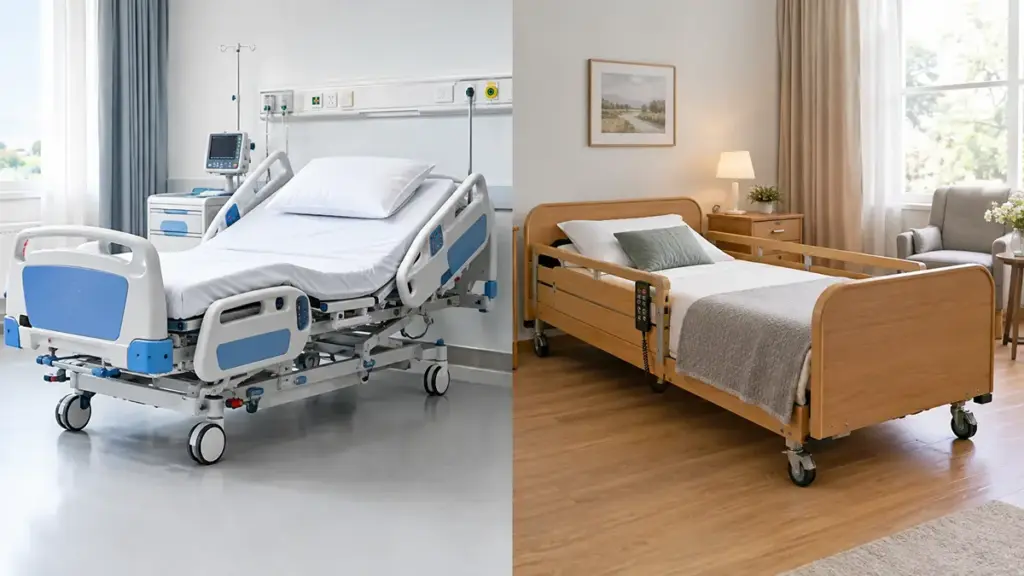
Las dimensiones de las camas de hospital no son iguales para todos. Ancho, longitud, y cambio de rango de altura según la función principal de la cama, desde operación manual hasta soporte bariátrico y prevención de caídas..
Camas de hospital manuales
Estos son los modelos más básicos, confiar enteramente en el esfuerzo físico.
- Ajustes de altura, cabeza, y las secciones de rodillas se accionan mediante manivelas, Requerir el esfuerzo físico de un cuidador..
- Las dimensiones suelen ser estándar, con un ancho de 36 pulgadas y una longitud de 80 pulgadas, que puede extenderse a 84-88 pulgadas.
- El rango de altura suele ser limitado. Los modelos de altura fija suelen tener una plataforma alrededor 20 centímetros del suelo.
Camas de hospital semieléctricas
Una opción híbrida que reduce parte del trabajo manual involucrado en el reposicionamiento del paciente..
- Estas camas ofrecen una combinación de controles.. Los ajustes de cabeza y pies suelen ser eléctricos., pero el ajuste de altura sigue siendo manual mediante una manivela.
- La huella es generalmente el estándar. 36 pulgadas de ancho por 80 pulgadas de largo.
- Proporcionan un rango de altura moderado., a menudo desde aproximadamente 15 pulgadas en la parte más baja a 32 pulgadas en la parte más alta, ofreciendo una mejor capacidad de ajuste que las camas manuales.
Camas de hospital totalmente eléctricas
El estándar en la mayoría de instalaciones modernas., Estas camas priorizan la comodidad tanto del paciente como del cuidador..
- Todos los ajustes, incluyendo altura, cabeza, y secciones de pies, se controlan electrónicamente con un colgante manual, lo que reduce la tensión del cuidador.
- Mientras que el tamaño base es el estándar 36 incógnita 80 pulgadas, Estas camas suelen contar con el rango de ajuste de altura más amplio., desde tan bajo como 14 pulgadas en más 30 pulgadas.
- Muchos modelos incluyen extensión de longitud integrada y funciones de posicionamiento avanzadas como Trendelenburg.
bariátrico (Servicio pesado) Camas de hospital
Diseñado específicamente para la seguridad del paciente y soporte en capacidades de peso más altas..
- Construido con marcos reforzados para soportar mayores capacidades de peso., típicamente de 500 a más 1,000 libras.
- La principal diferencia dimensional es el ancho.. Los tamaños comunes incluyen 39, 42, 48, y hasta 60 pulgadas para acomodar a pacientes más grandes.
- La longitud es a menudo 80 a 84 pulgadas, con extensiones disponibles, y los ajustes de altura son totalmente eléctricos para mayor seguridad..
Camas de hospital bajas para la prevención de caídas
Este diseño se centra en un objetivo principal.: reducir el riesgo y la gravedad de las lesiones por caídas.
- Diseñado específicamente para reducir las lesiones relacionadas con caídas al permitir que la plataforma de la cama se coloque muy cerca del piso..
- La característica clave es una altura mínima ultrabaja, a menudo cayendo entre 8 y 10 centímetros del suelo.
- Las dimensiones de la huella generalmente siguen siendo estándar en 36 pulgadas de ancho y 80 pulgadas de largo para caber en habitaciones típicas, aunque la cama aún se puede elevar a una altura de trabajo cómoda para los cuidadores.
Obtenga equipo médico certificado, Directo de fábrica.
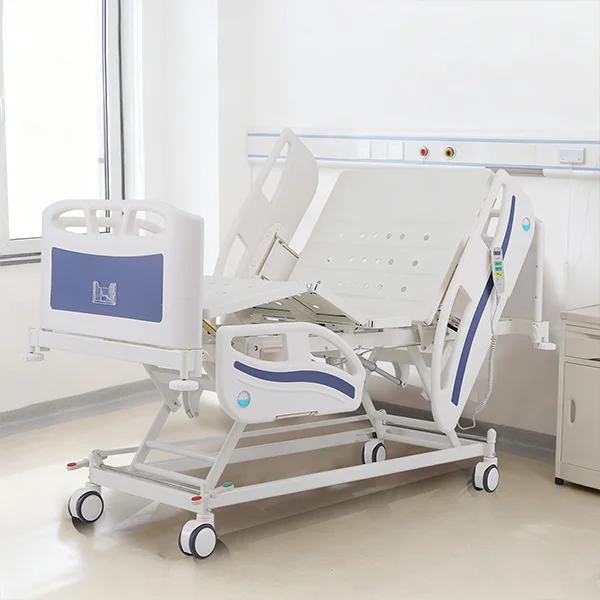
Tamaños de colchones de camas de hospital vs.. Tamaños de marco
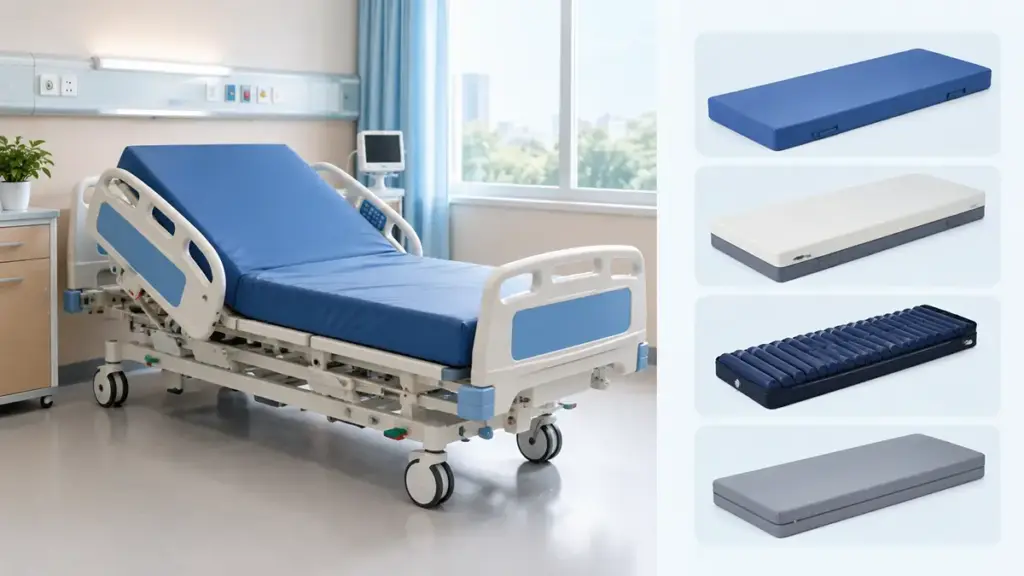
No coincide un colchón de cama de hospital y el marco no es un problema de comodidad: es una falla de seguridad crítica que crea espacios peligrosos para atrapar a la cama y anula las funciones clínicas de la cama..
La importancia de un ajuste perfecto
Una cama y un colchón de hospital están diseñados para funcionar como un solo sistema. Una combinación perfecta minimiza o elimina espacios peligrosos, conocidos como zonas de atrapamiento, entre el borde del colchón y las barandillas laterales., cabecera, o estribo. Este no es un detalle menor; es un requisito de seguridad fundamental.
El ajuste correcto también garantiza que las secciones articuladas de la cama para ajustar la cabeza y las piernas funcionen según lo previsto., evitar que el colchón se doble o se salga de su posición. Esto permite una redistribución eficaz de la presión para prevenir llagas y favorece el reposicionamiento seguro del paciente., torneado, y transferencias.
Prevención de brechas y zonas de atrapamiento
La regla no es negociable.: El ancho y el largo del colchón deben coincidir exactamente con la superficie para dormir especificada en el armazón.. Un marco de 36” x 80” requiere un colchón de 36” x 80”. El uso de un colchón estándar sobre un armazón bariátrico o de longitud extendida crea grandes, espacios peligrosos en los extremos o lados.
El grosor del colchón es igualmente crítico. Un colchón demasiado grueso, normalmente más 6-7 pulgadas, puede reducir significativamente la altura de protección efectiva de las barandillas laterales. Esto convierte una característica de seguridad en un riesgo potencial de caída..
Tabla de tamaños de camas de hospital comunes (Ancho x Largo)
El estándar de la industria es 36″ x80″, pero bariátrico, pediátrico, y existen tamaños extendidos para necesidades específicas. Hacer coincidir el colchón con la estructura es un requisito de seguridad fundamental.
Dimensiones por tipo de cama
| Categoría de cama | Ancho común | Longitud común |
|---|---|---|
| Adulto estándar | 36″ | 80″ |
| Longitud extendida | 36″ | 84″ – 88″ |
| bariátrico | 42″, 48″, 54″ (algunos hasta 60″) | 80″ – 88″ |
| Angosto | 30″ | 80″ |
| Pediátrico | 30″ – 33″ | 62″ – 72″ |
Categorías de tamaño y aplicaciones típicas
Las dimensiones de las camas de hospital no son arbitrarias. Están estandarizados para equilibrar la seguridad del paciente., acceso del cuidador, y logística de habitaciones. El 36″ x80″ El tamaño se convirtió en el predeterminado porque funciona para la mayoría de los adultos y al mismo tiempo permite que el personal llegue al paciente desde ambos lados sin esforzarse..
Esta huella estándar es similar en longitud a un colchón Twin XL pero es dos pulgadas más estrecha.. Esta diferencia es fundamental: no se puede utilizar un colchón de consumo en un marco clínico sin crear espacios de seguridad en las barandillas laterales..
Aquí hay un desglose de cuándo usar qué tamaño.
- Adulto estándar: Este es el caballo de batalla para las salas generales., instalaciones de enfermería, y cuidados en el hogar. Es apropiado para la mayoría de los adultos con un IMC de hasta aproximadamente 45 ¿Quién puede reposicionarse de forma segura?.
- Longitud extendida: Esto es para pacientes más altos., normalmente cualquier persona mayor de 6'2″. La longitud adicional evita que sus pies presionen o cuelguen del estribo., que puede causar lesiones por presión. La mayoría de los marcos estándar se adaptan a estas extensiones..
- bariátrico: Estas camas son para pacientes con un IMC superior 45 o un peso corporal que excede el límite de una cama estándar. El ancho extra es esencial para girar con seguridad, reposicionamiento, y distribución de presión. Usar una cama estándar para un paciente bariátrico no es seguro y clínicamente inapropiado.
- Pediátrico: Estos simplemente están reducidos para adaptarse a niños y adolescentes.. Las dimensiones se combinan con rieles de seguridad especializados y gabinetes diseñados para cuerpos más pequeños..
- Angosto (30″ Ancho): Los ves con menos frecuencia, pero resuelven problemas en espacios reducidos como dormitorios pequeños.. Sólo son adecuados para adultos más pequeños o delgados donde un estándar 36″ el ancho no es necesario.
Normas clave sobre espacio y autorización para salas de hospital
ADA establece el piso legal para el acceso de sillas de ruedas. Las directrices de la FGI proporcionan las autorizaciones realistas necesarias para el flujo de trabajo clínico real, que casi siempre superan los mínimos de la ADA.
ADA (Ley de Estadounidenses con Discapacidades) Pautas
La ADA no dicta directamente el diseño de las habitaciones del hospital, pero establece mínimos innegociables de accesibilidad. Estas reglas rigen el diseño básico de cualquier sala al definir el espacio más pequeño requerido para que una persona en silla de ruedas se mueva y transfiera de manera segura..
- Un espacio libre de 30 incógnita 48 Se deben proporcionar pulgadas al lado de la cama.. Esta es la base para que un usuario de silla de ruedas realice una transferencia o para que el personal coloque un elevador de pacientes..
- Las puertas requieren un ancho libre mínimo de 32 pulgadas cuando la puerta está abierta. Cualquier vía de circulación o pasillo de más de 24 pulgadas deben ser al menos 36 pulgadas de ancho.
- Un círculo de 60 pulgadas de diámetro es el estándar para que una silla de ruedas complete un giro de 180 grados.. Este espacio de giro puede superponerse a otros espacios libres requeridos., como el 30×48 pulgadas de espacio al lado de la cama, mientras siga funcionando.
FGI (Instituto de directrices de instalación) Recomendaciones
La FGI proporciona orientación específica para la atención sanitaria que aborda la realidad del trabajo clínico.. Mientras ADA impide bloquear el acceso, Los estándares del FGI garantizan que haya suficiente espacio para que los cuidadores y el equipo funcionen de manera eficiente. La mayoría de los diseños de hospitales modernos siguen las recomendaciones del FGI., que son más generosos que los mínimos de la ADA.
- Un mínimo de 5 pies (60 pulgadas) Se recomienda dejar espacio libre en el lado de transferencia principal de la cama.. Este espacio es lo suficientemente amplio como para contener todo el círculo de giro de la ADA y aún dejar espacio para el personal..
- la secundaria, o no transferencia, El lado de la cama debe tener 3 a 4 pies de espacio libre para el acceso del personal.
- Al pie de la cama, al menos 4 Se necesitan pies de espacio libre para mover las camas., camillas, y otros equipos grandes dentro y fuera de la habitación.
- Para salas de varias camas, una distancia de 8 a 10 Los pies entre las líneas centrales de la cama brindan a cada paciente su propio espacio adecuado para trabajar y maniobrar..
Calcular el radio de giro y el espacio de maniobrabilidad
El círculo de giro de 60 pulgadas de diámetro es la unidad central para calcular la maniobrabilidad.. Al diseñar una habitación, Combina este requisito con la huella de la cama y otros espacios libres para determinar el ancho necesario.. Las matemáticas son sencillas.
Para una habitación accesible típica, podrías calcular el ancho como: 60 pulgadas (espacio libre del lado primario) + 42 pulgadas (una cama estándar con rieles) + 36 pulgadas (espacio libre del lado secundario). Esto le da un ancho total requerido de 138 pulgadas, o 11.5 pies. Este cálculo garantiza un radio de giro completo por un lado y un camino de acceso funcional por el otro..
Los diseñadores pueden recuperar algo de espacio mediante el uso de superposiciones. El espacio libre requerido para un fregadero o gabinete puede compartir el área del piso con el círculo de giro principal., especialmente si el dispositivo proporciona espacio para las rodillas y los dedos de los pies debajo para que un usuario de silla de ruedas se acerque.
Cómo elegir el tamaño adecuado de cama de hospital
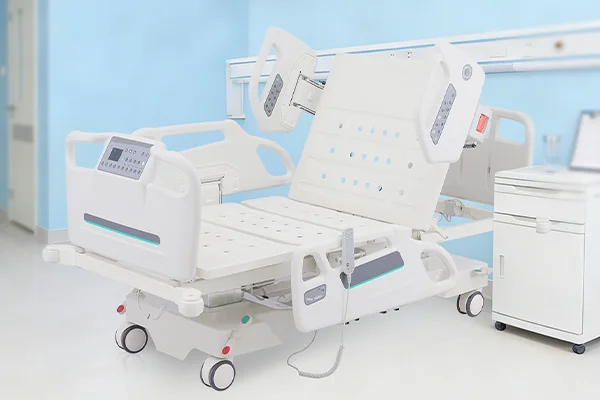
Elegir el tamaño de cama adecuado equilibra las necesidades del paciente con el acceso del cuidador y las limitaciones de la habitación. Es una decisión crítica para la seguridad y el funcionamiento., no solo comodidad.
Evaluación para pacientes de atención domiciliaria
Utilice el peso y el IMC del paciente para decidir entre una cama estándar de 36 pulgadas o un modelo bariátrico más ancho. (42–54 pulgadas). Una cama demasiado estrecha restringe el movimiento y aumenta el riesgo de caídas. Pero uno que es demasiado ancho puede dificultar que el paciente salga de la cama y que los cuidadores lo alcancen..
Las camas estándar de 80 pulgadas funcionan para la mayoría de los adultos. Si un paciente es más alto que 6 pie 2 en, necesitas un marco extendido (84–88 pulgadas) para darles el espacio adecuado para la cabeza y los talones. sin eso, corre el riesgo de sufrir lesiones por presión en los pies.
Para pacientes con alto riesgo de caídas., agitación, o aquellos que necesitan reposicionamiento frecuente, una cama un poco más ancha (39–42 pulgadas) puede ser un movimiento inteligente. Proporciona más espacio y reduce la posibilidad de que los brazos o las piernas queden atrapados en las barandillas laterales..
Cumplimiento para arquitectos y planificadores de instalaciones
Al diseñar habitaciones para pacientes, plan para la cama más grande posible, no solo el ancho estándar de 36 pulgadas. Esto significa que los pasillos y las puertas deben acomodar un modelo bariátrico.. También es necesario tener en cuenta la huella operativa completa., incluyendo rieles desplegados y accesorios.
Sus diseños deben cumplir con códigos de seguridad que minimicen el atrapamiento del paciente.. Esto significa especificar colchones que se ajusten con precisión a la plataforma de la cama.. También requiere seleccionar marcos con una carga de trabajo segura que sea apropiada para la población de pacientes esperada del centro..
Prepare la distribución de sus habitaciones para el futuro para que puedan acomodar camas más anchas (como modelos de 42 a 48 pulgadas) por la línea. Este simple paso prepara las instalaciones para los cambios demográficos de los pacientes y los nuevos estándares de atención sin forzar renovaciones importantes más adelante..
Preguntas frecuentes
¿Cuál es el tamaño estándar de una cama de hospital??
el sueño superficie de una cama de hospital estándar es típicamente 36 pulgadas de ancho y 80 pulgadas de largo. El marco general, incluyendo la cabecera y el pie de cama, a menudo se extiende hasta 84 a 88 pulgadas de largo. La altura de la cama es ajustable para ayudar con los traslados de pacientes y el acceso de los cuidadores..
¿Es una cama de hospital del mismo tamaño que un colchón Twin XL??
No, aunque tienen una longitud muy parecida. Un colchón de cama de hospital estándar es 36 pulgadas de ancho por 80 pulgadas de largo. Un colchón Twin XL tiene la misma longitud de 80 pulgadas pero es un poco más ancho en 38 pulgadas. Esta diferencia de dos pulgadas significa que la ropa de cama y los colchones Twin XL no se ajustan exactamente a los marcos de camas de hospital estándar..
¿Cuánto espacio se necesita alrededor de una cama de hospital para lograr accesibilidad??
Para una correcta accesibilidad, necesita un espacio libre de al menos 30 pulgadas por 48 pulgadas a lo largo de un lado largo de la cama. Esto deja espacio para una silla de ruedas o un elevador de pacientes.. La sala también debe tener un área de giro despejada con un diámetro de 60 pulgadas para maniobrar..
¿Cuáles son las dimensiones de una cama de hospital bariátrica??
Las camas de los hospitales bariátricos se construyen más anchas y resistentes para acomodar con seguridad a pacientes más grandes. Su ancho suele oscilar entre 42 a 54 pulgadas, y su longitud es aproximadamente 80 a 84 pulgadas, a menudo con la opción de extenderse a 88 pulgadas. Estas camas tienen marcos reforzados para soportar capacidades de peso desde 750 arriba a 1,000 libras.
Pensamientos finales
Elegir el equipo según el precio ignora los costos no negociables de quedar atrapado por el paciente y el incumplimiento de las instalaciones. Las dimensiones de esta guía son el modelo para la seguridad operativa., protegiendo tanto a sus pacientes como a su reputación.
No adivine el cumplimiento: verifique las especificaciones de su proyecto. Póngase en contacto con nuestro equipo para obtener un catálogo completo o para analizar el diseño de sus instalaciones y los requisitos OEM.