The semi electric vs full electric hospital bed decision isn’t a feature comparison—it’s a direct lever on caregiver back injury claims and long-term care liability. A single misjudgment in motor configuration can lock a facility into years of repetitive manual cranking, multiplying the risk of staff injuries and patient falls.
This analysis breaks down motor functions, height adjustability, and total cost of ownership across an 8-to-12-year lifecycle. We map price tiers from $800 को $3,500 against Medicare coverage rules and caregiver workload data, giving you a scalable framework to match equipment to clinical reality—not just the purchase order.
What Is a Semi Electric Hospital Bed?
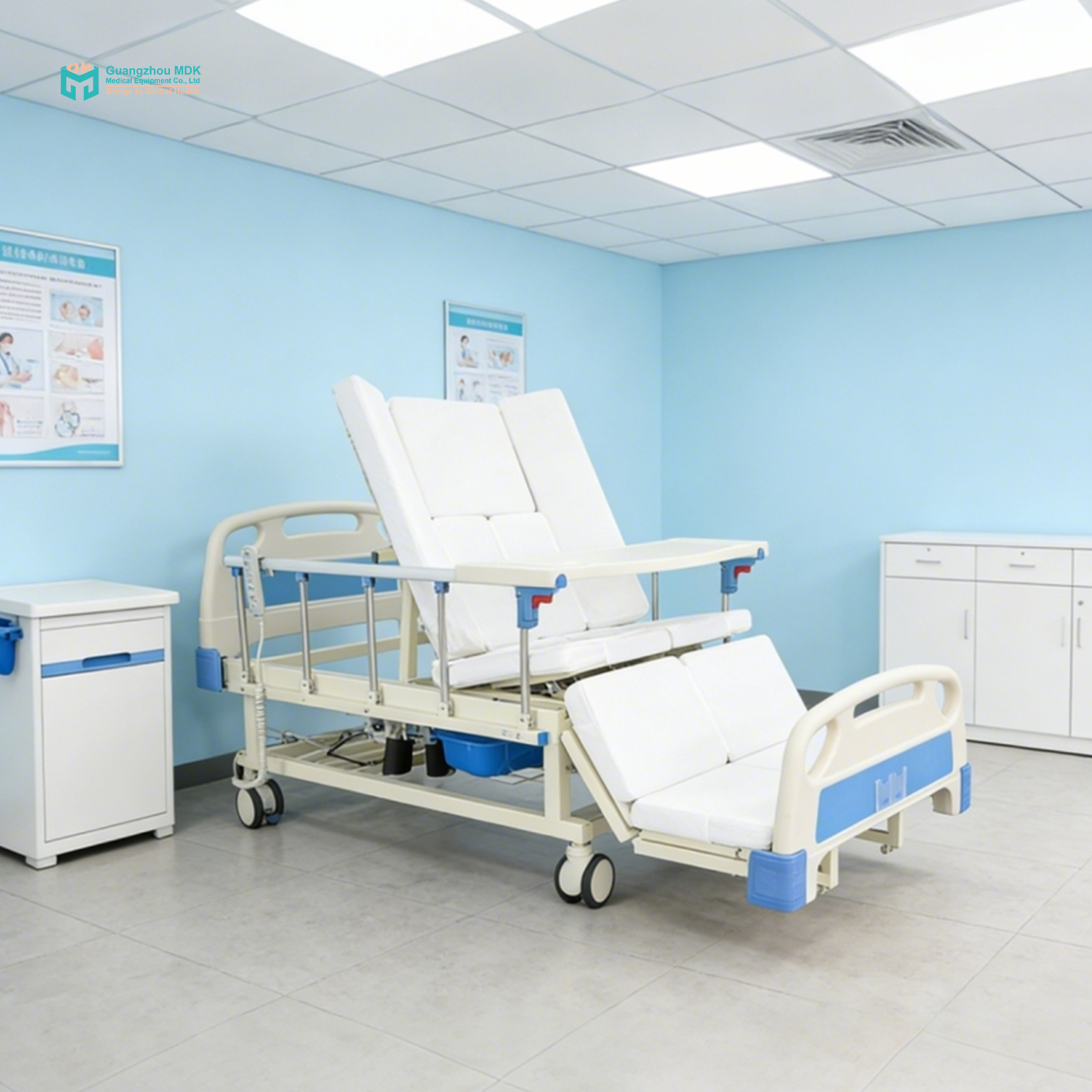
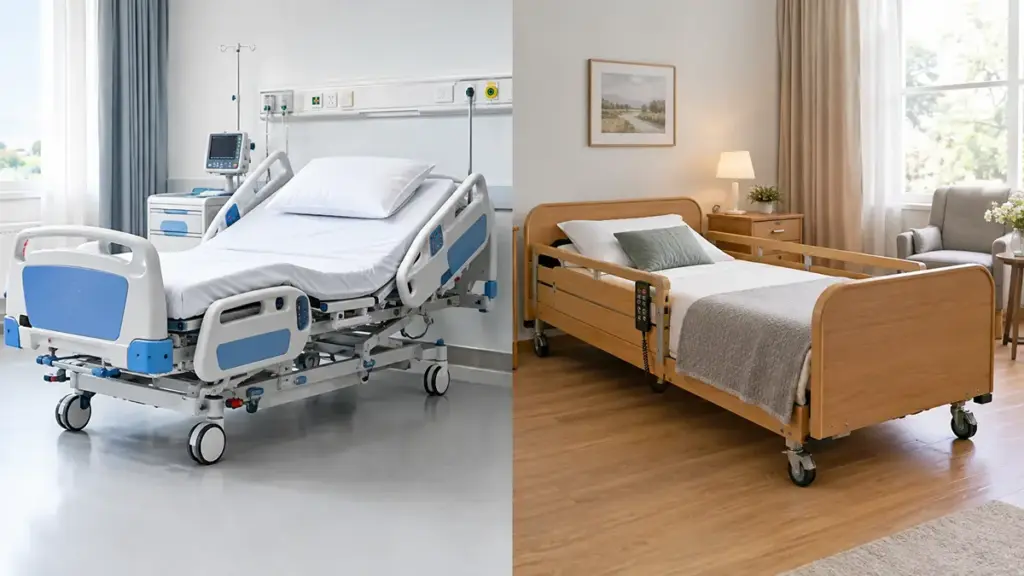
A semi electric bed powers head and foot sections by motor while leaving height to a manual crank—the middle ground between a full manual and full electric bed.
Core Motor Functions
- Electric motors raise and lower the head and foot sections through a handheld pendant or remote.
- Common therapeutic and comfort positions—sitting up, reclining, leg elevation—happen without manual effort.
- The bed height is not motorized; that’s the functional line between semi and full electric models.
Manual Adjustments That Stay Manual
Head and foot sections are electric, not manual. The only manual function on a semi electric bed is the overall height, which changes via a hand crank at the foot of the bed.
- Head and foot sections: Powered by pendant—no cranking needed.
- Height adjustment: Manual crank; raise or lower by turning the crank clockwise or counterclockwise.
What Is a Full Electric Hospital Bed?
A full electric hospital bed motorizes all three primary functions—backrest, knee section, and bed height—eliminating manual cranks entirely.
Complete Motorized Control
A full electric hospital bed runs every adjustment through electric actuators. Three independent motors handle the backrest, the knee section, and the overall bed height. Nothing relies on a hand crank. You control everything through a handheld pendant with clearly labeled buttons. Press a button, the bed moves. Release it, it stops.
The contrast with a semi electric bed is straightforward. A semi electric model gives you powered head and foot movement but leaves the height function manual. That means every transfer, every wound care session, every linen change that needs the bed raised or lowered forces someone to bend down and crank. A full electric bed removes that bottleneck.
Independent Adjustment Zones
The frame of a full electric bed is built around separate motorized zones. Each zone operates on its own actuator, so you can adjust one section without disturbing another—or combine movements for clinical positioning like the Fowler position or cardiac chair setup.
Backrest — The head section motor lifts the upper body from flat to near-sitting. Clinicians use this for respiratory support, reducing aspiration risk during feeding, and basic comfort during reading or watching TV. The adjustment is continuously variable, not locked into preset notches. That means you can dial in the exact angle the patient tolerates best.
Knee Break — The knee section flexes at the leg area to create a bend. This is not just about comfort. When you raise the backrest, the knee break stops the patient from sliding down toward the foot of the bed, which reduces shear forces on the skin. For patients with lower-back pain or circulation issues, a slight knee bend relieves pressure. Combined with the backrest, it creates a stable seated posture.
Hi-Lo Height — The entire sleep surface raises and lowers on electric power. Lower the bed close to the floor at night to reduce injury severity if a confused patient exits unassisted. Raise it to waist height during the day so caregivers can do wound care, catheter maintenance, or repositioning without bending. For transfers to a wheelchair, you can match the bed height to the chair seat precisely, which makes lateral transfers safer and less physically demanding.
Integrated Control Panels and Nurse Call
Full electric beds in acute and long-term care environments come with more than a basic pendant. Higher-end models include control interfaces built into the side rails and footboard. The patient pendant handles day-to-day adjustments. The side-rail controls offer backup access when the pendant slips out of reach. A central nurse panel at the footboard gives staff master control over all zones, including the ability to lock out patient adjustments when necessary.
Nurse call integration is the other piece. A call button on the pendant or side rail ties directly into the facility’s nurse call system. When a patient presses it, the signal registers at the nurse station with the room location. No separate call bell dangling from the bed rail. No patient reaching for a device they cannot find. This consolidation reduces clutter, simplifies training, and cuts down on the kind of falls that happen when a patient tries to get up alone instead of waiting for help.
For a facility buyer or a distributor specifying beds for a skilled nursing unit, these features are not add-ons. They determine whether staff can work efficiently across multiple patients and whether safety protocols actually get followed during a busy shift.
Factory-Direct Medical Equipment, Global Compliance
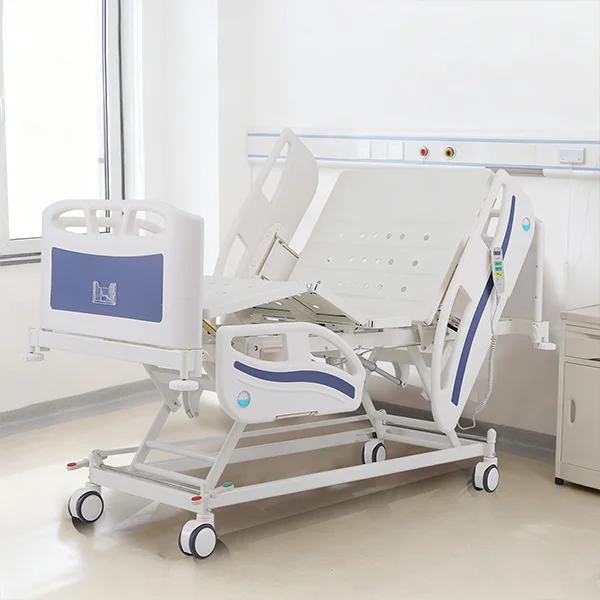
Semi Electric vs Full Electric: Key Differences Every Caregiver Must Know
The single biggest difference? Full electric beds motorize height; semi electric don’t. That one feature impacts transfers, caregiver strain, and patient independence.
| Feature | Semi Electric | Full Electric |
|---|---|---|
| Motorized Functions | Head & foot sections only | Head, foot, and overall bed height |
| Height Adjustment | Manual hand crank (caregiver required) | Push-button electric pendant |
| Caregiver Physical Strain | Higher—repetitive cranking for every height change | Lower—no cranking; all adjustments powered |
| Patient Independence | Partial—can’t change height alone | High—full control via pendant (if physically able) |
| Long-Term Maintenance | Fewer electrical components; manual crank may wear | More actuators; slightly higher service potential |
| Typical Price (New) | $800–$1,500 | $1,200–$3,500 |
Motor Configuration and Dependency
Full electric beds run on three electric actuators: head section, foot section, and overall bed height. A handheld pendant controls all three. That means no manual labor for any primary adjustment.
Semi electric beds still use electric motors for the head and foot sections, but they rely on a manual hand crank for height. The caregiver has to physically turn that crank every single time the bed needs to go up or down.
The consequence is straightforward. A full electric bed takes the physical effort off the caregiver’s shoulders completely. A semi electric bed forces the caregiver into a recurring, strenuous motion for height changes, which adds up fast if you’re adjusting the bed multiple times a day.
Height Adjustability and Transfer Safety
Full electric beds let you tap a button and instantly raise or lower the bed. For transfers into a wheelchair or commode, you can match the bed height to the other surface exactly, which reduces shear forces and fall risk. You can also drop the bed low at night to cut injury severity if a confused patient tries to get out.
Semi electric beds technically have the same height range, but in practice the crank effort often means height changes get skipped. Many caregivers leave the bed at one fixed height, even if that height is not ideal for the next transfer. That “good enough” compromise introduces a real safety gap.
Patient Independence and Ease of Use
Full electric beds hand the user complete control over head, foot, and height from a single pendant. That means a patient who can operate buttons doesn’t have to call for help just to adjust the bed for comfort or to prep for a transfer. It’s a major independence boost.
Semi electric beds limit the patient to head and foot adjustments only. For any height change, they must rely on a caregiver. For someone already struggling with loss of autonomy, that can be a daily frustration.
Also, full electric beds cut down on call bell frequency. When a person can self-position for breathing relief, pressure redistribution, or just to watch TV, they bother staff less. That’s a significant workflow improvement in facilities where every minute counts.
Long-Term Durability and Maintenance
Full electric beds add a third actuator and extra wiring, so there’s a little more that can fail electrically down the road. Maintenance costs tend to be slightly higher over a 8–12 year lifespan. But the flip side is that automating height eliminates the repetitive strain that leads to caregiver injuries, which often have bigger hidden costs.
Semi electric beds have fewer electronic failure points: only two motors plus the mechanical crank. The crank is simple and can be serviced without special tools, but it’s still a wear point. More importantly, if you’re cranking height multiple times a day, the ergonomic risk to the caregiver’s back and shoulders is very real.
Advantages of Semi Electric Beds in a Long-Term Care Setting
Semi electric beds cut capital costs by $200–$800 per unit compared to full electric, while reducing electronic failure points and training time for long-term care staff.
Lower Acquisition Cost
- Semi electric beds cost $800–$1,500 per unit. Full electric equivalents run $1,200–$3,500, creating a $200–$800 saving per bed.
- For residents who don’t need frequent height changes, you get the same electric head and foot adjustability at a lower price.
- Lower base cost reduces coinsurance obligations under Medicare Part B, easing financial burden on patients and facilities.
- Capital freed can shift to pressure-redistributing mattresses, lift systems, or staffing.
Fewer Electronic Components to Fail
- Electric motors are limited to head and foot sections; height uses a manual crank, so total active components drop.
- Fewer motors and control boards lead to slightly lower maintenance costs and simpler troubleshooting.
- Reduced electronic complexity means less downtime risk in high-utilization long-term care environments.
- The manual crank provides a reliable mechanical fallback for height adjustment if electronics fail.
Advantages of Full Electric Beds for Long-Term Care
Motorizing the height function eliminates the physical toll of manual cranking, directly preserving caregiver health and giving patients control over their own environment.
Effortless Height Adjustments for Caregivers
The defining advantage here is the motorized height control. Semi-electric beds force you to squat down, find a crank, and manually raise or lower the frame every single time. In a long-term care setting—where you might transfer a patient four, six, eight times a day—that repetition destroys backs and shoulders over weeks and months.
A full electric bed gets rid of that bottleneck. You press a button to raise the sleep surface to waist height for wound care, bathing, or changing linens. You lower it to the floor at night to reduce fall risk. These adjustments happen in seconds, not minutes. That speed means caregivers actually do it, rather than skipping the height change because cranking is a hassle. Less repetitive bending and lifting directly translates to fewer musculoskeletal injuries among staff, which is the number one hidden cost in long-term care operations.
Enhanced Patient Autonomy
We talk a lot about reducing caregiver strain, but the patient’s perspective is equally critical. In a full electric bed, the remote puts head, foot, and height adjustments in the patient’s hands. For someone with limited mobility, this is a massive psychological shift. They don’t have to wait for a call bell to be answered just to sit up for a glass of water or relieve pressure on their back.
This independence is directly tied to long-term outcomes. A person who can reposition themselves is less likely to develop pressure injuries because they can micro-shift throughout the day. They can adjust the bed to make breathing easier if they have COPD, or raise their legs without waiting for help. For older adults in home care, this level of control often determines whether they can stay at home versus moving to a facility. The bed becomes a tool for self-directed care, not another reason to feel helpless.
How to Decide: A Purchasing Framework for Distributors and Families
Skip the sticker price. Match the bed to clinical needs, who’s doing the lifting, and what the room can actually handle.
Caregiver Availability and Physical Capacity
The manual crank on a semi-electric bed isn’t a minor inconvenience. It’s a repetitive physical task that strains backs, shoulders, and wrists—especially with heavier patients, bariatric mattresses, or multiple height changes per day.
A full electric bed eliminates that strain entirely. One button press does what dozens of crank rotations accomplish. Industry data and clinical experience consistently link manual handling to caregiver back injuries and cumulative strain. Automated height adjustment isn’t a luxury—it’s a safety feature.
Budget vs. Total Cost of Ownership
The upfront price gap gets too much attention. Full electric beds run $1,200 को $3,500. Semi-electric beds land at $800 को $1,500. The difference is typically $200 को $800 for comparable models. That’s not nothing—but it’s not the whole story either.
Both bed types qualify for Medicare coverage when prescribed as medically necessary, with roughly 80% of the approved amount covered after deductible. The net out-of-pocket difference shrinks considerably once insurance kicks in. For many families, the real decision comes down to a few hundred dollars spread across 8 को 12 years of daily use.
Lifespan is similar for both—8 to 12 years under normal use. Full electric beds carry slightly higher maintenance because they have more motors, but they also hold higher resale value. Semi-electric beds have fewer electronic failure points, but manual crank mechanisms wear over time and can become difficult to operate.
The hidden costs are where the math shifts. Caregiver back injuries from repetitive cranking generate medical bills, lost work time, and potential workers’ compensation claims. Delayed repositioning because the bed is physically hard to adjust increases pressure injury risk. Those clinical complications carry significant downstream costs—wound care, clinic visits, hospitalizations. A full electric bed future-proofs against disease progression and avoids the need for a replacement purchase when the patient’s condition deteriorates.
Room Environment and Accessories
Both bed types share a similar footprint, but the functional use of space changes with height adjustability. Full electric hi-low motion needs clearance under the bed for downward travel and clearance above for over-bed tables, trapeze bars, or ceiling lifts. Semi-electric beds don’t demand that same overhead and under-bed clearance, but they also can’t drop into a low-bed position for fall safety.
Both beds need a reliable power outlet. Full electric beds draw slightly more power due to the extra motor, but both are low-demand household loads. Backup power or manual override matters for both types, and semi-electric has one practical edge here: during an outage, height can still be adjusted via the manual crank even though head and foot motors are dead. Full electric beds without battery backup may lock at their current height until power returns.
Dingli’s Advanced Electric Bed Catalog: Where Innovation Meets Care
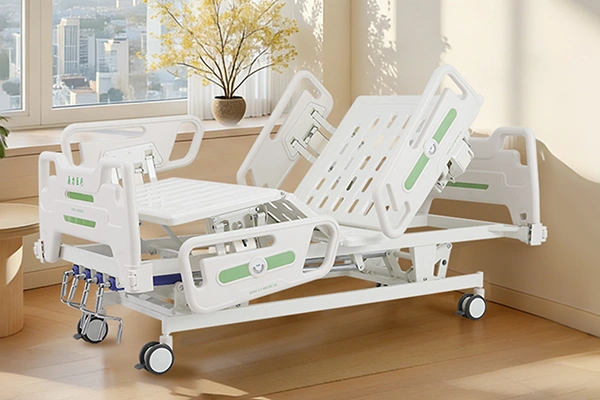
Full Electric Series for High-Acuity Long-Term Care
Full-electric beds remove manual height cranking, cutting caregiver strain and enabling precise positioning that semi-electric frames can’t match in high-acuity wards.
Full-electric beds use dedicated actuators for backrest elevation, knee section articulation, and overall height adjustment—three independent motorized functions that replace the manual crank still found on semi-electric models. In high-acuity long-term care, this complete motorization matters. Caregivers avoid repetitive physical stress, and the care team can dial in exact angles for pressure injury prevention, respiratory therapy, and safe feeding without compromise.
Dingli’s full-electric platforms support safe working loads typically from 180 kg to 250 किग्रा, with heavy-duty bariatric configurations exceeding 250 किग्रा. The frame construction relies on steel or alloy with anti-corrosion coatings, paired with ABS head/foot boards and removable side rails for fast emergency access and disinfection. Each bed rides on four casters with centralized braking, corner bumpers, and protected actuators to handle daily mobility in ICU and long-term care corridors.
Smart Controls and Connectivity
डिंग्ली’s control ecosystem moves beyond simple up/down buttons to preset clinical positions, lockouts, and integration-ready nurse call interfaces that cut response times.
The handset controllers on Dingli beds give more than basic adjustment. Preset positions—flat, Fowler, cardiac chair—let staff jump to critical angles with one touch. Lockout keys stop confused patients from making unsafe adjustments, while nurse control panels at the footboard or side rail provide global lock and full-function access, plus a dedicated CPR position that flattens the bed instantly.
Behind the scenes, linear actuators are sized with a safety factor of 1.5–2.0, so they handle dynamic loads in ICU repositioning without early failure. Automatic stop limits and low-noise motors protect both the mechanism and patient rest. The beds accept AC mains power, and optional battery backup keeps critical functions running during short outages. Cable routing is designed to minimize tripping hazards around IV poles and monitors.
अक्सर पूछे जाने वाले प्रश्नों
What’s the real difference between full electric and semi-electric beds?
Full electric beds motorize three functions—head elevation, foot/knee elevation, and overall bed height—through a single pendant remote. Semi-electric beds motorize the head and foot sections but leave height adjustment to a manual hand crank at the foot of the bed. That manual crank is the entire difference, and it dictates everything from caregiver workload to transfer safety.
Which bed is easier for a single caregiver to handle?
A full electric bed, hands down. With a semi-electric, every height change—lowering for wheelchair transfers, raising for wound care, adjusting for safe sit-to-stand—means walking to the foot of the bed and cranking manually. Multiply that across a day of caregiving and the physical strain adds up fast. Full electric eliminates all cranking. One button press handles it, which matters enormously for a single caregiver who’s already stretched thin.
Is the extra cost of a full electric bed worth it for long-term home care?
For most long-term home care situations, yes. The price gap between semi-electric and full electric typically runs $200–$800. Spread over an 8–12 year lifespan, that’s a negligible per-day cost. What you’re actually buying is reduced caregiver injury risk, faster transfers, better fall prevention through frequent height adjustments, and genuine patient independence. If the patient has limited mobility or the caregiver is older or working solo, the full electric bed pays for itself in avoided injuries and preserved caregiver health.
Does Medicare cover full electric hospital beds?
Typically, no—not the full electric height feature. Medicare classifies the powered height adjustment as a “convenience feature” and denies claims under full-electric HCPCS codes (E0265, E0266, E0296, E0297). What Medicare does cover are semi-electric beds (head and foot motorized, height manual) when medically necessary. If you want full electric, you’ll either pay out-of-pocket for the upgrade portion or handle it entirely as a private-pay item. Some suppliers bill Medicare for the semi-electric equivalent and charge you the difference.
How long do the motors actually last?
In home care, expect 5–10 years from the motors with proper maintenance; in high-use facility settings, closer to 5–8 years before actuators need replacement. Quality medical-grade actuators are rated for 10,000–20,000 cycles. The height motor usually fails first because it bears the heaviest load—lifting the patient, MATTRESS, and frame. Semi-electric beds have fewer motors to fail (2 vs 3–4), but the manual crank mechanism can wear, bend, or strip over time too. Maintenance practices—lubrication, cable checks, avoiding overload—are the biggest variable in motor lifespan.
Can I upgrade a semi-electric bed to full electric later?
Almost never. Semi-electric frames are engineered with a mechanical crank-based lift system. Adding a motorized height function isn’t a simple bolt-on—the mounting points, wiring, control box, and structural load paths are all different. The industry default is “no upgrade path.” There are rare exceptions like the Invacare IVC 5310, which has a manufacturer-specific conversion kit, but these are outliers. If you think you’ll need full electric down the road, buy it upfront. The $200–$800 you save now won’t cover the cost and disruption of replacing the entire bed later.
What motor setup does Dingli use in their full electric beds?
Dingli runs 3–4 independent DC linear actuators per bed. The standard 3-motor layout covers height (hi-low), backrest, and knee/leg adjustment—each with its own dedicated actuator controlled through a central junction box and hand pendant. Higher-spec models add a fourth motor for Trendelenburg/reverse Trendelenburg tilt or fine thigh/calf adjustments. This is a step up from semi-electric designs that use 1–2 motors and a manual crank for height. All Dingli full electric actuators run on 24V DC with built-in limit switches and overload protection, and the beds include emergency manual override at each motor for power-out situations.
अंतिम विचार
While semi‑electric beds cut initial capital by a few hundred dollars, that saving evaporates the moment a caregiver strains a back from repetitive cranking or a patient falls because the bed wasn’t lowered. Only a full electric bed with motorized hi‑lo height eliminates the manual‑handling risk that drives the hidden costs of injury claims, staff turnover, and avoidable safety incidents. In long‑term care, skipping the height motor isn’t a budget win—it’s a liability you carry every day.
Don’t guess on configuration—verify performance. Request a sample unit to test actuator durability and control precision under your daily workload. Contact our team to discuss bulk pricing and OEM customization for your specific bed fleet.