Consumer “top 10” lists rank power chairs by brand recognition. Importers rank them by something harder to see in a photo: weld consistency, battery documentation, and whether the company selling the chair actually owns the production line behind it. That difference decides your return rate three years into a distribution contract, not on the day the container clears customs.
This guide compares the best electric wheelchair classes a B2B buyer can source in 2027 and decodes the specs that separate real factory capability from spec-sheet cosmetics. It also lists the certifications to verify before a bulk order goes out. Every figure is written for evaluation-stage purchasers: distributors, private-label brands, rehab suppliers, and care-home procurement teams.
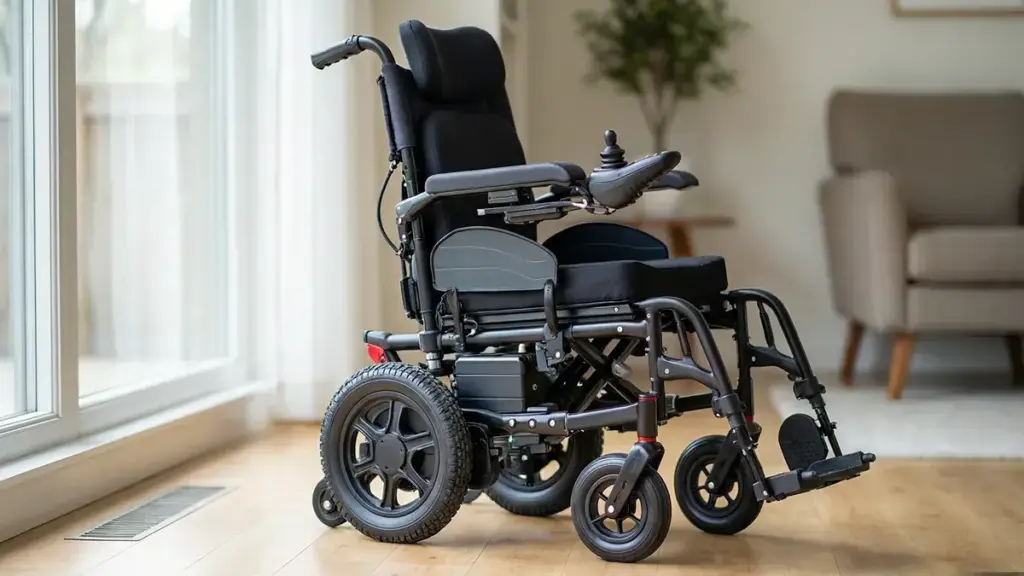
Best Electric Wheelchairs by Category 2027
Power chairs are not one product. They are five distinct machines that happen to share a joystick, and each one serves a different end-customer and margin profile. Before comparing brands, decide which classes your market actually resells.
1. Folding Travel Power Chairs
A staple of e-commerce mobility catalogs. A cross-brace or hinge-frame chair folds to roughly the size of a suitcase, lifts into a car boot, and ships in a single carton. Retail examples typically list 42-55 lb frames. For buyers hunting the best electric wheelchair in this segment, packed weight is the first filter. Dingli’s lightweight lithium model nets 22 kg (48.5 lb) at a 100 kg user capacity. The brand’s brushless 10 A model folds to 950 x 700 x 300 mm, fitting mixed-container loading without a furniture-grade footprint.
2. Lightweight Lithium Models
Quick-release 18650 ternary lithium packs weigh markedly less than lead-acid setups and split the chair into two carry-on-sized loads. For distributors, the lithium line is the premium SKU tier; the same frame with lead-acid batteries becomes the entry price point. One chassis, two price positions.
3. High-Back Reclining Care Chairs
Built for nursing homes and post-stroke users who need trunk support and pressure distribution. Tall backrests and recline mechanisms allow rest positioning between transfers. These chairs sell to institutional tenders, where the buyer checks load ratings and warranty terms before price.
4. Heavy-Duty and Bariatric Classes
US retail convention sorts capacity into roughly 300 lb standard and 400-500 lb heavy-duty tiers, with bariatric programs sitting above that band. If your market includes those buyers, confirm the tested capacity on the datasheet, not the listing title, and match the frame, motor, and controller to the rating as a system.
5. Indoor/Outdoor Dual-Purpose Chairs
Larger 12-16 inch rear wheels, higher ground clearance, and suspension options. They ask more of the braking system and the frame welds, which is exactly where factory process quality becomes visible in the field.
| Category | Typical End-Customer | Frame and Battery Traits | Sourcing Angle |
|---|---|---|---|
| Folding travel | E-commerce buyers, travel-oriented users | 22-25 kg net, hinge frame, lithium pack | High-velocity online SKU, private-label ready |
| Lightweight lithium | Urban dealers, rental fleets | Quick-release 6-20 Ah packs | Premium tier on a shared chassis |
| High-back reclining | Nursing homes, rehab departments | Tall backrest, steel frame, lead-acid standard fitment | Tender business; warranty terms decide |
| Heavy-duty and bariatric | US care markets, bariatric programs | Reinforced frame, twin motors, 400-500 lb class | Verify tested rating per component |
| Indoor/outdoor | Suburban and rural users | 12-16 inch rear wheels, suspension | Durability claims need test reports |
Key Specs That Define a Quality Power Chair
Five specification groups carry most of the purchasing risk. Read them as a system: a strong motor behind a weak weld is still a weak chair.
Drive units. Twin 250 W motors are the common mid-class configuration; higher-wattage units appear on all-terrain frames. Brushless motors cost more and run cooler, with longer service intervals. Dingli’s current line spans both drive types: brushed twin-motor lightweight models and a brushless 10 A lithium model. That spread lets a distributor price a base and premium tier from one supplier.
Controller. A 360-degree programmable joystick module is now the market expectation. Behind that phrase, factory capability splits in two: OEM partners that can tune speed curves, acceleration ramps, and fault codes in firmware, and traders reselling a fixed controller. ISO 7176-14 covers power and control system requirements for electrically powered wheelchairs, and it is the line item to ask about when a supplier claims a “smart” controller.
Frame and welding. Spec sheets rarely mention welds, yet weld quality decides lifespan on a folding frame that flexes hundreds of times a month. Robotic welding produces consistent penetration and fewer stress risers than manual bead work. At Dingli’s Hengshui plant, Kawasaki welding robots handle key structural joints, backed by laser cutting at +/-0.1 mm tolerance so frame parts mate without force-fitting.
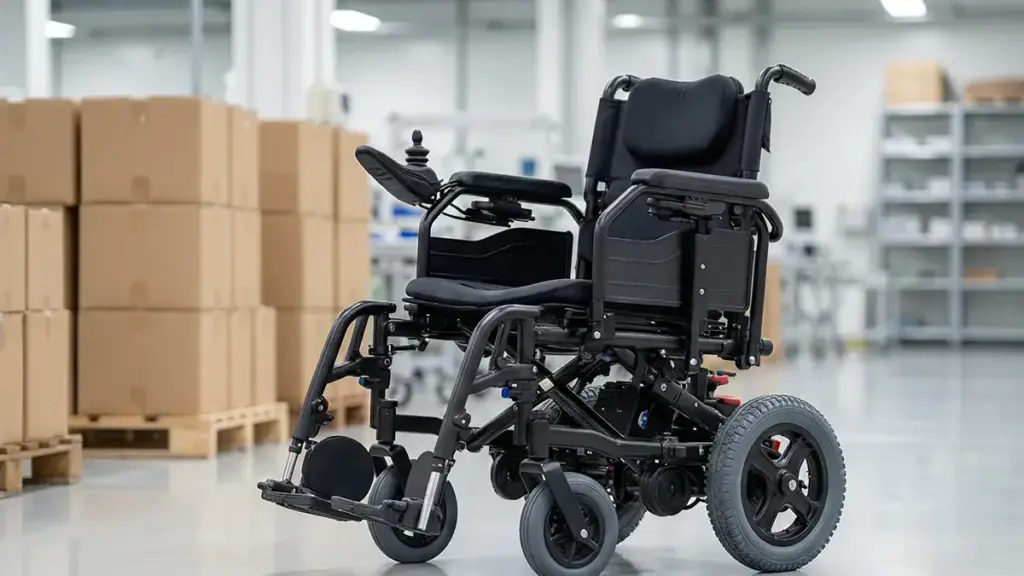
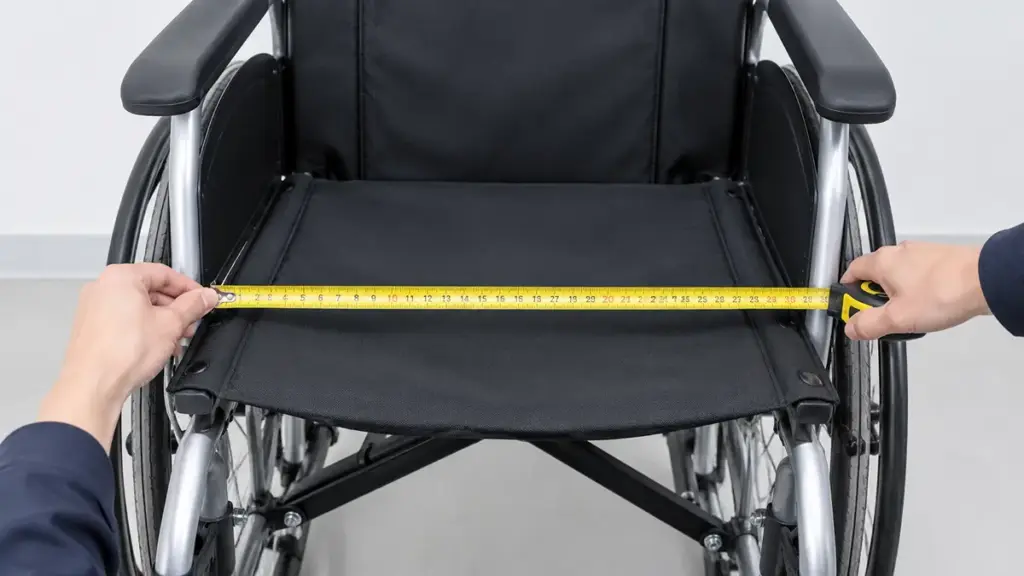
Seat geometry and capacity. US retail listings cluster around 16, 18, and 20 inch seat widths; Dingli’s current models measure 41-45 cm with a tested 100 kg user capacity. Confirm the seat depth and backrest height against local anthropometry before locking a private-label spec.
Braking and stability. Electromagnetic brakes should hold on a slope without creep. Ask for test reports under ISO 7176-3 for brake effectiveness and ISO 7176-2 for dynamic stability, not a generic “safe up to 6 degrees” claim in a PDF brochure.
Power Wheelchair vs Mobility Scooter Comparison
Importers are often asked to quote both, and the right answer depends on who sits on the machine all day. A power chair supports the user’s trunk, positions hips for pressure relief, and fits a vehicle hoist. A scooter is a tiller-steered vehicle for users with good trunk control who need range more than postural support.
| Decision Factor | Power Wheelchair | Mobility Scooter |
|---|---|---|
| Seated support | Full back, lateral trunk support | Open seat, user supplies trunk control |
| Steering | Joystick, one-hand operation | Tiller, two-hand and reach-dependent |
| Indoor turning | Compact footprint, mid-wheel options | Long wheelbase, wider aisles needed |
| Range class | 8-25 km typical lithium packs | Often larger packs, outdoor errands |
| Main channel | Care homes, rehab, medical supply | Consumer retail, mobility dealers |
For a first container, most care-channel distributors stock power chairs and treat scooters as a second-phase line. The chair shares accessories, batteries, and service tooling with beds and cushions. The scooter needs a different parts shelf.
Battery Range and Charging Performance Explained
Range is the number buyers distrust, usually with good reason. A “15 mile” claim is a best-case figure: flat ground, nominal load, warm temperature, new battery. ISO 7176-4 defines how energy consumption and range of electric wheelchairs are measured, so a supplier quoting ISO-tested figures is giving you a comparable number, not a marketing one. The best electric wheelchair on paper means little if that paper was never measured.
Compare packs by watt-hours, not amp-hours alone: stored energy is pack voltage multiplied by amp-hour rating. Doubling the Ah rating at the same voltage doubles stored energy, and real-world range scales with it. Dingli’s lightweight model illustrates the ladder: a 6 Ah option for 8-10 km, 10 Ah for 10-15 km, and 20 Ah for 15-25 km, all from one frame. That option grid lets you place an entry SKU and a long-range SKU in the same catalog without two toolings.
Lithium or lead-acid. Lithium (typically 500+ charge cycles) weighs less, charges faster, and tolerates partial charging; lead-acid costs less upfront but wants full overnight cycles and dies sooner in rental duty. The practical sourcing divide: many trading companies buy cells of unknown grade and re-wrap them. A factory that programs its own controllers and holds UN 38.3 test summaries for its battery packs controls the two components that most often fail in the field.
Transport rules. Lithium cells and batteries shipped by air must meet UN 38.3 of the UN Manual of Tests and Criteria, and forwarders routinely request the test summary before booking. Build the 38.3 documentation into your purchase order language, not the freight claim.
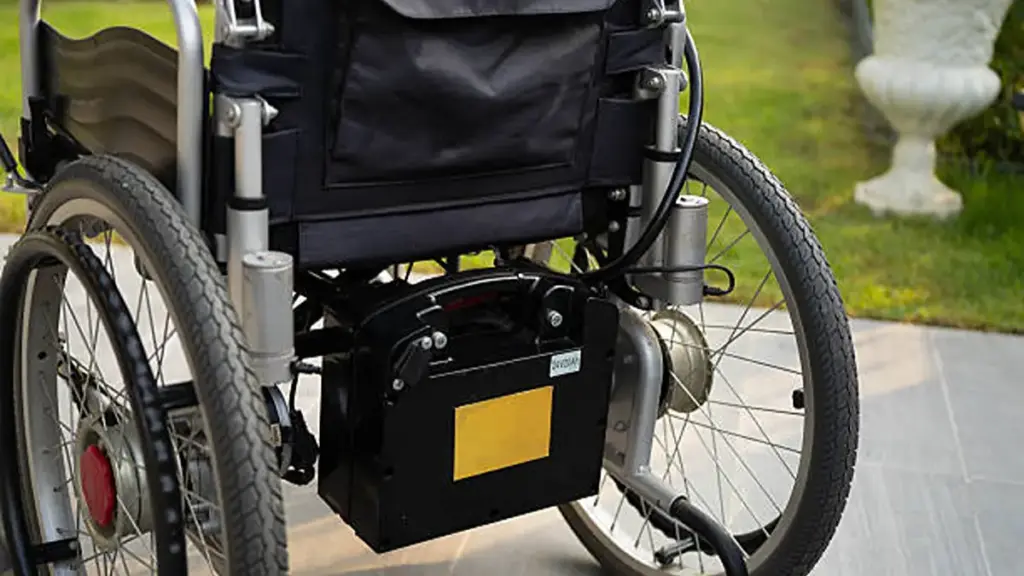
Charging windows on standard chargers run 6-8 hours for most lithium packs and 8-14 hours for lead-acid. Ship the right plug and voltage for the destination market; a 110 V charger in a 230 V country is a first-week warranty claim.
Certifications Every Importer Must Verify First
Certificates are the second place factories cut corners, after welds. No best electric wheelchair shortlist survives a failed model-level audit. Verify each document at the model level: the legal entity named, the certificate number, validity dates, and the covered product family must all match what ships. A generic ISO scan hanging on a showroom wall proves nothing about your SKU.
For the EU market. EN 12184 is the harmonized standard covering electrically powered wheelchairs, scooters, and their ancillary equipment, and it sits on the EU MDR harmonised standards list. Ask which clauses were tested: stability, braking, EMC (ISO 7176-21), and charger safety are separate reports.
For the US market. Powered wheelchairs are a Class II device under 21 CFR 890.3860, and a 510(k) clearance is the normal route to market. Manual wheelchairs sit in a lighter classification lane, so a supplier’s “FDA registered” claim needs unpacking: establishment registration is not the same as a device clearance. Ask for the registration number and the product code, then check both against FDA’s public database.
The test-report stack. Beyond market access, request the ISO 7176 series reports that map to your risk list. Start with Part 2 for dynamic stability and Part 3 for braking effectiveness. Then ask for Part 4 on energy consumption and range and Part 5 on dimensions and mass. A factory that has run its chairs through this stack answers RFQs with PDFs instead of promises.
The same verification discipline that exposes a weak chair exposes a weak bed frame. Our guide to hospital bed safety standards walks the checklist logic step by step, and most of it transfers directly to mobility devices.
OEM and Private-Label Sourcing From Factories
The wholesale market for the best electric wheelchair programs is not won on unit price. It is won on differentiation: a private label with seat widths, colors, and controller behavior tuned to your patients. And on a MOQ that lets you test demand before committing a full container.
A direct factory can go deeper than a logo on a carton. Dingli’s OEM scope covers nameplate, labeling, manual, and packaging customization, plus seat-width and cushion options across the 16-20 inch retail band. Charger plugs and voltage are matched to the destination market, and firmware speed profiles are tuned on programmable controllers. Sample orders start at one unit, and 40HQ mixed-container loading lets a wheelchair program ride alongside beds and lithium battery models from the same production schedule.
Two questions separate factories from intermediaries fast. First: which joints are robot-welded, and can I see the weld seam specification? Second: who programs the controller firmware, and under which test report? Traders answer both with a vendor’s name. Factories answer with a process.
Mobility is also the natural second category for bed distributors. The same care-home buyers who order wholesale hospital beds requisition transfer chairs and pressure-relief cushions, and one supplier across the ward raises your share of wallet. If you are still shortlisting factories, our hospital bed manufacturers guide shows the vetting criteria top importers apply. Dingli currently supplies the folding, lightweight lithium, and high-back reclining classes above; the heavy-duty and large-wheel segments are listed as market context, not as house stock.
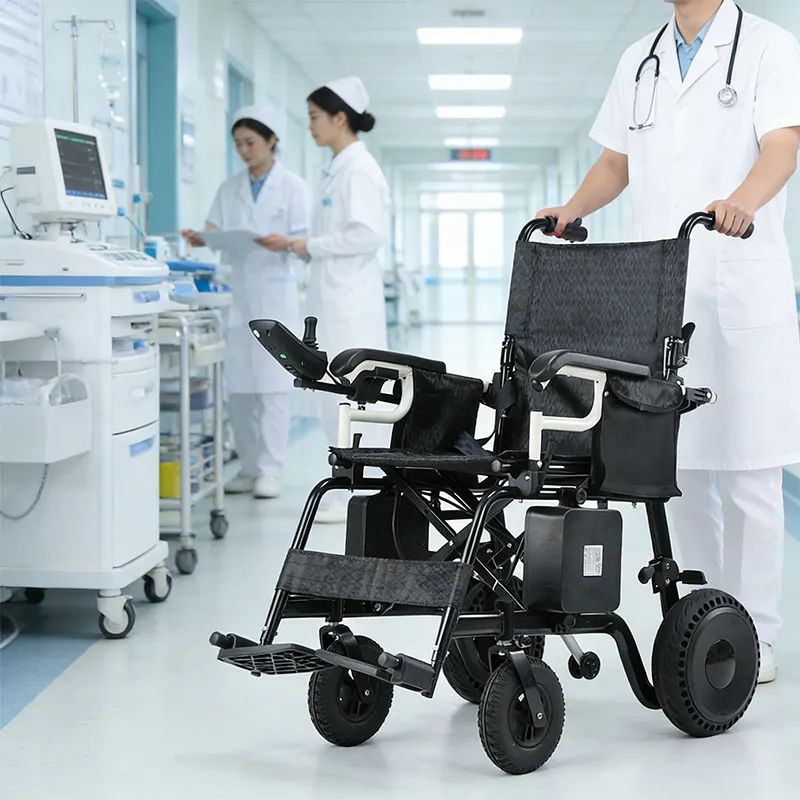
Frequently Asked Questions About Electric Wheelchairs
What is the lightest electric wheelchair available for bulk orders?
Foldable lithium power chairs currently start around 22-25 kg (48-55 lb) net weight, with quick-release batteries that split the load for car boots. Dingli’s lightweight model ships at 22 kg net in a single carton, which keeps per-unit freight inside travel-chair economics.
How long do electric wheelchair batteries last?
Lithium packs typically deliver 500+ charge cycles, roughly two to three years of daily use. Lead-acid packs carry a lower cycle rating and reach replacement sooner under the same duty. Cycle life assumes correct chargers and no deep-discharge storage, so specify cut-off protection in the OEM battery contract.
Can you take an electric wheelchair on a plane?
Yes, under airline mobility-aid rules, provided the battery type is declared and prepared correctly. Lithium packs generally must be removed, carried indoors, and protected from short circuits, and carriers ask for UN 38.3 documentation. Design end-user manuals around removable quick-release packs to keep this routine simple.
How fast does a standard power wheelchair go?
Standard indoor/outdoor class chairs are limited to about 6 km/h (roughly 4 mph), close to a brisk walking pace. Higher-speed outdoor models exist but move the product into different regulatory treatment in some markets, so confirm local rules before importing a 10 km/h variant.
Lithium or lead-acid battery: which should importers choose?
Lead-acid wins where the listing competes on shelf price and the user charges overnight. Lithium wins wherever weight, range per charge, or air-freight handling matters, at a higher pack cost per unit. Many distributors stock both: the same frame on two battery tiers covers both buyers.
What warranty is normal on bulk power wheelchair orders?
Factory-direct B2B terms commonly cover the frame and motors for two to three years, with batteries warranted separately for a shorter period. Dingli’s standard program is a 3-year warranty with lifetime spare-parts support, and the purchase order should state which parts the warranty clock applies to.