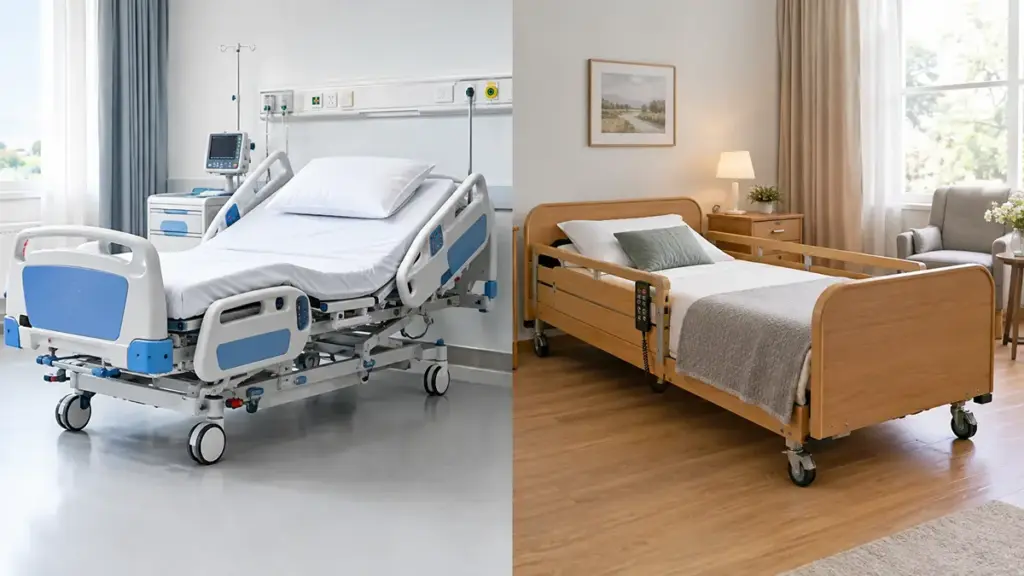
When sourcing a five-function electric hospital bed, buyers should verify the technical specifications rather than rely only on marketing claims. Details such as Trendelenburg range and CPR release performance can affect how well the bed meets the needs of an ICU or other high-acuity setting.
This guide focuses on the specifications buyers should verify before purchasing a five-function electric hospital bed, including movement ranges and tolerances, CPR release performance, and the control system. We focus on how to verify these specifications against applicable medical-device and safety requirements, including IEC 80601-2-52:2026 where applicable.
What Is a 5-Function Electric Hospital Bed?

A 5-function electric bed offers five core motorized adjustments: backrest, leg, высота, Тренделенбург, and reverse Trendelenburg. Five-function electric beds are commonly specified for ICU and acute-care applications, but the appropriate configuration depends on the intended use and clinical requirements.
The Five Core Motorized Functions
The term “5-function” generally refers to five powered bed adjustments: backrest, leg rest, высота, Тренделенбург, and reverse Trendelenburg. The number of motors and the mechanical design can vary by model. Forget the manual cranks; these are all electrically controlled via a handset or nurse panel.
- Backrest Elevation: This adjusts the head and upper body. The available angle range varies by model and should be confirmed in the manufacturer’s technical specifications. This function supports patient positioning for activities such as eating, communication, and care.
- Leg/Knee Rest Elevation: The leg section raises or lowers the knees to support patient positioning and comfort. The available angle range varies by model, so buyers should verify the manufacturer’s stated specifications. Raising the leg section can also help reduce sliding when the backrest is elevated.
- Регулировка высоты кровати: The entire bed platform raises or lowers. A low height helps patients get in and out of bed safely, while a higher position gives caregivers better, more ergonomic access for procedures without straining their backs.
- Trendelenburg Position: The bed tilts so the patient’s head is lower than their feet. It is mainly used for selected clinical procedures and patient-positioning needs, with its use determined by the medical team.
- Reverse Trendelenburg Position: The opposite of Trendelenburg, this tilts the bed frame so the patient’s head is higher than their feet. It provides a head-up position that may be used for selected clinical and post-operative positioning needs.
Clinical Applications and Key Features
These beds are commonly used in ICU and other acute-care settings, but they can also be specified for other hospital and long-term care environments where powered positioning is needed.
- Primary Use: These beds are commonly used in ICU and other acute-care settings, but they can also be specified for other hospital and long-term care environments where powered positioning is needed. In these settings, frequent and precise repositioning is often required, making powered adjustments more practical for many clinical workflows.
- Ergonomics and Safety: Motorized functions reduce the need for manual adjustment by caregivers. Common safety features may include integrated side rails, a central locking brake system, и, depending on the model, a backup battery for continued operation during a power interruption.
- Emergency Functions: During an emergency, the CPR release should allow staff to return the bed to the required position quickly. Emergency CPR functions vary by model. Some beds provide one-touch electric CPR, while others also include a manual CPR release for use when power is unavailable. They also include a nurse lock-out system, which allows staff to disable patient controls to prevent accidental or unsafe adjustments.
- Advanced Positioning: Many 5-function beds also include one-button presets that combine movements. The “cardiac chair” position, for example, seats the patient upright to support heart and lung function, a complex posture that is achieved with a single command.
Which Movements Make Up the Five Functions?

The five functions are split into three core adjustments for patient comfort and two specialized tilts for clinical procedures.
Core Adjustments: Head, Legs, and Overall Height
The first three functions are the workhorses of any hospital bed, handling the daily needs of the patient and caregiver. These are the adjustments used most frequently.
- Спинка (Head) Elevation: This function allows the patient’s upper body to be raised, typically from a flat 0° up to a seated 75°. It’s essential for eating, breathing more easily, and communicating with staff or family.
- Leg Section Elevation: This raises the patient’s knees, often up to 40°. Elevating the leg section can support patient positioning and comfort and can help reduce sliding when the backrest is raised.
- Hi-Low Height Adjustment: This moves the entire bed platform vertically. The bed can be lowered for safe patient transfers from a wheelchair and raised to a comfortable working height for caregivers to prevent back strain.
Specialized Tilting: Trendelenburg and Reverse Trendelenburg
The final two functions involve tilting the entire bed platform. These are not for general comfort but are used for specific clinical applications under medical supervision.
- Тренделенбург: This position tilts the bed so the patient’s head is lower than the feet. It may be used for selected procedures or other clinical positioning requirements under the direction of trained medical staff.
- Reverse Trendelenburg: This tilts the bed in the opposite direction, with the patient’s head higher than the feet. It is used for selected procedures and positioning needs, and may be specified when a head-up position is clinically appropriate.
Equip Your Hospital with 5-Function Electric Beds
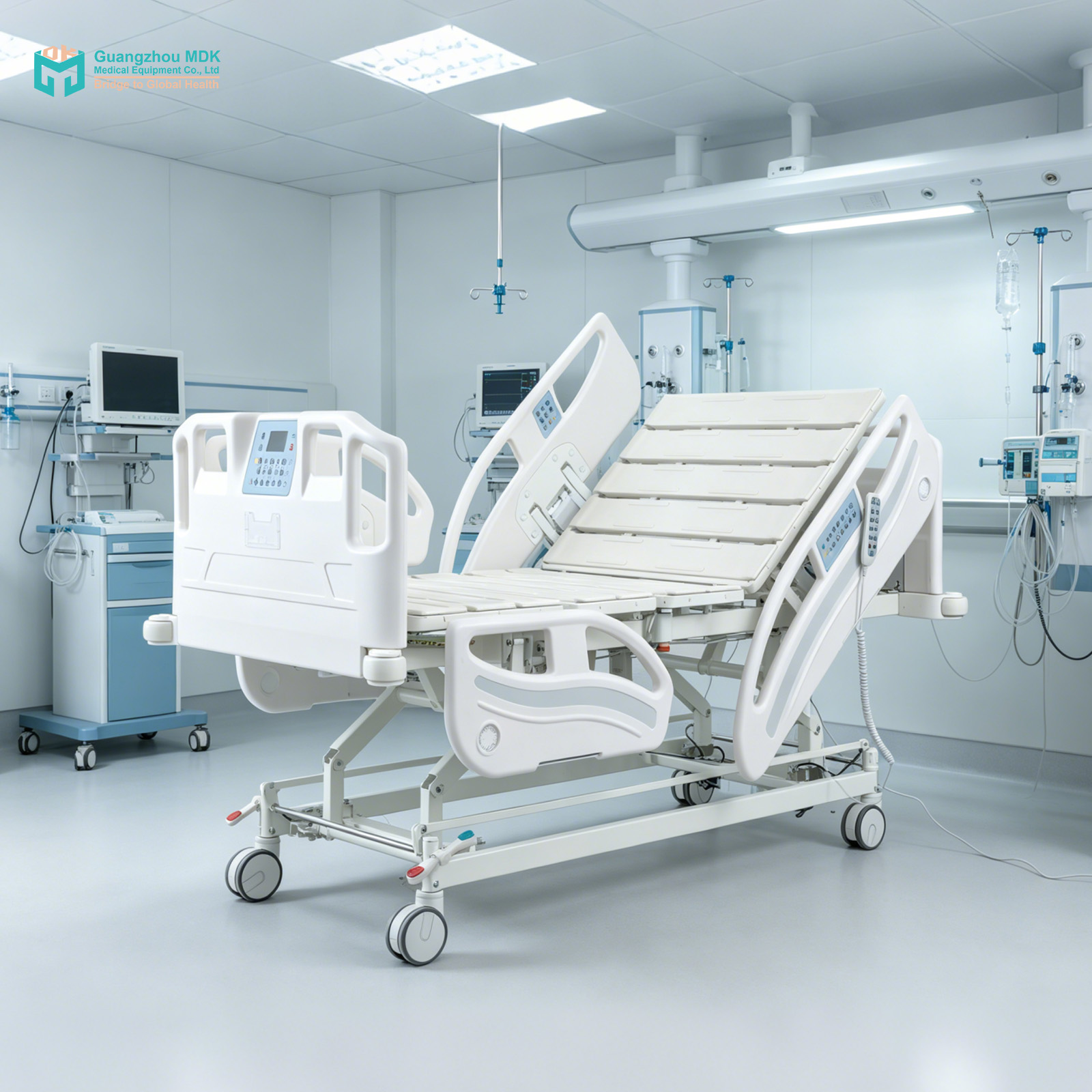
Do All 5-Function Beds Use the Same Configuration?
Нет. While 5-function beds share the same five functional categories, the actual implementation—like movement angles, motors, and control layouts—varies significantly between models.
Standardized Functional Categories vs. Variable Implementations
The term “5-function electric hospital bed” is commonly used to describe five powered positioning functions:
- Backrest adjustment
- Leg/knee section adjustment
- Overall height adjustment (Привет-Низкий)
- Trendelenburg tilt
- Reverse Trendelenburg tilt
This functional combination is common across many hospital bed models. Однако, тот “5-function” label does not indicate the number of motors or the exact mechanical design. Movement ranges, control systems, and additional features can vary between models.
Key Areas Where Configurations Differ
While the functional labels are the same, the underlying configurations are not. Two beds, both sold as “5-function,” can have very different capabilities. The main variations fall into these areas:
- Motion Ranges and Angles: Movement ranges vary by model. Например, one bed may provide a backrest angle of 75°, while another may have a different maximum angle. Trendelenburg and reverse Trendelenburg ranges can also differ between models, as can the height adjustment range. Buyers should compare these model-specific values with the clinical and operational requirements of their facility.
- Mechanical Architecture: The number of motors isn’t standard. Some beds use four motors to deliver five functions through mechanical linkages, while premium models might use five independent motors for more direct control. The design of the lifting mechanism and chassis also changes.
- Control Interfaces: How the user operates the bed varies widely. Options range from a basic patient handset to integrated side-rail controls and comprehensive nurse control panels that can lock out patient adjustments.
- Ancillary Features: Important capabilities like a one-touch CPR function, backup battery, or an integrated weighing scale are not part of the core “five functions.” These are critical differentiators that significantly impact clinical workflow and safety but are configured differently on every model.
How Should the Five Functions Be Verified on the Technical Sheet?
Verify a spec sheet by comparing its listed parameters with measurable data and checking the relevant hospital bed safety standards, including IEC 80601-2-52:2026 where applicable. Specifications should also be supported by appropriate technical and test documentation.
Treat the specification sheet as a technical document and look for measurable values rather than feature checkmarks or general marketing claims. The five core functions—backrest, knee-rest, высота, Тренделенбург, and reverse Trendelenburg—must be defined by measurable parameters, not just checkmarks. These specifications describe the bed’s stated capabilities, but they should be reviewed together with relevant test reports and compliance documentation.
Matching Specifications to Listed Parameters
A legitimate technical sheet breaks down each function into quantifiable data. Don’t accept vague claims. Look for specific values that can be measured and validated by an engineering or QA team. Each of the five functions should have its own set of parameters.
Here’s what to look for, function by function:
- Backrest Adjustment: The spec sheet should list the angle range in degrees, relative to the flat mattress platform. Например, a manufacturer may specify a range such as “Backrest Tilting: 0–70° ±5°.” The stated tolerance indicates the manufacturer’s specified allowable variation and should be reviewed together with the relevant test and product documentation.
- Knee-Rest/Leg Adjustment: Similar to the backrest, this requires a maximum angle and tolerance (например, “Knee-rest Tilting: 0–45° ±5°”). If the bed has separate thigh and calf sections, the sheet should specify the angle for each.
- Height Adjustment (Привет-Низкий): This must be specified as a minimum-to-maximum range in millimeters (например, “Height Adjustment: 450–650 mm”). The document should clarify the measurement reference point: from the floor to the top of the mattress support platform, without the mattress.
- Trendelenburg Tilt: The maximum tilt angle should be specified in degrees relative to the horizontal plane. The technical sheet should state the actual range for the model, such as “Тренделенбург: 0–12°” as an example. Buyers should not assume a universal angle and should compare the stated range with their clinical requirements.
- Reverse Trendelenburg Tilt: This function should have its own specified angle range. The range may differ from the Trendelenburg angle depending on the bed’s design, so buyers should check the manufacturer’s technical specifications rather than assume the two ranges are symmetrical.
An internal QA team would verify these specs using calibrated tools like an inclinometer for angles and a height gauge for the Hi-Low range. The results must fall within the stated tolerances.
Aligning Parameters with Safety and Performance Standards
The specifications on a technical sheet describe the bed’s stated capabilities and should be reviewed alongside the applicable safety and essential-performance requirements, including IEC 80601-2-52:2026 where applicable. Buyers should also request supporting test reports and compliance documentation rather than rely on the specification sheet alone.
These standards establish requirements for evaluating basic safety and essential performance, while compliance should be supported by appropriate testing and technical documentation. Например, the full range of height and tilt adjustments must not compromise the bed’s stability or lead to tipping, especially under a rated patient load. The bed’s movement and side-rail configuration should also be assessed for hospital bed entrapment risks, together with the mattress and other compatible accessories, in accordance with applicable safety requirements such as IEC 80601-2-52:2026 where applicable.
When reviewing a technical sheet, you should confirm that the manufacturer cites compliance with relevant safety standards. A reference to IEC 80601-2-52:2026 on a specification sheet indicates that the manufacturer is claiming applicability of the standard, but buyers should request the relevant test reports, certificates, or other supporting documentation to verify compliance where applicable.
Дингли Медикал: Direct Manufacturing Support for 5-Function Bed Projects
Once buyers know which specifications to verify, the manufacturer’s production and customization capabilities also matter. Дингли Медикал operates a 15,000 m² core manufacturing base with two factories, four main workshops, and a reported monthly capacity of 200,000 units. The company supports OEM/ODM customization and low-MOQ orders, with its warehouse system supporting 7–10 day delivery for applicable orders. Its current five-function ICU bed lineup includes models with a Jieshun 4-motor system, built-in weighing scale, electric CPR, and backup battery, giving buyers concrete configurations to compare during procurement. Dingli also reports ISO 9001, ИСО 13485, CE, and FDA certifications, supporting projects that require documented quality and compliance requirements.
Which Controls and Emergency Functions Should Buyers Compare?
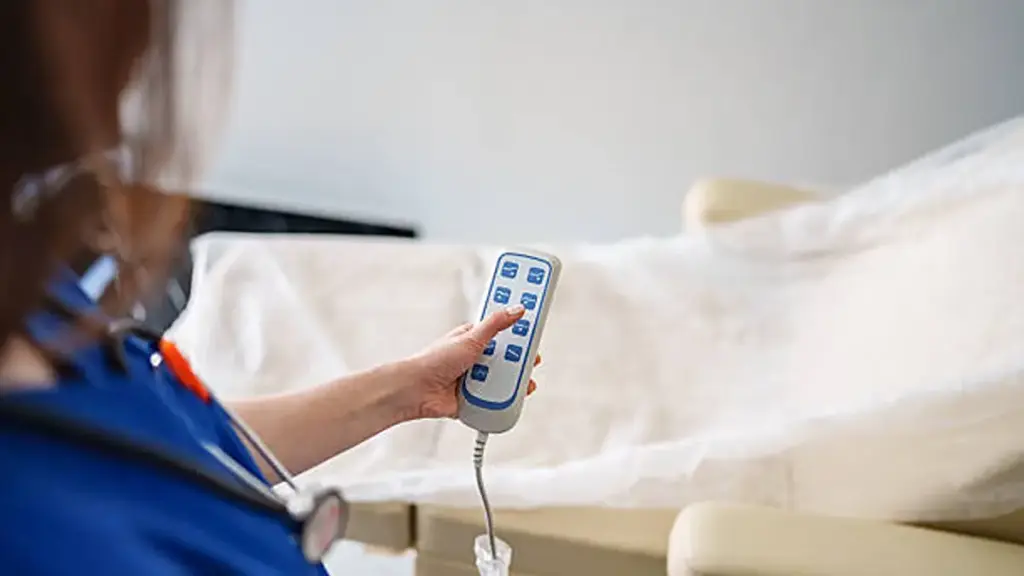
Look past the basic five functions. The real differentiators are in the control hierarchy, CPR response time, and fail-safes like manual releases and battery backup.
Standard Control Interfaces and Hierarchy
When evaluating a five-function bed, the control setup tells you who is really in charge—the patient, the nurse, or a central system. Control configurations vary by model. Common options include a patient handset, side-rail controls, nurse controls, и, on some ICU beds, foot controls.
First is the patient handset. It handles basic movements like back and leg adjustments. But the key feature to check is the lock-out capability. Can a nurse disable functions like height adjustment or Trendelenburg to prevent unsafe patient-led movements? This isn’t a nice-to-have; it’s a core safety requirement.
Next are the controls embedded in the side rails. These are often split, with simple controls on the inside for the patient and a more comprehensive set on the outside for staff. The nurse-side panel should be able to override the patient’s handset completely. A good system has separate, clearly marked nurse controls, not a shared interface that can cause confusion.
On ICU-grade models, a nurse control panel is often used as the main staff interface and may provide access to all bed functions, presets, and lockout controls. It operates all five functions, presets like the “chair” position, and can lock out both the patient handset and the side rail controls. High-end panels also integrate features like a weighing scale or bed exit alarm.
Critical Emergency Response Functions
In a crisis, a bed’s emergency functions are what truly matter. The most important feature to compare is the CPR function, which should instantly flatten the bed for chest compressions.
There are two main types you’ll see:
- Electric CPR: A one-touch control allows staff to quickly return the bed to the required CPR position. Some models specify a CPR release time, so buyers should check the manufacturer’s stated response time for the specific bed rather than rely on a general benchmark. It is also important to confirm the location and accessibility of the CPR controls, including whether they are available from the required sides of the bed and through the nurse control panel.
- Manual CPR: A mechanical lever or handle that disengages the motor and drops the backrest flat. This is your fail-safe during a power outage or motor failure. For critical-care applications, buyers should check whether the bed provides a manually accessible CPR release and whether it can be reached from the required sides of the bed.
Some ICU beds combine electric and manual CPR releases so staff have an emergency positioning option even when electrical power is unavailable. For high-acuity applications, buyers should verify whether both electric and manual CPR release are included in the specified configuration.
Also, scrutinize the power failure plan. A backup battery is essential. You need to know how many movements it supports when unplugged. Ask the manufacturer how many positioning cycles or operations the backup battery can support under the specified load and conditions. Without a battery, the manual CPR release becomes the only way to get the bed flat quickly.
Finally, check for a dedicated emergency Trendelenburg control. While the standard handset can activate the tilt, some ICU beds also provide foot controls for hands-free adjustment of selected bed positions. This speeds up response time when every second counts.
Is an Integrated Weighing System Standard or Optional?
An integrated scale isn’t a given. It’s standard on premium ICU models but typically an optional, paid upgrade for general ward beds. You have to specify it.
Standard on Designated ‘With-Scale’ and ICU Models
In high-acuity environments such as the ICU, an integrated weighing system is available on some advanced hospital bed models and may be included as a standard feature or offered as an optional configuration, depending on the model. For patients who require close monitoring of fluid balance, regular in-bed weight measurements can provide useful clinical information without requiring the patient to be transferred to a separate scale. Some manufacturers offer specific models with integrated weighing systems, while others provide the scale as an option depending on the bed configuration. On models equipped with integrated weighing systems, the scale should be clearly identified in the technical specifications as either a standard feature or an optional configuration. Depending on the model, the weighing system may use load cells integrated into the bed frame, with weight information shown through a dedicated display or the bed’s control interface. These systems are built for precision, often able to weigh a patient in any bed position while compensating for added equipment.
Optional on Base Configurations and General Ward Beds
On many general ward beds, an integrated weighing system is offered as an optional feature rather than part of the base configuration. This configuration allows facilities to equip only the beds that require in-bed weighing, while using mobile or standalone scales for other patients. Catalogs and quotations may list the same bed in different configurations, such as a base version and a version with an integrated weighing system. The technical documentation will list the weighing system as an “optional accessory” or have separate net weight specifications for the standard bed versus the scale-equipped one. During procurement, confirm whether the weighing system is included in the quoted configuration or needs to be specified as an additional option.
Which Specifications and Documents Should Buyers Request?
Don’t trust brochures. Buyers should request the technical specifications, applicable test reports, and regulatory documentation needed to verify the product before placing an order.
Hospital beds are regulated medical devices in many markets, but the applicable registration and compliance requirements vary by country or region. Vetting one requires more than a simple feature check. Before placing an order, you need to see the full documentation package to verify performance, безопасность, and compliance. If the supplier cannot provide the relevant documentation, ask what alternative evidence is available before proceeding with the purchase.
| Technical Specifications and Performance Data | Compliance, Usage, and Support Documents |
|---|---|
|
|
What Should Be Checked Before Placing an Order?
Before you sign a purchase order, you need to verify both the clinical specifications for your facility and the commercial terms to avoid ending up with the wrong bed or surprise costs.
Verify Clinical and Safety Specifications
Getting the technical details right is the first half of the job. A bed isn’t just a piece of furniture; it’s a medical device that needs to match your clinical workflow, популяция пациентов, and facility layout. Getting these details wrong can lead to installation, workflow, or servicing problems after delivery.
- Match the bed to the department. Define the intended clinical use—is it for the ICU, a general ward, or a step-down unit? An ICU bed requires more robust features and precise controls than a general ward bed.
- Confirm the five functions and their ranges. Don’t just accept the “5-function” label. Verify the specific motion ranges, especially the Trendelenburg and reverse Trendelenburg angles, and make sure they meet the requirements of the intended clinical application.
- Check load capacity and physical dimensions. The Безопасная рабочая нагрузка (SWL) must be appropriate for your expected patient population and the total supported load. And you have to measure your facility. Make sure the bed can actually fit through doorways, into elevators, and within the patient room.
- Review critical safety features. Look closely at the side-rail design to ensure it prevents patient entrapment. Confirm the bed has a reliable central braking system and an emergency CPR release mechanism for rapid flattening.
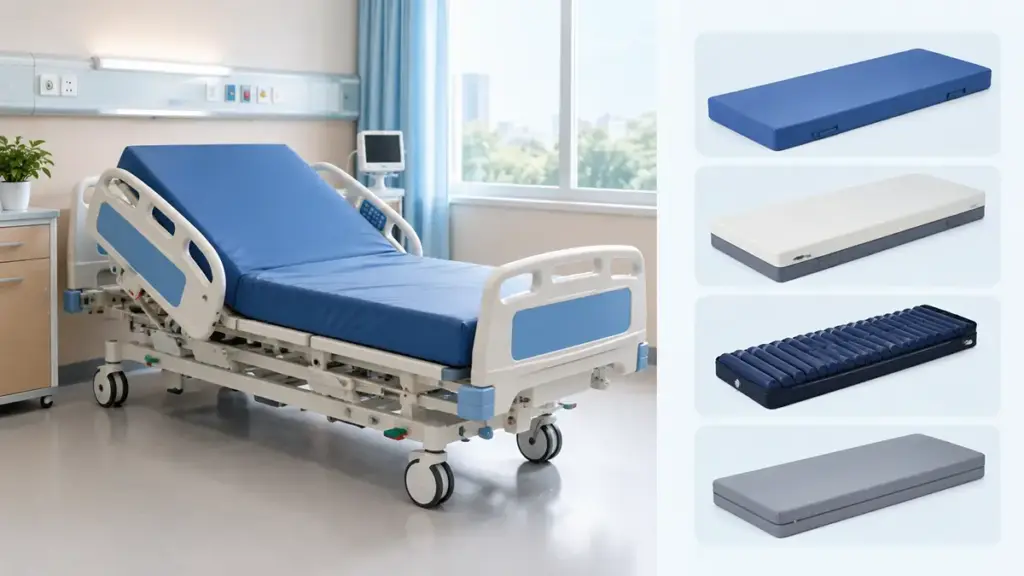
- Verify mattress fit and power backup. Ensure your standard mattresses are compatible with the bed’s platform and side rails. A battery backup isn’t optional for beds that will be used for transport or in areas prone to power interruptions.
- Check for cleaning compatibility. The bed’s surfaces and materials must stand up to your hospital’s specific cleaning and disinfection protocols. If the materials are not compatible with the facility’s cleaning and disinfection procedures, they may create maintenance and infection-control concerns.
Confirm Commercial and Logistical Terms
Once the technical specs are locked in, you need to scrutinize the commercial agreement. This is where hidden costs and long-term service issues often appear. Compare the full commercial terms, not just the unit price.
- Make sure the quote is complete. A price for the “bed” is not enough. The quotation must explicitly list every single item: the bed frame, матрас, all accessories, delivery charges, and on-site assembly fees.
- Confirm warranty and service terms upfront. What is the warranty period for the frame versus the electronics? Who provides service, and what is their response time? Most importantly, confirm the availability and cost of spare parts before you buy.
- Request all necessary documentation. You need the technical datasheets, user manuals, and relevant compliance documentation, including applicable test reports or certificates related to IEC 80601-2-52:2026. These documents can also support your biomedical team in equipment maintenance and service.
- Clarify included accessories. Don’t assume anything. Confirm if IV poles, drip stand mounts, or other necessary accessories are included in the price or are extra-cost options.
- Define installation and training needs. Clarify who is responsible for installation and commissioning. You should also ensure the supplier provides on-site training so your staff can operate the beds safely and correctly from day one.
Часто задаваемые вопросы
What is a five-function hospital bed?
A five-function hospital bed is an electric medical bed that provides five powered positioning functions for patient care and caregiver use. The five commonly included functions are backrest elevation, leg or knee section adjustment, overall height adjustment, Trendelenburg tilt (head lower than feet), and reverse Trendelenburg tilt (head higher than feet). The number of motors and the mechanical design can vary by model.
What are the five functions of an electric hospital bed?
A five-function electric hospital bed provides five powered positioning functions. The number of motors can vary by model, so five functions do not necessarily mean five separate motors. The five commonly specified functions are:
- Backrest Elevation: Raises the patient’s upper body to support sitting, eating, communication, and positioning.
- Leg/Knee Elevation: Raises the leg section to support patient positioning and comfort and help reduce sliding when the backrest is elevated.
- Регулировка высоты кровати: Raises or lowers the entire bed to support patient transfers and provide a more suitable working height for caregivers.
- Trendelenburg Tilt: Tilts the bed so the patient’s head is lower than the feet for selected clinical positioning needs.
- Reverse Trendelenburg Tilt: Tilts the bed so the patient’s head is higher than the feet for selected clinical and post-operative positioning needs.
Does every five-function hospital bed include Trendelenburg positioning?
Five-function hospital beds commonly include both Trendelenburg and reverse Trendelenburg positioning, along with backrest, leg-rest, and overall height adjustment. Однако, the exact configuration can vary by model, so buyers should confirm the available functions and movement ranges in the manufacturer’s technical specifications before purchasing.
How many motors does a five-function hospital bed have?
A five-function electric hospital bed does not necessarily use five motors. Four-motor configurations are common, while some models may use five or more actuators depending on the mechanical design. The number of motors does not directly define the number of functions, so buyers should compare the actual movement ranges, motor configuration, and technical specifications of each model.
What should be checked before buying a five-function electric hospital bed?
Key points to verify include:
- Clinical Fit: Ensure the bed’s movement ranges (angles and height) meet the needs of your care environment, whether it’s an ICU or home care.
- Безопасность: Check the safe working load, the reliability of the central braking system, and the presence of emergency functions like a CPR release.
- Размеры: Confirm the bed fits through doorways and has enough clearance in the room for caregivers to work around it.
- Controls and Power: Assess the ease of use of the controls and determine if a battery backup is included for power outages.
- Warranty and Service: Understand the warranty terms for the frame and electronics, and check for available local service and spare parts.
Заключительные мысли
Price should be considered alongside the bed’s verified specifications, safety documentation, and service support. Buyers should confirm that the selected model meets the applicable medical-device and safety requirements for the target market. Your decision rests on proven data, not marketing claims.
Don’t guess on performance—verify it. Request our complete technical documentation to align our bed specifications with your facility’s exact requirements. Свяжитесь с нашей командой to discuss your project, whether for direct procurement or OEM/ODM partnership.