Choosing the correct hospital bed mattress size is the first line of defense against patient entrapment, falls, and pressure injuries. A dimension off by even two inches can create dangerous gaps between the mattress and side rails, or reduce effective rail height below the 220 mm minimum required by IEC 60601-2-52. For B2B buyers—distributors, wholesalers, and facility procurement teams—sizing errors also translate into rejected shipments, wasted inventory, and compliance exposure.
This guide consolidates the exact specifications for standard adult, bariatric, extended-length, and pediatric hospital bed mattresses. It explains the clinical reasoning behind the 36 in × 80 in × 6 in baseline, walks through measurement protocol, and shows how to match a replacement mattress to the bed frame’s internal sleep deck—not its outer dimensions.
Standard Hospital Bed Mattress Dimensions

The 36 in × 80 in × 6 in baseline is a clinical standard, not a retail convenience size. Every dimension is tied to caregiver access, 患者安全, or side-rail efficacy.
The 36″ × 80″ × 6″ Baseline for Adult Care
Across acute-care hospitals, long-term care facilities, and home-care programs, the most common hospital bed mattress size is 36 inches wide by 80 inches long, with a thickness of 6 inches (occasionally 7). This is the operational baseline for general adult inpatient care, and it drives everything downstream—linen procurement, side-rail specification, patient-lift clearance, and even doorway and elevator sizing.
- 36-inch width. Wide enough for an average adult to turn safely, narrow enough for a caregiver to reach across from either side without excessive leaning. It also keeps the full bed system within standard hospital doorway and elevator clearances.
- 80-inch length. Provides full-body support for most adult patients, including heel containment. Heel overhang is a leading cause of pressure injuries in immobilized patients, so the 80-inch length is treated as a minimum, not a target.
- 6-inch thickness. Balances patient comfort with side-rail efficacy. IEC 60601-2-52 requires at least 220 毫米 (about 8.7 in) of rail above the uncompressed mattress surface; a 6-inch mattress on a standard frame preserves that clearance, while a 10-inch residential mattress typically erases it.
On electric hospital beds with multi-section articulation, the 6-inch profile also matters for flexibility. Thinner mattresses bend cleanly at the head and knee hinge points; thicker ones bridge across the hinges, creating pressure points and interfering with therapeutic positioning.
Why Clinical Standards Differ from Consumer Sizes
Buyers often assume the 80-inch length means a hospital mattress is interchangeable with a consumer Twin XL. It is not. A Twin XL is typically 38 inches wide—two inches wider than the clinical standard. Those two inches are enough to prevent the mattress from sitting flush against the side rails, which blocks rail locking and can strain the bed’s articulation motors.
Consumer sizing is driven by bedroom furniture conventions and comfort marketing. Clinical sizing is driven by the bed frame’s internal sleep deck—the actual platform the mattress rests on—and by the safety envelope that deck creates with the side rails. Always size against the deck, never against the outer frame dimensions or a retail mattress label.
After width is fixed, thickness is the second constraint. A 6-inch profile is the operational sweet spot: thick enough to distribute pressure and prevent bottoming out on the deck, thin enough to preserve the 220 mm effective rail height required by IEC 60601-2-52. Thicker mattresses—8, 10, 或者 12 inches—may feel more comfortable to a healthy person lying down for five minutes, but they erode the safety envelope that the side rails are designed to create.
Bariatric, Extended-Length, and Pediatric Options
Specialty sizes are engineered systems, not scaled-up consumer mattresses. They carry higher weight ratings, different construction, and different rail-interface requirements.
Bariatric Mattress Specifications
Bariatric mattresses support patients who exceed the working load limit of a standard 36 in × 80 in bed—typically 350 lb (160 千克). Specifications go well beyond adding a few inches:
- Core bariatric widths: commonly 42, 48, 或者 54 inches. Many bariatric bed systems are engineered specifically around a 48-inch or 54-inch mattress.
- Super-bariatric widths: for larger body frames, some systems extend to 60, 72, 或者 76 inches. These typically require expandable-width bed frames and wider doorways.
- Weight capacity: typically rated 600 到 1,000 lb, versus roughly 350 lb for a standard adult mattress.
- Thickness: commonly 7 到 10 inches, achieved through multi-layer high-density foam, dynamic air cells, or hybrid foam-air construction. The extra depth prevents bottoming out under concentrated load.
- Cover: medical-grade, fluid-proof, and wipeable, rated for hospital disinfectants at concentrations defined by the manufacturer.
Where pressure-injury risk is elevated, bariatric surfaces often integrate alternating-pressure or low-air-loss technology. See our bariatric-support air mattresses category for powered systems rated at these higher working loads.
Extended-Length and Pediatric Sizes
Extended-length mattresses address patients taller than roughly 6 ft (183 厘米). Standard 80-inch lengths leave heels hanging past the foot of the mattress, which is a documented risk factor for heel pressure injuries. Extended options are typically available in 84 and 88 inches, and some manufacturers offer 94-inch lengths for very tall patients.
Pediatric mattresses are sized for smaller bodies and lower side rails. Typical dimensions are 30 到 33 inches wide by 62 到 72 inches long, with a thickness of 5 到 6 inches. The narrower width ensures side rails provide proper containment without creating gap hazards, and the shorter length keeps the mattress within the pediatric bed’s articulation envelope.
Selection Criteria for Clinical and Facility Needs
Choosing the right specialty size is a two-axis decision. Clinical factors come first:
- Patient weight and BMI: the mattress working load limit must safely exceed the patient’s weight, with margin for repositioning forces.
- Body width and height: shoulders and hips should rest fully inside the mattress edges, and heels should not overhang the foot.
- Mobility and skin risk: immobile or high-risk patients benefit from dynamic air or advanced multi-layer foam systems designed for bariatric loads.
Operational factors come second, but they can veto a clinically correct choice:
- Bed frame compatibility: mattress dimensions must exactly match the sleep deck. Placing a 48-inch mattress on a 36-inch frame is a recipe for instability and entrapment.
- Room layout and transport: super-bariatric widths of 60 inches or more may not fit through standard doorways, hallways, or elevators.
- Handling and storage: bariatric mattresses are heavier and bulkier; staff need lifting aids and clear protocols.
- Infection control: covers must withstand the disinfectants your facility actually uses, at the concentrations your staff actually apply.
Facility constraints often veto a clinically correct choice. A 60-inch super-bariatric mattress may be the right surface for the patient, but if the bed cannot pass through the ward doorway or the elevator, the mattress cannot be deployed. Expandable-width bed systems and bariatric-rated patient lifts are the usual workarounds, and they need to be specified at the same time as the mattress—not retrofitted after delivery.
How to Measure a Hospital Bed Mattress

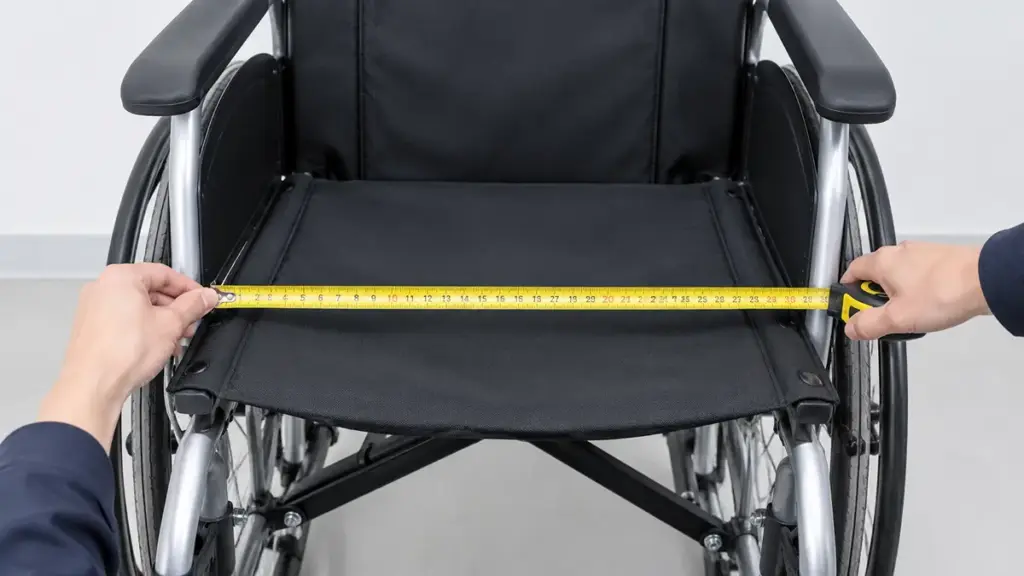
Measure the mattress sleep surface directly, not the bed frame. Use a rigid steel tape, lay the mattress flat, and check every number twice.
Key Dimensions and How to Measure Them
Three measurements define a hospital bed mattress size. Take all three directly from the mattress, not from the frame or from a spec sheet you have not verified:
- Length: run a tape measure straight down the centerline, from the head of the mattress to the foot. The industry standard is 80 inches; extended models run 84 或者 88 inches.
- 宽度: measure across the sleep surface from one side edge to the other. A typical adult hospital mattress is 36 inches wide—narrower than a residential Twin XL.
- Thickness: measure from the flat base to the highest point of the uncompressed surface. Do not press down on the foam. Standard medical mattresses are 6 到 7 inches thick; bariatric models commonly run 7 到 10 inches.
Ensuring an Accurate Fit
Before pulling out the tape measure, identify the bed type. A standard adult bed, a bariatric model, and a home-care bed all carry different mattress requirements, and misidentifying the frame is the single most common source of ordering errors.
For the most reliable numbers, lay the mattress completely flat on the bed deck. Use a rigid steel tape measure, not a flexible sewing tape, and take each measurement twice. Round numbers to the nearest half inch and record them on the purchase requisition—do not rely on memory or on a vendor’s “standard size” claim.
Correct sizing drives more than safety. It also determines whether fitted sheets, incontinence pads, and therapeutic overlays stay in place during articulation. An ill-fitting mattress shifts under the linens, which increases nursing workload and creates additional skin-shear risk for the patient.
One additional check that most buyers skip: measure the mattress in the compressed state, not only in the uncompressed state. Foam and air surfaces behave very differently under a patient’s weight. A mattress that reads 6 inches uncompressed may compress to 4.5 inches under a 200-lb load, which changes the effective rail height and the Zone 3 and Zone 4 gap dimensions. If the manufacturer does not publish compressed-state data, request it before signing the purchase order.
Matching Mattresses to Bed Frames
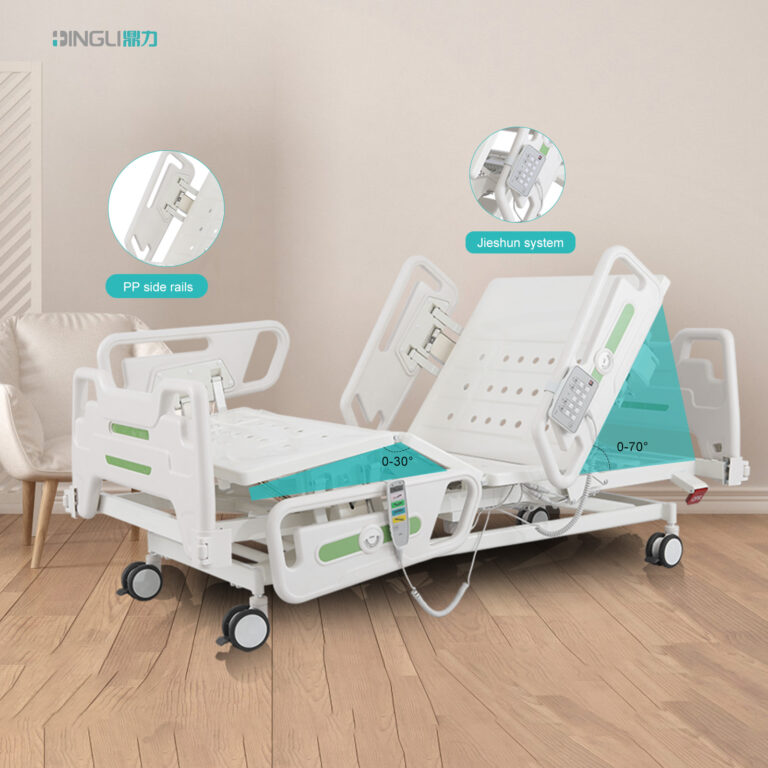
Match the mattress to the bed’s internal sleep deck, not the outer frame. Verify width, length, thickness, and articulation behavior before you sign the PO.
Common Mattress Dimensions by Bed Type
The table below summarizes the most common hospital bed mattress sizes by bed type. Use it as a planning reference; always confirm against the specific bed frame’s specification sheet before ordering.
| Bed Type | 宽度 × Length | Typical Thickness | Common Use Case |
|---|---|---|---|
| Standard Adult Hospital Bed | 36 in × 80 in | 6–7 in (150–180 毫米) | General adult inpatient and home care |
| Wide / ICU Hospital Bed | 39–42 in × 80 in | 6–8 in (150–200 毫米) | Higher-acuity adult care, lines and turning space |
| Bariatric Hospital Bed | 48–54 in × 80 in | 7–10 in (180–250 毫米) | Patients above 350 lb (160 千克) working load |
| Extended-Length Hospital Bed | 36–42 in × 84–88 in | 6–8 in (150–200 毫米) | Patients taller than 6 ft (183 厘米) |
| Pediatric Bed | 30–33 in × 62–72 in | 5–6 in (125–150 毫米) | Children and smaller adolescents |
How to Verify a Correct Fit
A proper fit is essential for both patient safety and bed functionality. Run the following checks every time a mattress is specified, sampled, or received:
- Measure the internal sleep deck. Ignore the outer frame’s overall width and length. The deck is the surface the mattress actually rests on, and it is the only dimension that matters for fit.
- Check the manufacturer’s maximum mattress thickness. Exceeding it reduces effective rail height below the 220 mm required by IEC 60601-2-52 and creates a fall hazard.
- Confirm articulation behavior. The mattress must flex with the head and knee sections without buckling, bridging, or pulling away from the deck. A rigid mattress fights the frame and can damage the motors.
- Run compressed-state gap checks. Measure Zones 3 and 4 with the mattress under load, not empty. Full dimensional test methods for all seven entrapment zones are published in Health Canada’s Adult Hospital Beds guidance, jointly developed with the U.S. FDA Hospital Bed Safety Workgroup.
Two additional verification steps separate a professional sourcing process from a casual reorder. 第一的, run an articulation cycle test: raise the head section to 60 度, then the knee section to 45 度, and observe whether the mattress tracks the deck or bridges across the hinge. Second, if the bed includes a CPR release function, verify that the mattress firms adequately when the release is activated—a soft, highly absorbent surface can reduce effective chest-compression depth during resuscitation.
Common Compatibility Problems to Avoid
Mismatched Mattress Dimensions and Bed Frame
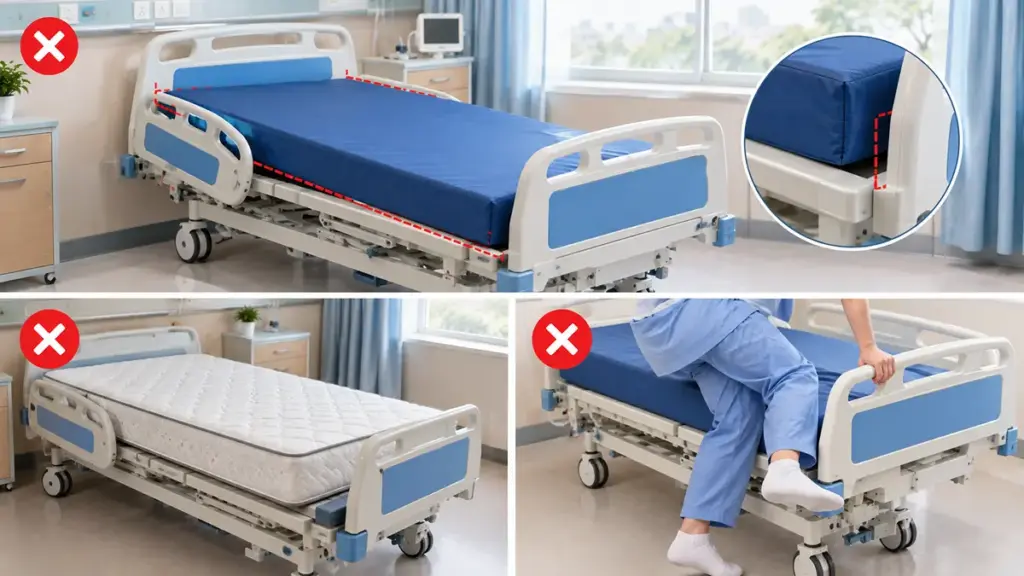
The most common error is a dimensional mismatch. A standard hospital bed frame is built for a 36-inch wide by 80-inch long mattress; any deviation creates a predictable failure:
- Too wide (例如, a 38-inch residential Twin XL): the mattress bunches against the side rails, prevents the rails from locking properly, and can strain the articulation motors.
- Too narrow: gaps open between the mattress edge and the rail. This is the primary mechanical cause of patient entrapment in Zones 3 and 4.
- Too thick (10- or 12-inch residential mattresses): effective side-rail height drops below the 220 mm minimum, and the bed’s exit height rises, making transfers more difficult and increasing fall risk.
- Too short: heels overhang the foot of the mattress, which is a documented pressure-injury risk factor for immobilized patients.
Using Non-Medical Mattresses and Ignoring Safety Rules
Placing a regular consumer mattress on a hospital bed creates three distinct problems:
Mechanical. Consumer mattresses are built to sit on a flat, rigid foundation. They do not bend. When the head or knee section of a hospital bed articulates, a rigid consumer mattress buckles, bridges across the hinge, or fights the motors—compromising the bed’s therapeutic positioning functions and shortening the frame’s service life.
卫生. Consumer mattresses use fabric covers that absorb fluids. They cannot be wiped down or disinfected to clinical standards, which creates a serious infection-control risk in any patient-care setting. Medical mattresses use fluid-proof, wipeable covers for exactly this reason.
Regulatory. A non-medical mattress on a certified hospital bed puts the entire system outside its approved configuration. Gap dimensions typically violate entrapment-prevention guidance, and effective rail height falls below the IEC 60601-2-52 minimum. For a step-by-step verification protocol, see our companion guide on hospital bed mattress compatibility checks.
Documentation is the fourth problem, and the one that surfaces during an audit. A certified hospital bed is approved as a system: frame, 床垫, and side rails tested together. Substituting a non-specified mattress voids that system-level certification, even if the mattress itself is a medical device. Facilities that allow this substitution typically discover it during a regulatory inspection or after a sentinel event, not during routine procurement.
常见问题解答
What is the standard size of a hospital bed mattress?
The standard adult hospital bed mattress size is 36 inches wide by 80 inches long, with a typical thickness of 6 inches (sometimes 7). The length matches a consumer Twin XL, but the 36-inch width is two inches narrower—a clinical standard that preserves caregiver access and side-rail geometry.
Are all hospital bed mattresses the same size?
不. The 36 × 80 inch mattress is the adult baseline, but hospital bed mattress sizes span a range: 39–42 inches wide for ICU and higher-acuity care, 48–54 inches wide for bariatric patients, 84–88 inches long for taller patients, and 30–33 inches wide by 62–72 inches long for pediatric beds. Always size against the specific bed frame’s internal sleep deck.
How thick should a hospital bed mattress be?
A standard adult hospital mattress is typically 6 inches thick, with most models ranging from 4 到 8 inches. Bariatric and advanced pressure-relief surfaces commonly run 7 到 10 inches. Before accepting a thicker mattress, verify that the resulting effective rail height still meets the 220 mm minimum in IEC 60601-2-52.
Can you use a regular mattress on a hospital bed?
不. Regular consumer mattresses are too thick, do not bend with the adjustable frame, and lack the fluid-proof covers required for clinical hygiene. Using one on a hospital bed creates dangerous gaps at the side rails, reduces effective rail height below the IEC 60601-2-52 minimum, and puts the entire bed system outside its certified configuration.
What should distributors verify before bulk-ordering replacement mattresses?
Confirm four items before signing the PO: (1) dimensional match against the target bed frame’s spec sheet, not a generic size chart; (2) rail-interface compatibility, including effective rail height after compression; (3) cover material rating for the destination market’s common disinfectants; and (4) the manufacturer’s certifications (国际标准化组织 13485, CE, and FDA registration where applicable) plus a signed sample approval. Request an AQL pre-shipment inspection clause and a written specification-freeze document.
最后的想法
Getting hospital bed mattress size right is a risk-management decision, not a price decision. A single entrapment incident or a fall from compromised side rails carries liability that far outweighs any per-unit savings from a generic substitute. Matching the mattress to the bed’s internal sleep deck—and verifying thickness against IEC 60601-2-52 rail-height requirements—is the first line of defense.
For distributors and facility procurement teams, the sourcing path is straightforward: request the bed frame specification sheet, sample on the actual bed model, run compressed-state gap checks at Zones 3 and 4, and freeze the specification in writing before bulk production. Send us your bed frame models and target-market requirements; our engineering team returns the exact mattress dimensions, cover options, and rail-interface drawings you need to place a compliant, factory-direct order.