Sourcing hospital beds without a structured Request for Quotation (Solicitud de cotización) leaves you comparing hospital bed quotation documents that don’t actually describe the same product. Bids come back with different functions, build qualities, and service terms, so a straight price comparison hides clinical mismatches and lifecycle costs.
This guide gives procurement teams, biomedical engineers, and B2B distributors a working framework for preparing a detailed hospital bed quotation request and normalizing the offers that come back. It covers technical specifications such as safe working load (SWL) and IEC 60601-2-52 cumplimiento, alongside commercial terms like warranty, capacitación, Incoterms, and payment milestones.
What Belongs in a Hospital Bed Quotation RFQ?
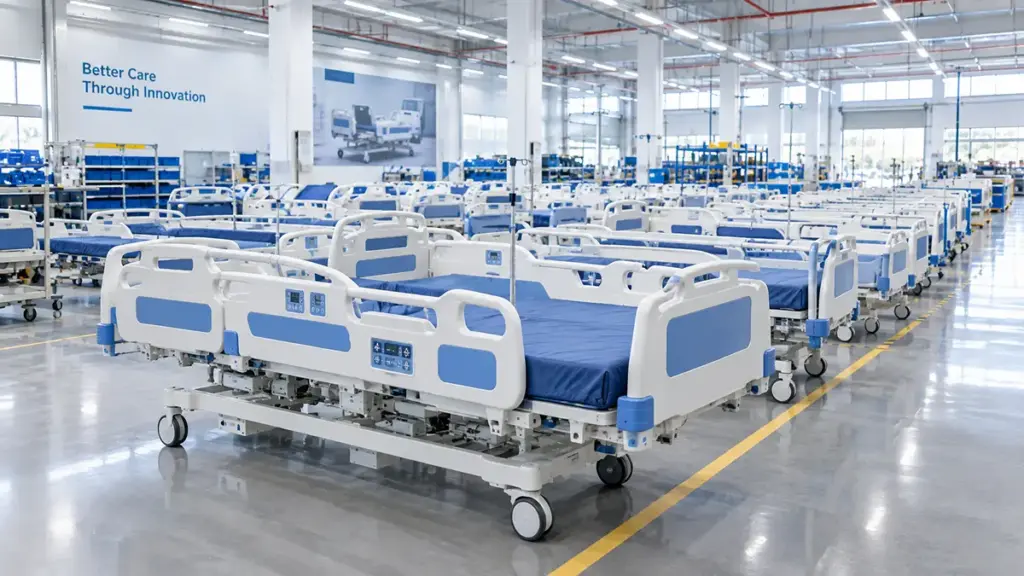
A strong RFQ pins down two areas in writing: the technical specification of the bed and the commercial terms around service, pricing, and submission. Anything left open becomes a source of variation between bids.
Effective conversations with hospital bed suppliers start from a written requirement set, not a verbal brief. Define needs upfront and every bidder quotes against the same scope, which is what makes a hospital bed quotation comparable in the first place.
Clinical, Functional, and Regulatory Requirements
Before you review a single catalog, specify what the bed has to do, for whom, and against which standards. Vague requests here are the main reason quotes come back mismatched.
- Care setting and patient group: state whether the bed serves ICU, general ward, cuidado a largo plazo, maternity, pediátrico, or bariatric patients.
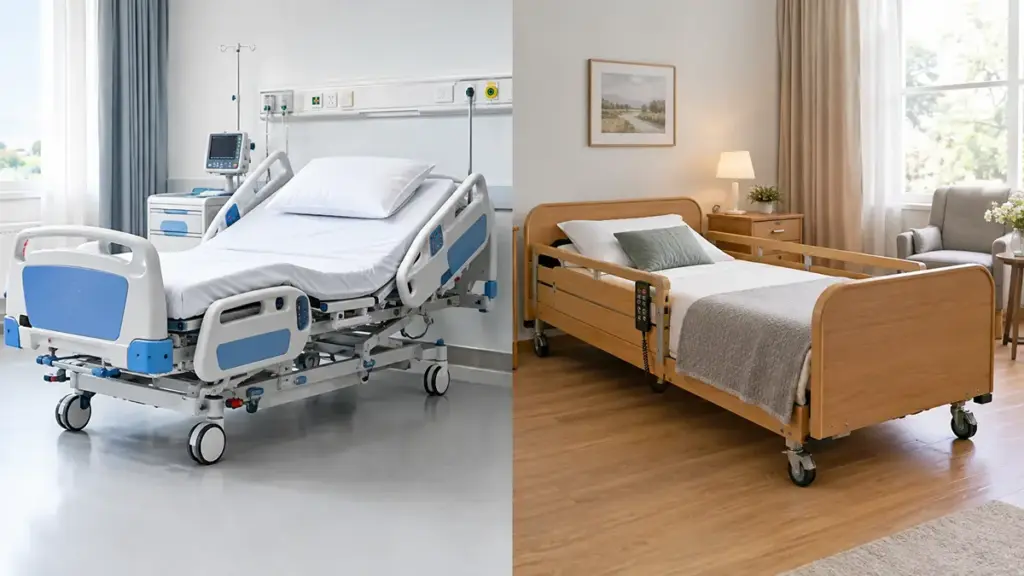
- Bed type and drive mechanism: manual, semi-electric, or fully electric, with the required movements such as height adjustment, backrest and knee articulation, Trendelenburg and Reverse Trendelenburg, and a CPR release.
- Safe working load (SWL): a numeric rating covering patient, colchón, and accessories. Standard adult beds are typically rated around 250 kilos; bariatric models are rated higher, depending on the manufacturer.
- Dimensions and materials: platform length and width, height adjustment range, frame material and coating, and mattress platform type (Por ejemplo, perforated steel or ABS sections).
- Safety and side-rail requirements: rail type, entrapment-zone compliance, and reference to IEC 60601-2-52, the international safety standard for medical beds. See our companion guide on the seven hospital bed entrapment zones for zone-by-zone measurement.
- Certifications for the destination market: CE marking for Europe, FDA establishment registration and device listing for the United States, ISO 13485 for medical device quality management, and any country-specific licenses. Regulatory expectations for hospital beds in the US market are published by the FDA hospital beds guidance.
- Cleaning and infection control: confirm that all patient-contact surfaces tolerate the disinfectants your facility uses, at the concentrations your protocols specify.
- Accessories and interoperability: list IV poles, barandillas laterales, mattress type, nurse-call interfaces, and any patient-lift compatibility required.
Commercial, Servicio, and Submission Terms
The product is only half of the RFQ. The other half defines the commercial relationship and how bidders must respond, which is what allows an otherwise mismatched set of offers to be evaluated fairly.
- Warranty and service level: minimum warranty period for frame, motores, y electrónica, plus post-warranty service availability and a target response time for critical repairs.
- Itemized pricing: instruct bidders to separate base bed, accesorios, colchón, installation, on-site training, and any ongoing service contracts, so hidden costs don’t disappear into a lump sum.
- Training and documentation: scope of training for clinical users and biomedical staff, plus user manuals and service manuals in the destination language.
- Bidder qualifications: minimum criteria such as ISO 13485 certification, relevant project references, and evidence of comparable hospital deployments.
- Submission format and deadline: separate technical and commercial proposals, defined file formats, and a firm submission deadline.
- Embalaje, Incoterms, and delivery: target Incoterm (Por ejemplo, DAP or CIF) with the named place and version, packaging requirements, and delivery schedule.
How to List Bed Types, Functions, and Quantities
Inside the RFQ, structure each line item so a bidder can’t misread it. Start every line with the clinical type and drive mechanism (Por ejemplo, “Electric ICU Bed” o “Manual General Ward Bed”), then attach a specification block with the minimum data set below.
- Intended use: “for adult ICU,” “for general medical ward,” and so on.
- Safe working load: a numeric rating, Por ejemplo 250 kilos.
- Dimensiones: platform length × width and height adjustment range.
- Movement ranges: respaldo, knee rest, and Trendelenburg angles.
- Safety features: side rail type, brake system, and CPR function.
- Controls: handset, embedded panel, nurse lockout.
- Materials and finish: frame material, panel material, coating, and disinfectant compatibility.
- Accessory interfaces: provisions for IV poles, drainage bag holders, and similar items.
- Warranty and service: coverage period and what it includes.
For multi-ward orders, break quantities down by delivery location (Por ejemplo, “ICU Ward A: 10 units; Surgical Ward B: 40 units”) and keep beds and accessories on separate line items. This is what allows procurement teams to compare offers on scope rather than on a lump-sum number.
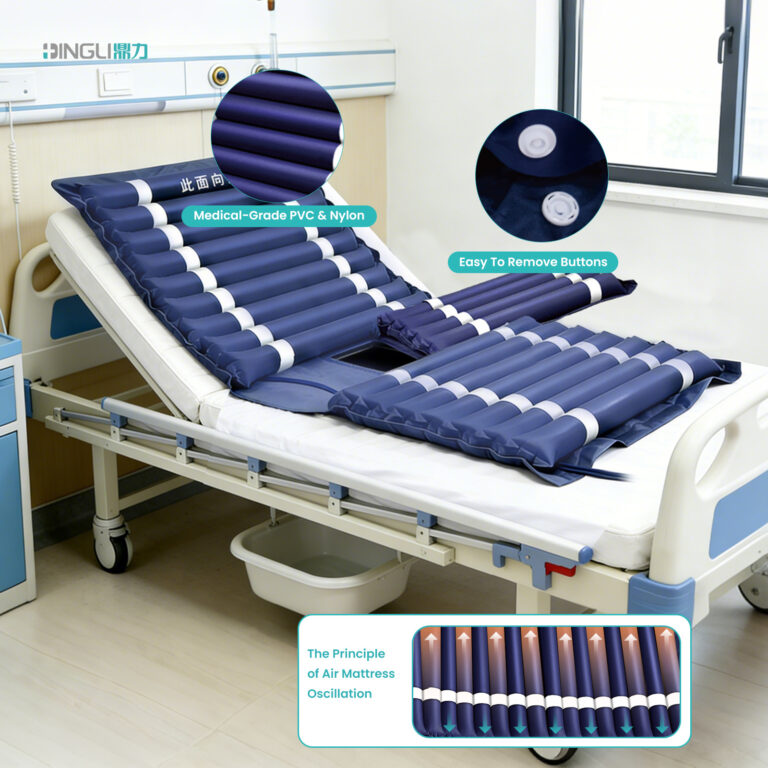
Which Accessories and Spare Parts Should Be Priced Separately?
A bed’s base price normally covers the frame and standard functions. Any item that adds capability, or that is needed for repair, is typically a separate line item on the quotation.
Suppliers price accessories and spare parts separately because every facility configures beds differently. Modular pricing lets you equip an ICU differently from a general ward without paying for features you won’t use, and it makes maintenance budgeting predictable across the fleet.
On the accessory side, expect separate line items for anything beyond the base configuration: specialty side rails, patient assist or trapeze bars, therapeutic mattresses and pressure-relief overlays, overbed tables, patient hand pendants, and attendant control panels. On the spare-parts side, wear items such as casters, brake mechanisms, and lift motors are typically priced individually, as are electronic modules like control boards, user interface panels, and sensor units. Structural and cosmetic parts—headboards, footboards, side-rail assemblies—are also ordered separately.
For a full breakdown of accessory categories, compatibility checks, and how to verify a spare part before ordering, see our companion guide on hospital bed accessories and spare parts compatibility. The rest of this article focuses on the RFQ and quotation side.
What Documentation Should the Supplier Confirm?
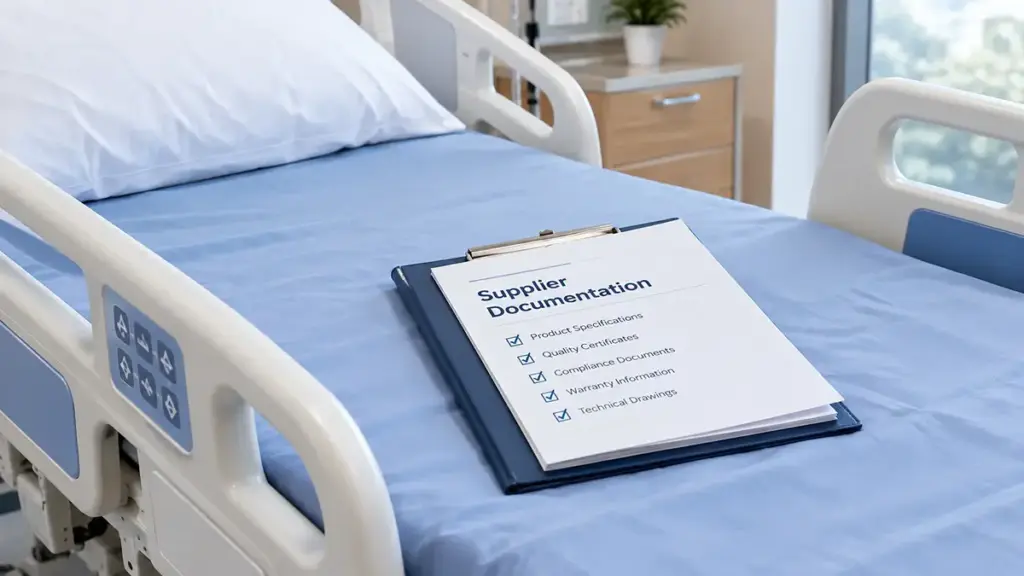
A supplier should provide a complete paper trail proving regulatory compliance, technical safety, and traceable records for every bed model and delivered batch.
A professional hospital bed supplier has a complete, traceable documentation set ready for review. This isn’t about ticking boxes; it’s the evidence that the bed is a legitimate medical device and can be supported through its lifecycle. Verify the paperwork before signing.
Compliance and Technical Files
This is the core evidence pack. If a supplier can’t produce it, treat that as a red flag.
- Regulatory and quality certificates: a valid ISO 13485 certificate, a CE Declaration of Conformity referencing IEC 60601-2-52 for the EU, FDA establishment registration and device listing for the US market, and any country-specific licenses.
- Technical file: detailed specifications, design drawings, material lists, manufacturing processes, and a Risk Management File per ISO 14971 covering hazards such as entrapment, falls, and electrical shock.
- Third-party test reports: accredited lab reports for electrical safety (IEC 60601-1), mechanical strength, and stability. A self-declaration alone is not sufficient evidence for most regulated markets.
- Batch-level QC records: final inspection reports tied to specific serial numbers for each shipment, so every bed can be traced back to its production batch.
- User and service manuals: Instructions for Use (IFU), service manuals, and label artwork for the destination market, in the local language.
Transactional and Service Records
These documents cover the commercial relationship from purchase through long-term support.
- Compliance matrix and scope of supply: a clause-by-clause confirmation that the bid meets every technical requirement in the RFQ, plus an itemized list of what’s included—bed, accesorios, colchón, installation, capacitación.
- Warranty and preventive maintenance: explicit warranty terms for frame, motores, y electrónica; a recommended preventive maintenance schedule; and a priced list of critical spare parts, so a low initial bid doesn’t turn into expensive, hard-to-source parts later.
- Traceability and vigilance: internal records linking every bed’s serial number to its manufacturing batch and QC reports, plus a documented process for logging and investigating complaints or adverse events.
How Should Packaging, Incoterms, Payment, and Delivery Be Stated?
State packaging, delivery, Incoterms, and payment terms as linked clauses. Specificity here is what prevents disputes and allocates risk clearly between buyer and supplier.
Physical Logistics: Packaging and Delivery
The contract needs to specify how the beds get from the factory to your facility. Ambiguity here leads to damaged goods, delays, and disputes. Packaging has to protect the product so it arrives undamaged, clean, and ready for clinical use, and it must comply with medical device labeling rules, including any required Unique Device Identification (UDI) markings.
Delivery terms should nail down:
- The exact delivery location, whether a warehouse loading dock or a specific hospital ward.
- The delivery timeframe, typically expressed as a number of days after purchase order confirmation.
- A detailed delivery note with each shipment as proof of what was sent.
- Whether partial deliveries are allowed, and the inspection and acceptance process on arrival.
Packaging cost is normally included in the unit price. Confirm this in writing so it aligns with the agreed commercial terms.
Commercial Terms: Incoterms and Payment
Commercial terms are where cost and risk transfer between you and the supplier. Be specific with the Incoterm—don’t just write “DAP.” State the full term, its version, and the named place, Por ejemplo: DAP Central Hospital Warehouse, [City] — Incoterms 2020. The chosen Incoterm assigns responsibility for transport and insurance, defines where risk of loss transfers, and allocates export and import customs clearance.
Payment terms need the same precision. Specify the method (bank transfer or letter of credit), the currency, and a milestone schedule. A common structure is an advance payment to start production, a second payment against shipping documents, and a final payment after delivery and inspection. Linking payment triggers to delivery events and the chosen Incoterm keeps the contract internally consistent.
Why Do Hospital Bed Quotations Differ So Much?
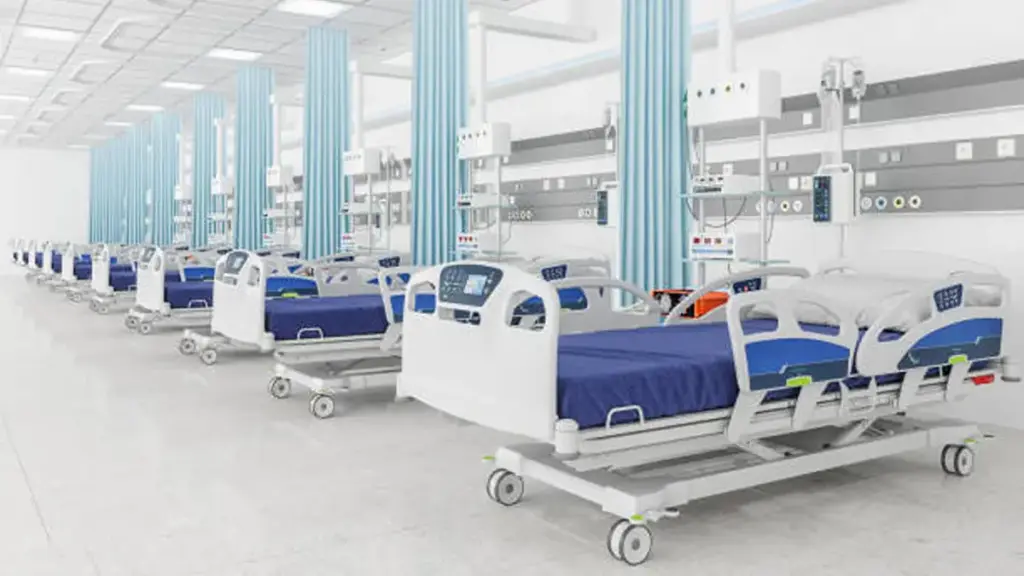
Two quotations that look comparable on the surface can describe entirely different classes of bed. Most price variation traces back to specifications, inclusions, and build quality.
Core Product Specifications and Build Quality
- Bed type and automation: a basic manual bed with hand cranks sits at the low end of the range; a semi-electric model costs more; a fully electric med-surg or ICU bed with integrated scales and monitoring interfaces can cost several times more again. Camas bariátricas, with reinforced frames and higher SWL, sit at the top of the range.
- Functions and positioning: the number of functions matters. A simple 2-function bed (backrest and knee break) is far cheaper than a 5- or 7-function ICU bed with Trendelenburg, Reverse Trendelenburg, a wider height range, and auto-contouring. Higher SWL ratings also require stronger materials and more robust motors.
- Build quality and manufacturer credentials: heavy-gauge powder-coated steel frames, high-spec casters, and full regulatory documentation cost more to produce than lighter-duty alternatives. Quotes from established, ISO-certified manufacturers with CE or FDA compliance carry a premium that reflects testing, documentation, and proven reliability.
Inclusions, Servicios, and Commercial Terms
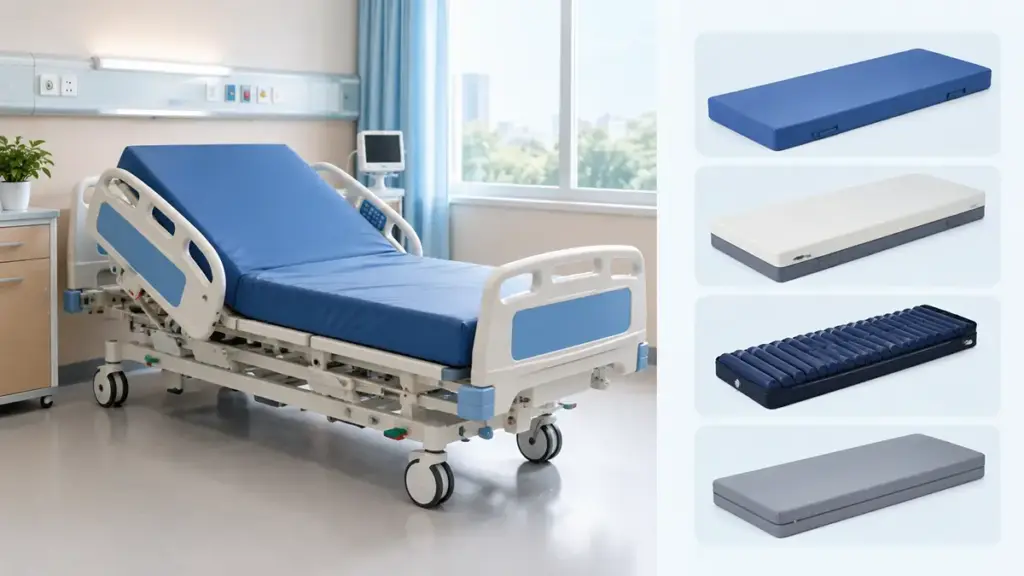
- Bundled accessories: a quote for a bare frame is not comparable to one that includes a mattress, barandillas laterales, and an IV pole. Accessory grade matters too—a basic foam mattress is inexpensive, but an advanced pressure-redistribution surface can add significantly to the per-bed cost.
- Warranty and service: a short parts-only warranty sits at a different price point from a multi-year comprehensive warranty covering parts and on-site labor. Bundled preventive maintenance contracts, annual safety inspections, and user training raise the initial price but can lower total cost of ownership.
- Order size and sales channel: unit pricing is sensitive to volume. A tender to outfit an entire hospital attracts different pricing from a single-bed order. A local distributor’s quote includes margin for regional stocking and service; a manufacturer-direct quote may be lower on hardware but requires you to arrange local support.
Without a standardized scope, buyers end up comparing numbers, not value.
How Can Hospital Bed Quotations Be Compared on the Same Scope?
Normalize every bid to an identical technical, commercial, and service scope first. Only then can total cost be evaluated objectively.
Establish a Common Baseline for All Bids
Create a single reference specification that every supplier must quote against. Substitutions should only be considered as formal alternatives, not as silent swaps. The table below is the normalization checklist we recommend attaching to the RFQ.
| Dimension | What to Normalize Across Every Bid |
|---|---|
| Technical | SWL, deck dimensions, movement angles (respaldo, knee, Trendelenburg), drive type, safety features (liberación de RCP, entrapment controls), frame material, coating, and platform construction. |
| Commercial | Delivery terms (Incoterm, named place, version), installation and commissioning, on-site user training. If a bid excludes any of these, add an internal cost estimate before comparison. |
| Lifecycle | Warranty length and coverage, target service response time, spare-parts availability window, and an itemized price list for critical spares such as casters, actuadores, and control boards. |
Apply a Structured Evaluation Model
Once all bids are normalized, use a documented evaluation process rather than a price-only ranking.
- Two-stage screening: first, screen every bid against the mandatory baseline. Any offer that fails a required specification is disqualified before commercial scoring begins.
- Weighted scoring: for compliant bids, apply a weighted model. A common structure gives most of the weight to technical score (clinical fit, durabilidad, service capability) and the remainder to financial score, with the lowest-priced compliant bid taking full financial marks and others scored proportionally.
- Ward trials: shortlist the top two or three bidders and run ward trials. Feedback from nurses, porters, and biomedical engineers on maneuverability, cleaning, and day-to-day usability belongs in the technical score.
- Total cost of ownership (costo total de propiedad): add projected maintenance, spare parts, and downtime costs over the bed’s expected service life to the initial purchase price. A cheaper bed with expensive parts or poor reliability often costs more over time.
From RFQ to Bulk Delivery: Un camino de adquisiciones de cinco pasos
Para mayoristas, distribuidores, and facility procurement teams, a controlled path from RFQ to delivery prevents scope drift and keeps every unit inside the certified configuration:
- RFQ and sample request. Issue the RFQ with the frozen reference specification and request a sample unit for evaluation on your own ward or in your own warehouse.
- Sample approval. Install the sample, run functional and safety checks (including compressed-state gap checks where relevant), and confirm the documentation set is complete.
- Specification freeze. Lock configuration, materiales, voltaje y tipo de enchufe, etiquetado, tolerances, and packaging in a written spec sheet signed by both parties.
- Pre-shipment inspection. Verify production units against the frozen spec and the approved sample using AQL sampling and, donde se aplica, load and functional checks.
- Delivery and after-sales. Confirm warranty activation, spare-parts availability, y ventanas de respuesta de soporte técnico ante los buques portacontenedores..
Preguntas frecuentes
What information is needed for a hospital bed quotation?
A supplier needs the clinical setting (ICU, general ward, pediátrico, cuidado a largo plazo), the required functions and drive type, technical specs such as SWL, dimensions, and safety features, plus the destination market’s certifications. Add quantity, delivery terms, and expected warranty coverage. The more specific the input, the tighter the quotation.
How can quotations from different hospital bed suppliers be compared effectively?
First, screen every bid against your mandatory technical and safety baseline; anything non-compliant is out. Then calculate total cost of ownership, not just purchase price, including maintenance, spare parts, and service contracts. Where possible, run ward trials and use a weighted scoring model that separates technical fit from commercial price.
Can different models of hospital beds be ordered together?
Yes. Most manufacturers support mixed-model orders, and this is common when a distributor or wholesaler is outfitting several departments at once or filling a mixed container. Confirm the supplier’s minimum order quantity per model, and verify that shared accessories such as mattresses and side rails are compatible across the models you’re combining.
What documents should a hospital bed supplier provide with a purchase?
Expect a Declaration of Conformity, quality certifications such as ISO 13485, third-party test reports for IEC 60601-1 and IEC 60601-2-52, batch-level QC records tied to serial numbers, user and service manuals in the local language, an itemized scope of supply, and the warranty certificate. For US-bound shipments, FDA establishment registration and device listing should also be verifiable.
Pensamientos finales
A low hospital bed quotation often signals hidden risk in build quality, regulatory compliance, or long-term service. The RFQ process isn’t paperwork for its own sake—it’s the mechanism that separates professional manufacturers from traders, and it protects your budget against premature failures and lifecycle costs you didn’t price in.
Whether you’re a hospital procurement lead outfitting a single ward or a distributor planning a mixed-container order, the same logic applies: define scope, normalize bids, and evaluate against total cost of ownership. Dingli Medical supports both audiences with OEM/ODM manufacturing, low-MOQ trial orders, and 40HQ mixed-container supply. Send us your specification and target market; our team returns a documented, factory-direct quotation aligned to your RFQ.