Choosing incorrectly between hospital beds vs nursing home beds creates significant liability. A decision based on appearance instead of function invites regulatory penalties and higher operational costs from patient falls. The bed’s core purpose—acute intervention or long-term care—dictates every design choice, from motor duty cycles to side-rail configuration.
This analysis benchmarks the key engineering differences that matter to procurement teams. We compare the clinical necessity of Trendelenburg positioning in hospital beds against the critical safety function of hi-lo height adjustment in nursing home beds. These specifications determine which model meets your facility’s care and regulatory standards—and which one will still perform reliably five years from now.
Hospital Beds vs Nursing Home Beds Explained
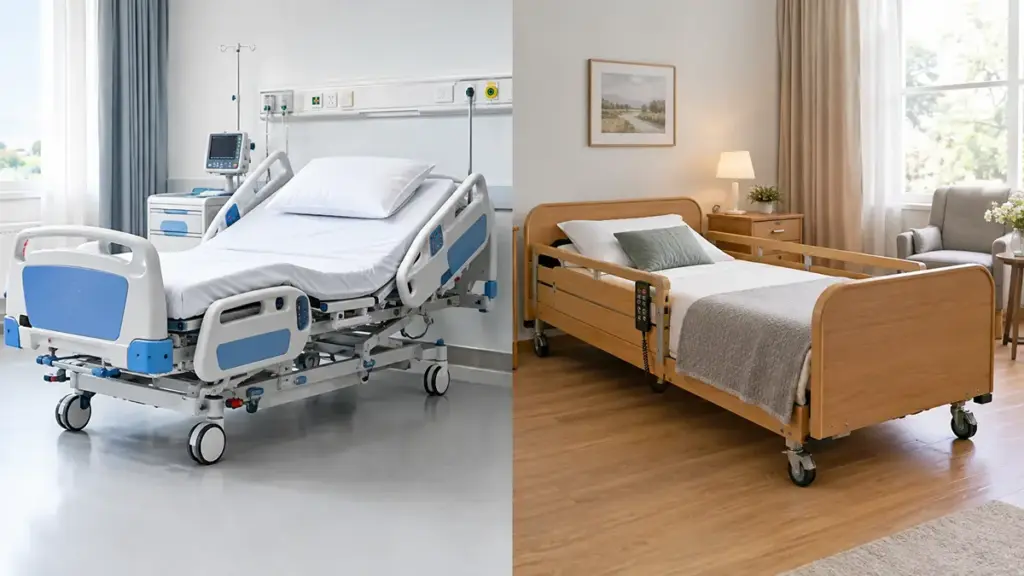
Hospital beds are built for short-term, intense medical treatment. Nursing home beds prioritize long-term residential comfort, safety, and daily support.
Designed for Medical Treatment and Recovery
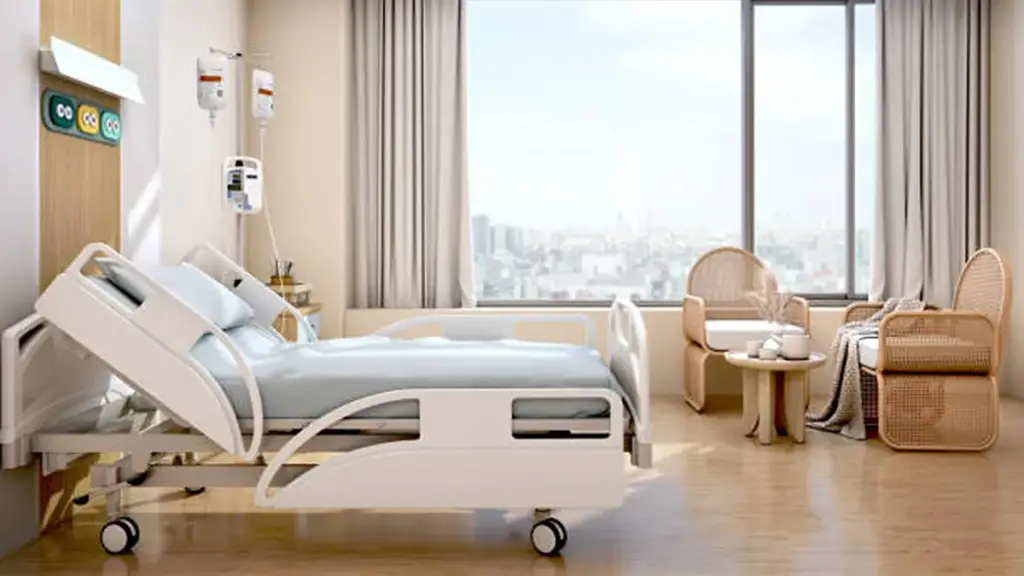
A hospital bed is a piece of technical medical equipment classified under FDA Class II (product code FRO, “Bed, Fixed, Powered”). Its purpose is to support patients during short, high-intensity episodes of care—surgery recovery, acute illness, or trauma stabilization. Stays are usually measured in days or weeks, not years. The entire design prioritizes clinical function and rapid intervention over patient comfort or aesthetics.
These beds are built for a fast-paced medical environment. They have features for frequent repositioning, emergency responses, and easy access for clinicians. You will find functions like Trendelenburg and Reverse Trendelenburg positioning, integrated scales for continuous weight monitoring, CPR release levers that flatten the bed in under 5 seconds, and mounts for IV poles and patient monitors. The construction is robust enough to handle frequent transport between hospital departments and aggressive terminal disinfection between patients.
The care model around a hospital bed is medically intensive. It involves physicians, specialists, and higher nurse-to-patient ratios, all focused on active treatment to cure or stabilize a condition. Regulation reflects this intensity: hospitals must demonstrate that every bed meets electrical safety standards (IEC 60601-1), electromagnetic compatibility (IEC 60601-1-2), and performance requirements specific to powered beds (IEC 60601-2-38). Non-compliance is not an option when patient acuity is high.
Built for Long-Term Care and Daily Support
A nursing home bed is designed for a fundamentally different purpose: long-term residence. People who use these beds often have chronic conditions—dementia, limited mobility, post-stroke recovery—and need ongoing nursing support, but not constant intensive medical treatment. They may live in the facility for months or years, making the bed their primary living space.
The design focuses on three priorities: long-term comfort, fall prevention, and creating a home-like environment. The most critical feature is a “hi-lo” or “low bed” function, which allows the sleeping surface to descend to within 20–25 cm of the floor. This significantly reduces the risk of injury from falls—the single most reported adverse event in long-term care facilities. These beds often feature wood-grain headboards and footboards to reduce the institutional feel. While adjustable, the controls are simpler and geared toward daily activities like sitting up for meals or watching television.
The staffing and regulatory environment also differs substantially. Care is focused on assisting with activities of daily living (ADLs), managing chronic conditions, and ensuring quality of life. Regulations in long-term care emphasize resident rights and the minimization of physical restraints—which is why side rails are often optional and used only after a documented, resident-specific risk assessment. For a detailed guide on selecting the right home care bed for elderly residents, see our companion article covering mobility, fall risk, and caregiver workflow.
Key Differences in Bed Functions and Design
The core purpose dictates every design choice: hospital beds are clinical tools for acute intervention, while nursing home beds are residential furniture optimized for safety and comfort.
| Feature | Hospital Bed | Nursing Home Bed |
|---|---|---|
| Primary Use | Short-term acute care (days–weeks) | Long-term residential care (months–years) |
| Key Positioning | Trendelenburg, Reverse Trendelenburg, CPR release | Hi-lo height adjustment (ultra-low to floor level) |
| Side Rails | Full-length integrated, with bed-exit alarm connectivity | Optional/assist rails; restraint-minimization policies apply |
| Controls | Clinician-focused panels with patient lockout | Simple resident-friendly handsets |
| Aesthetics | Clinical metal, powder-coated steel, easy to disinfect | Wood-grain headboards, residential appearance |
| Typical Service Life | 8–15 years (ICU beds shorter due to intensity) | 7–15 years (continuous occupancy stress) |
For facilities evaluating their options, electric hospital beds from Dingli are available in three-function, five-function, and ICU configurations—each with Trendelenburg capability and CPR release as standard. Nursing home and home care models prioritize the hi-lo range and residential aesthetics without compromising structural durability.
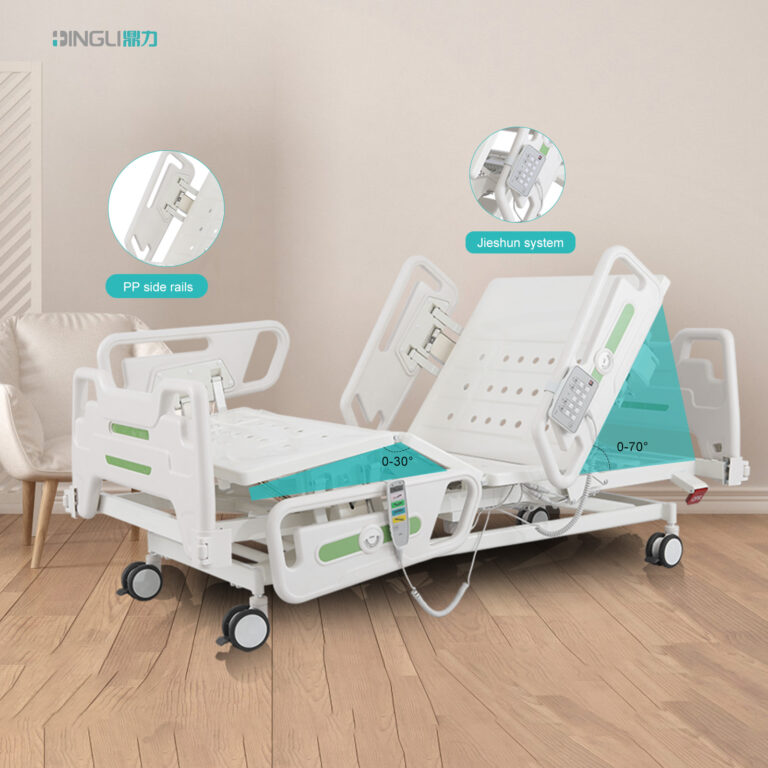
Safety and Positioning Features Compared
Hospital bed safety supports rapid clinical intervention. Long-term care bed safety prioritizes routine fall prevention and resident autonomy over extended stays.
Hospital Beds: Supporting Acute Interventions and Rapid Recovery
In an acute care setting, bed safety means supporting clinical teams and managing unstable patients through high-intensity, short-duration episodes. Every feature exists to enable faster response:
- Wide height range (25–80 cm): Allows both optimal caregiver access during procedures and ultra-low settings to reduce fall severity when patients attempt unassisted exits.
- Advanced articulation: Trendelenburg (head-down tilt) supports post-surgical drainage and hypotension management. Reverse Trendelenburg aids respiratory function in ventilated patients. These positions are clinical necessities, not comfort features.
- Integrated bed-exit alarms: Side rails connect directly to the facility’s nurse call system. When a patient attempts to exit, staff receive an alert within seconds—critical for fall-risk patients in high-acuity units.
- CPR release mechanism: A single lever flattens the entire bed surface to enable chest compressions without transferring the patient. Response time target: under 5 seconds from decision to flat surface.
Long-Term Care Beds: Prioritizing Routine Safety and Resident Autonomy
For long-term care, safety priorities shift from acute intervention to daily well-being over months or years. The design philosophy centers on balancing protection with independence:
- Ultra-low height as primary safety feature: Beds descend to 20–25 cm from the floor, reducing fall injury severity by over 50% compared to standard height. Residents can still transfer independently with minimal risk.
- Smoother, quieter articulation: Motors are engineered for low-noise operation (<45 dB) to avoid disturbing sleep during routine repositioning for pressure injury prevention.
- Restraint-minimization approach: Non-rail alternatives like low bed heights, floor mats, and sensor-based monitoring are emphasized. Full side rails are used only after documented assessment, as they can constitute physical restraint under LTC regulations.
- Entrapment risk management: Even in LTC settings, gap compliance matters. The Health Canada Adult Hospital Beds guidance defines seven entrapment zones with strict dimensional limits that apply to both acute and long-term care beds.
Durability and Daily Use Requirements
Hospital beds endure intense short-term use and aggressive cleaning. Nursing home beds are engineered for continuous 24/7 occupancy and sustained stability over many years.
Acute Care: High-Frequency Adjustments and Aggressive Cleaning
Hospital beds are designed for a demanding duty cycle. In an acute care setting, a single bed may be adjusted 40–60 times per shift for examinations, repositioning, transfers, and emergency procedures. Electric motors are rated for this frequency—typically 10,000+ full-cycle operations before requiring service. Because patient turnover is high (average acute stay: 4–6 days), beds must endure terminal cleaning with hospital-grade disinfectants between every occupant.
This environment dictates material choices. Frames are welded, powder-coated steel with smooth continuous joints to prevent harboring pathogens and to withstand harsh chemicals. Surfaces must tolerate daily exposure to quaternary ammonium compounds, accelerated hydrogen peroxide, and bleach solutions without degrading:
- Powder-Coated Steel Frames: Chemical tolerance rated for 10+ years of daily disinfection cycles.
- Silicone Mattress Covers: Handle 10,000+ cleaning cycles; service life exceeds 10 years.
- Vinyl (PVC) Covers: Excellent bleach tolerance; 7–10 years of daily cleaning before replacement.
The expected service life for a fully electric hospital bed is typically 8 to 15 years, though ICU beds may require replacement sooner due to more intense use. Maintenance protocols are rigorous: daily functional checks by nursing staff, monthly mechanical inspections by biomedical engineering, and annual electrical safety certifications per IEC 60601-1.
Long-Term Care: Continuous Occupancy and Sustained Stability
A nursing home bed operates under different pressures. The challenge is not high turnover but continuous 24/7 occupancy by the same resident for months or years. Durability here means long-term structural integrity and a near-zero failure rate under constant static load. Frames are typically constructed from robust carbon steel tubing, engineered to prevent fatigue over a multi-year service life of 7 to 15 years.
The adjustment cycle is less frequent but no less important. Repositioning occurs on a schedule for pressure care—raising the head section for meals, adjusting height for safe transfers, and periodic lateral tilting for pressure redistribution. Motors are engineered for smooth, quiet, reliable operation over thousands of cycles rather than raw speed. While these beds are cleaned daily, they do not face the same terminal disinfection frequency as hospital beds between patient turnovers.
From a procurement perspective, total cost of ownership (TCO) differs significantly. Hospital beds have higher upfront costs but shorter depreciation cycles due to intense use. LTC beds cost less initially but require longer warranty coverage because they remain in service continuously. For facilities outfitting both acute and long-term care units, home care mobility solutions from a single supplier can simplify maintenance scheduling and spare-parts inventory.
Mattress and Accessory Compatibility
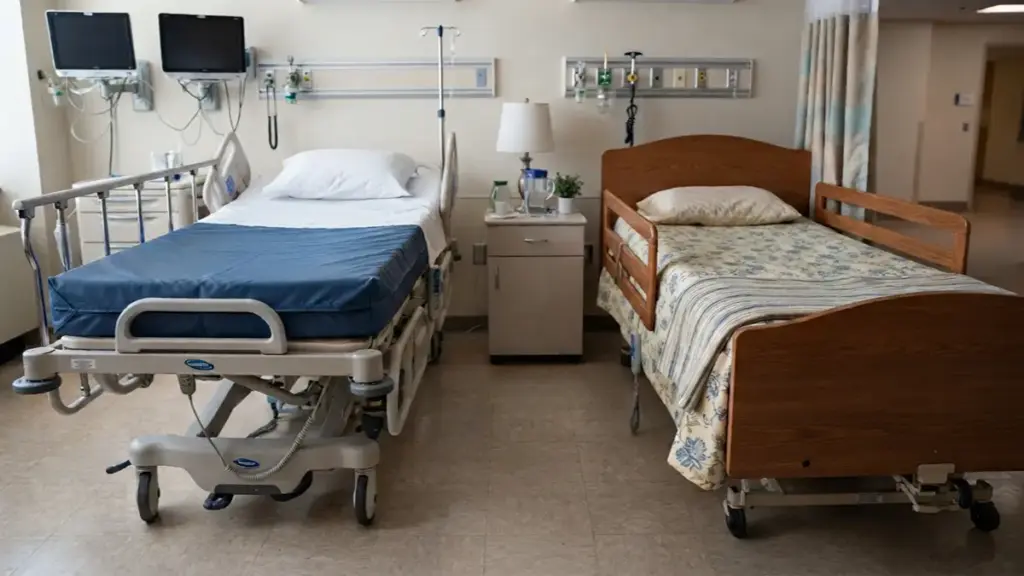
Compatibility is about the entire bed system—hospitals focus on technical compliance for acute risk, while LTC prioritizes long-term safety and resident comfort.
Hospital Bed System Compatibility
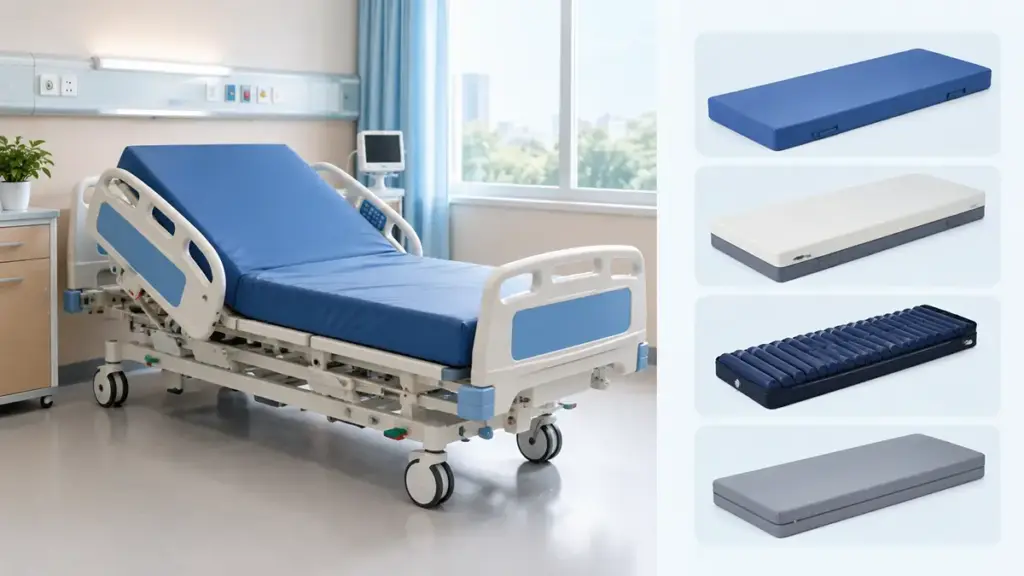
In a hospital, mattress and accessory compatibility is governed by strict technical standards designed to prevent immediate, acute harm—particularly patient entrapment. The entire bed system (frame, mattress, and rails) is treated as a single medical device, and every component substitution requires re-validation.
- IEC 60601-2-38 compliance: This standard sets mandatory limits for gaps between mattress and rails. Zone 3 must remain below 120 mm and Zone 4 below 60 mm under simulated patient load—measured with the mattress compressed, not empty.
- Overlay stacking rules: Adding specialty surfaces like alternating pressure pads cannot compromise rail effectiveness. An overlay that raises the mattress surface above the rail’s protective height creates a new entrapment hazard.
- Precision mattress sizing: Hospital mattresses require exact dimensional match to the frame—typically within 25 mm tolerance on all sides. Firm edge support prevents compression at rail contact points. For detailed sizing guidance, see our article on hospital bed mattress dimensions and compatibility.
Long-Term Care Bed System Compatibility
For long-term care, the focus shifts from acute risk mitigation to sustained safety over years of continuous use. Compatibility is driven by practical durability and LTC-specific regulations rather than acute intervention requirements.
- Periodic entrapment testing: LTC regulations require documented gap testing for every bed system—typically every two years—to detect mattress shrinkage, foam degradation, or frame wear that could create dangerous openings over time.
- Rail use requires assessment: Side rails are not a default in LTC. Their use demands a documented, resident-specific risk-benefit analysis because they can function as physical restraint under CMS F-tag 605 regulations.
- Long-term material performance: Mattresses must maintain dimensional stability for 5+ years without significant compression set. Flame-resistant covers (per 16 CFR 1633) must retain their integrity through years of cleaning cycles without delamination.
Which Bed Type Fits Your Facility
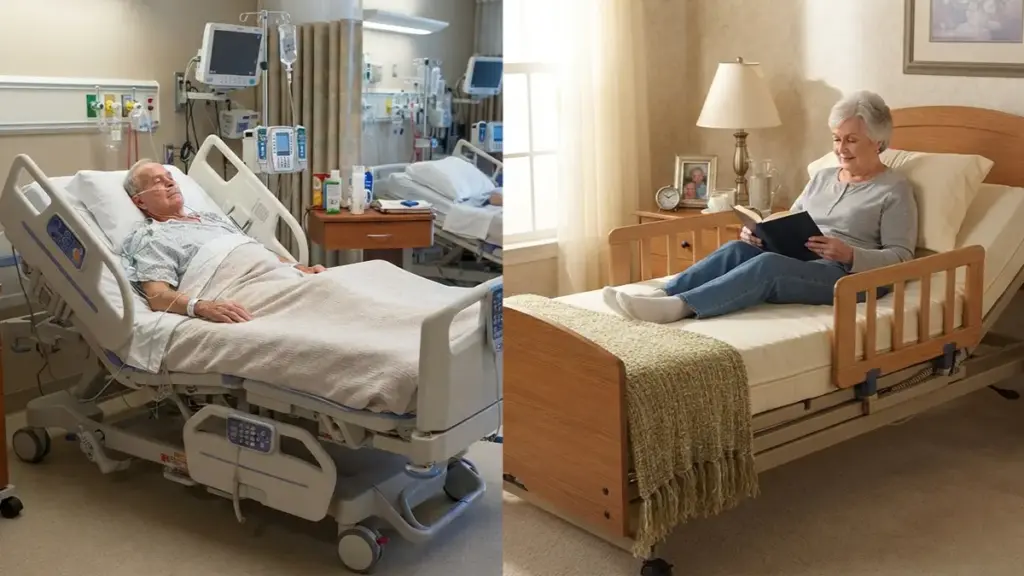
The right bed matches your patient population, care model, and regulatory environment—not your budget line alone.
Assess Patient Profiles and Care Requirements
The decision starts with who you are caring for. A patient’s medical condition, mobility level, cognitive status, and expected length of stay are the primary filters for choosing between an acute-care hospital bed and a long-term care model.
Acute-care hospitals, surgical units, and ICUs treat patients with short-term, intense needs. These environments demand hospital beds with advanced clinical features—Trendelenburg positioning, integrated scales, bed-exit alarms connected to the nurse call system, and CPR release. The goal is to support frequent procedures, close monitoring, and rapid response during stays typically under 30 days.
Nursing homes and skilled nursing facilities serve a different population. Residents often have chronic conditions, cognitive impairments like dementia, and elevated fall risk. For these populations, an LTC bed with ultra-low height capability is the appropriate choice. Since residents may occupy the same bed for years, durability under continuous load and long-term comfort are as important as clinical function.
Align Beds with Your Facility’s Environment and Workflows
A bed must fit your team’s workflow and physical space. Hospital caregiver workflows center on clinical interventions—staff need beds with high working positions (up to 80 cm) for bedside procedures and controls that can be locked out from patient access. The bed functions as medical equipment in a dense clinical environment with strict infection control protocols.
In long-term care, workflows focus on assisting with ADLs. Caregivers need reliable hi-lo functions to reduce occupational strain during transfers and routine care. Controls are simpler, and the bed is part of a resident’s personal space. Many LTC beds feature residential aesthetics—wood-look headboards, softer color palettes—to create a more home-like atmosphere that supports psychological well-being.
Regulations also shape the choice. Hospitals follow medical device standards (IEC 60601-2-38, FDA 510(k) clearance). Nursing homes operate under additional CMS Conditions of Participation that heavily emphasize restraint reduction and entrapment prevention. Choosing a bed that aligns with your specific regulatory environment is fundamental to both compliance and patient safety.
For mixed-use facilities that operate both acute and long-term care units: standardizing on a single supplier with both product lines simplifies training, spare-parts inventory, and maintenance scheduling. Dingli manufactures both categories under one roof, enabling consolidated procurement with consistent quality standards across your entire bed fleet.
Frequently Asked Questions
Why are nursing home beds different from hospital beds?
They serve different care models. Hospital beds support short-term, intensive medical treatment with features like Trendelenburg positioning, CPR release, and integrated monitoring connections. Nursing home beds serve long-term residential living with priorities on fall prevention (ultra-low height), resident comfort, restraint minimization, and a homelike appearance. The engineering reflects these divergent needs: hospital bed motors are rated for 40–60 adjustments per shift, while LTC bed motors are optimized for quiet, smooth operation over years of continuous occupancy.
What type of bed is best for nursing home residents?
The best bed is a specialized long-term care model tailored to the individual resident’s needs. Key features include hi-lo adjustable height (descending to 20–25 cm for fall-risk residents), smooth head and foot articulation for comfort, and compatibility with pressure-redistribution mattresses. For residents with high fall risk, an ultra-low bed paired with floor mats is the standard recommendation. For heavier residents, a bariatric LTC model with reinforced frame and wider sleeping surface (42–48 inches) is required.
Can hospital beds be used in nursing homes?
Technically yes, but it is often inappropriate and may create compliance risk. Hospital beds in LTC settings can conflict with restraint-minimization policies because their full-length integrated side rails may be classified as physical restraint under CMS guidelines. Additionally, the clinical appearance undermines the homelike environment that LTC regulations require. The exception is short-term skilled nursing stays (post-surgical recovery, rehabilitation) where acute features are genuinely needed for a defined period.
What regulations apply to each bed type?
Hospital beds must comply with IEC 60601-2-38 (performance and safety of electrically operated medical beds), IEC 60601-1 (general electrical safety), and IEC 60601-2-52 (side rail height and entrapment prevention). In the U.S., they require FDA 510(k) clearance. Nursing home beds are subject to the same device standards plus CMS Conditions of Participation (42 CFR 483), which add requirements for restraint minimization, resident-specific risk assessment before rail use, and periodic entrapment gap testing. Both bed types must meet flammability standards (16 CFR 1633 for mattresses).
What should distributors verify before bulk-ordering beds?
Four verification steps protect against costly mismatches: (1) Confirm the target market’s regulatory requirements—hospital beds need IEC 60601-2-38 certification and FDA 510(k) for the U.S. market; (2) Validate motor duty-cycle ratings match the intended care setting (acute vs. continuous occupancy); (3) Request entrapment zone gap test reports for the exact frame-and-mattress combination being ordered, not just the frame alone; (4) Verify warranty terms cover the expected service environment. Distributors should also confirm the supplier accepts specification freezing—locking dimensions, materials, and motor ratings—before production begins to prevent batch-to-batch variation.
Final Thoughts
The hospital beds vs nursing home beds decision should never be based on price alone—it overlooks the bed’s true role as critical care infrastructure. An incorrect choice introduces unacceptable risk: patient falls, regulatory penalties, premature equipment failure, and inflated lifecycle costs. Aligning the bed’s engineering to your care model is the only way to protect both patients and your capital investment.
Whether you are outfitting an acute-care unit with full-featured hospital beds or furnishing a long-term care wing with low-height residential models, the decision should start with clinical requirements and regulatory compliance—then move to budget. If you need help matching specifications to your facility’s exact care profile, our engineering team can provide a tailored configuration recommendation, including motor ratings, rail options, and mattress compatibility validation for your specific bed models.