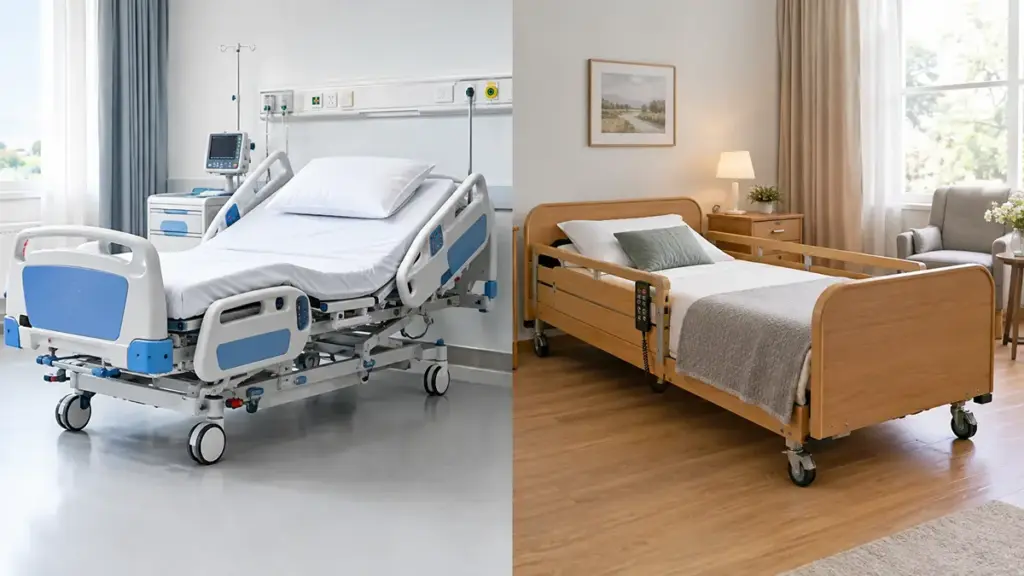
The cost of a hospital bed extends far beyond the sticker price, creating significant budget risk. Focusing on the initial quote alone invites crippling long-term expenses from hidden maintenance, accessory markups, and service contract gaps that inflate the total cost of ownership.
This price guide benchmarks the market, from manual beds under $1,500 to specialized bariatric models over $25,000. We analyze how frame specialization, motorization, and service agreements drive the real TCO, giving you the data to build an accurate procurement budget.
Understanding the Core Factors Driving Hospital Bed Prices
Bed prices are set by automation level, frame specialization for patient weight and acuity, and mattress technology. Brand and warranty also add significant cost beyond the basic hardware.
Manual vs. Electric Adjustments
The most fundamental price split comes down to how a bed adjusts. Manual beds, adjusted with hand cranks, are the lowest-cost option, typically running from $500 to $1,000. They work for short-term use where patients don’t need frequent repositioning. Full-electric beds start around $1,000 and can easily exceed $3,000 for standard clinical models. The price jump comes from the cost of multiple motors, power supplies, control pendants, and the stricter regulatory testing required for electrical safety.
Facilities often pay the premium for electric beds because they reduce staff injuries and save time, which provides long-term operational savings in busy units.
Frame Type and Weight Capacity
A bed’s frame and what it can safely hold directly impact its price. Standard beds are built for patients around 350-450 lbs. Bariatric beds, designed for loads of 600-1,000 lbs or more, require a completely different level of engineering. They use heavy-gauge steel, reinforced crossmembers, a wider deck, and higher-torque motors.
This robust construction pushes bariatric models into a specialist price tier, often ranging from $3,500 to over $9,000. Similarly, ICU frames integrate complex positioning features like Trendelenburg, which also raises the cost significantly over a basic med-surg frame.
Specialized Features (e.g., Low Air Loss, Bariatric)
Adding clinical features for high-acuity patients is a major cost driver. Beds with integrated low air loss or other pressure-redistribution surfaces move into premium price brackets, often in the $3,000 to $7,000+ range, because they require embedded blowers, pumps, and complex control systems.
Advanced ICU functions like lateral tilt or a built-in cardiac chair position also add thousands to the price tag. These features aren’t for every ward; they are justified in units where they directly address a high clinical risk, like pressure injuries in an ICU or patient safety in a bariatric program.
Mattress Type and Surface Technology
The mattress is not just an accessory; it’s a core part of the bed’s functional cost. A bed sold with a basic foam or innerspring mattress stays at the lower end of its price range. But when you add an advanced surface, the total system cost jumps. A high-density, multi-layer foam mattress adds a moderate cost, often used as an upgrade on mid-range electric beds. For high-risk patients, alternating pressure or low air loss systems are necessary. These surfaces require their own power units and air-cell mattresses, adding significant capital cost and ongoing maintenance, easily pushing the bed package price above $3,000.
Brand Reputation and Warranty
Established manufacturers with a reputation for quality and reliability command higher prices, even for beds with similar specs to lesser-known brands. This premium isn’t just for the name; it’s tied to the expectation of better durability, service support, and a more comprehensive warranty. A longer warranty that covers not just the frame but also electronics and motors is built into this higher price. While the initial purchase price is higher, a durable, well-supported bed can lower the total cost of ownership by reducing repairs, unplanned downtime, and the need for early replacement.
Hospital Bed Price Tiers: A Market Breakdown
Hospital bed prices scale with motorization and patient acuity. Manual beds start under $1,500, but specialized ICU or bariatric models can easily exceed $25,000 for advanced features.
| Bed Tier & Price Range | Key Characteristics |
|---|---|
| Basic Manual Beds ($500 – $1,500) |
|
| Semi-Electric Beds ($1,000 – $3,000) |
|
| Full Electric Beds ($2,000 – $7,000) |
|
| Specialized & Bariatric Beds ($5,000 – $25,000+) |
|
Certified Medical Equipment, Factory-Direct Prices.
Calculating the Total Cost of Ownership (TCO) for Procurement Managers
TCO isn’t the sticker price. It’s the full cost of maintenance, training, repairs, and energy over a hospital bed’s entire 10-15 year service life.
Initial Purchase Price vs. Long-Term Value
The sticker price is just the beginning. A cheap bed that fails early or injures staff is a massive long-term liability. Smart procurement looks at the bed as a capital asset, not a simple purchase.
- Think in decades, not quarters. A hospital bed is a capital asset expected to generate value for 10-15 years. The initial price is only a fraction of its total cost impact.
- Connect features to financial outcomes. A bed that helps reduce patient falls or pressure injuries directly avoids thousands in downstream treatment costs and penalties. That’s a real ROI.
- Calculate the cost of nursing time. Features that make patient transfers and repositioning faster don’t just reduce staff strain; they save measurable labor hours across the facility.
- Standardize the fleet. Managing a single bed model slashes costs by simplifying staff training, reducing spare parts inventory, and streamlining service contracts.
Maintenance and Repair Costs
Downtime is expensive. A bed that’s out of service isn’t just an idle asset; it’s a lost revenue opportunity. Maintenance and repair costs are predictable expenses that must be factored into the TCO from day one.
- Account for scheduled and unscheduled work. Your TCO model must include costs for both preventive maintenance (PM) and unexpected repairs, covering all parts and labor.
- Scrutinize service contracts. These contracts are a primary cost driver. Read the fine print to understand what’s covered—and what isn’t—to make your TCO predictable.
- Demand modular, serviceable designs. Beds with modular components and readily available spare parts reduce repair times, minimize downtime, and lower overall service expenses.
- Know when to repair versus replace. Use asset-level data on failure rates and repair costs. Once a bed’s annual maintenance cost hits a certain percentage of its replacement value, it’s time to replace it.
Staff Training and Ease of Use
A complicated bed is a liability. It creates operational drag, increases the risk of misuse, and adds hidden labor costs. The easier a bed is to operate, the lower its true cost to the organization.
- Budget for training labor. The cost of training isn’t just the vendor’s fee. It includes the overtime or backfill pay needed to cover staff who are in the training session instead of on the floor.
- Prioritize intuitive, standard controls. Beds that are simple to use reduce training time, minimize the chance of user error, and make it easier for staff to float between units.
- Evaluate the ergonomic impact. A bed designed to reduce physical strain on nurses is an investment in staff safety. This can directly lower workers’ compensation claims and related costs.
- Test before you buy. Insist on hands-on clinical demos before signing a purchase order. This is the only way to uncover usability issues that lead to poor adoption and hidden costs later.
Energy Consumption for Electric Models
While not the largest piece of the TCO pie, energy costs are a consistent, long-term expense. Across a fleet of hundreds of beds, small inefficiencies add up to a significant number on the utility bill.
- Calculate both active and standby power. Factor in the electricity used during motor adjustments and, just as important, the “phantom” power drawn by control panels and electronics 24/7.
- Multiply savings across the entire hospital. A small energy savings on a single bed might seem trivial, but it becomes a substantial cost reduction when applied to every bed in the facility.
- Demand hard data from vendors. Don’t accept vague claims of “efficiency.” Ask for quantified data, like standby power draw in watts, to make direct, apples-to-apples comparisons.
- Link energy use to sustainability goals. Choosing energy-efficient equipment is a practical way to include TCO calculations in your organization’s broader sustainability initiatives.
Hidden Costs to Factor into Your Budget
Don’t get ambushed by budget overruns. Delivery, accessories, and service contracts add hundreds or even thousands to the real cost of each hospital bed.
Delivery and Installation Fees
The sticker price is just the beginning. For a typical acute-care bed, expect to add $500–$850 per unit just for delivery and setup. If you’re managing a bulk order, freight alone can exceed 20% of the total equipment cost if not planned correctly. The quote you receive often hides the real logistical expenses.
Before you sign anything, demand clarity on these items:
- Freight Terms (FOB): Does the price include shipping to your loading dock, or just to the manufacturer’s? The difference can be a massive, unexpected bill.
- Inside Delivery: Getting a bed from the dock to a patient room on the fifth floor isn’t free. This “white-glove” service is almost always a separate charge, especially for heavy bariatric models.
- Installation & Integration: Basic assembly might be included, but connecting the bed to your nurse call system or other IT infrastructure will cost extra.
- Waste Disposal: Beds arrive in crates and pallets. Someone has to pay to haul that away.
- Old Bed Removal: De-installing and disposing of your old beds is another cost that vendors are happy to charge for if you don’t negotiate it upfront.
Accessory and Add-On Pricing (e.g., Overbed Tables, IV Poles)
A bare bed frame is useless. Once you add the necessary components to make it functional, the price climbs fast. A fully equipped bed station can easily add $300–$1,000 or more in accessories to the base price. In critical care units, that figure can be much higher.
Watch out for vendors who unbundle every item to make the frame price look low. The real cost comes from essential add-ons like mattresses ($200–$600+), side rails ($100–$400+), and IV poles. Some brands also use proprietary designs, forcing you to buy their overpriced accessories for the life of the bed. Always get a line-item quote for a fully configured bed, not just the frame.
Extended Warranty and Service Contracts
A standard manufacturer’s warranty is often less comprehensive than it sounds. It might cover the steel frame for five years but only provide one year of coverage for the parts that actually fail—actuators, control boards, and handsets. Labor and travel for repairs are almost never included.
The real hidden cost here is downtime. When a bed is out of service, you have two expensive problems: you’re either paying to rent a replacement or you’re losing patient capacity. Rental fees for specialty beds can run into thousands per month. For high-turnover or critical care beds, a solid service contract isn’t an upsell; it’s risk management. It ensures predictable maintenance costs and minimizes the operational chaos caused by equipment failures.
How Dingli Medical Balances Cost and Quality
We combine high-volume production, direct sales, and strict quality systems. This strategy reduces unit costs without sacrificing patient safety or the reliability of our hospital beds.
Getting the price right without compromising on quality isn’t magic. It’s the result of a deliberate manufacturing and business model. Here’s a look at the specific strategies we use to deliver reliable, certified hospital beds at a practical cost.
High-Capacity Manufacturing and Economies of Scale
Our approach is built on efficiency at scale. By focusing on high-volume production, we systematically reduce the cost of each bed that leaves our facility.
- Large-scale production spreads fixed expenses like tooling and engineering across more units. This directly lowers the manufacturing cost for each individual bed.
- Our high purchasing volume gives us leverage to get better pricing on raw materials and components, including steel, motors, and electronics.
- We use standardized production lines to streamline assembly and quality control. This cuts down on both labor costs and the rate of defects.
Direct-to-Buyer Pricing Model
We skip the traditional, multi-layered distribution chain. This allows us to control the process and pass the savings on to healthcare facilities.
- Cutting out intermediaries like distributors and wholesalers removes multiple markup layers. This reduces the final price you pay.
- Communicating directly with hospitals gives us clearer specifications and faster feedback. This improves our demand forecasting and reduces waste.
- This model means we remain responsible for logistics and service. You get a consistent, high-quality experience from the moment you purchase to final delivery.
Certifications and Quality Assurance (ISO, CE, FDA)
Our cost efficiencies come from smart processes, not shortcuts. Our certifications are the proof that quality control is built into our manufacturing, not bolted on at the end.
- Adhering to ISO, CE, and FDA standards requires us to maintain documented quality management systems that prevent defects rather than just correcting them.
- These formal systems reduce the costs that come from rework, recalls, and warranty claims, contributing to a lower total cost of ownership for you.
- Certifications prove our cost savings are achieved through process optimization, not by compromising on patient safety or product reliability.
Final Thoughts
A low sticker price on a hospital bed often hides the true cost of operational failure and repair liabilities. Choosing equipment built to certified ISO and FDA standards is a strategic defense against these long-term risks. It ensures your investment protects patients, staff, and your budget.
You now have the framework to calculate total cost, not just the purchase price. The next step is to get a transparent quote that validates these principles in practice. Contact our specialists to configure your equipment and discuss your project’s specific requirements.