A Cochrane overview of 40 randomised trials ranked the support surfaces hospital wards argue about every season. Reactive air surfaces cut pressure ulcer risk by 54 percent against foam. That is a risk ratio of 0.46 with a 95 percent confidence interval of 0.29 に 0.75. Alternating pressure air surfaces cut the same risk by 37 percent (RR 0.63). Foam sat at the bottom as the reference surface, not because foam fails, but because powered surfaces move tissue under it.
That evidence sets the order of the decision. Alternating pressure vs low air loss vs static foam is not a product preference. It is a match between patient risk, pump duty, and the ward budget. A distributor who reads it in that order quotes the right three SKUs instead of the cheapest one. This guide covers the mechanism, the indication band for each surface, and the pump specifications a nurse manager and a tender writer check on the same line.
Three Pressure Relief Technologies Compared Side by Side
Two families decide the spec sheet: active surfaces cycle the pressure under the body, reactive surfaces spread it and hold it.
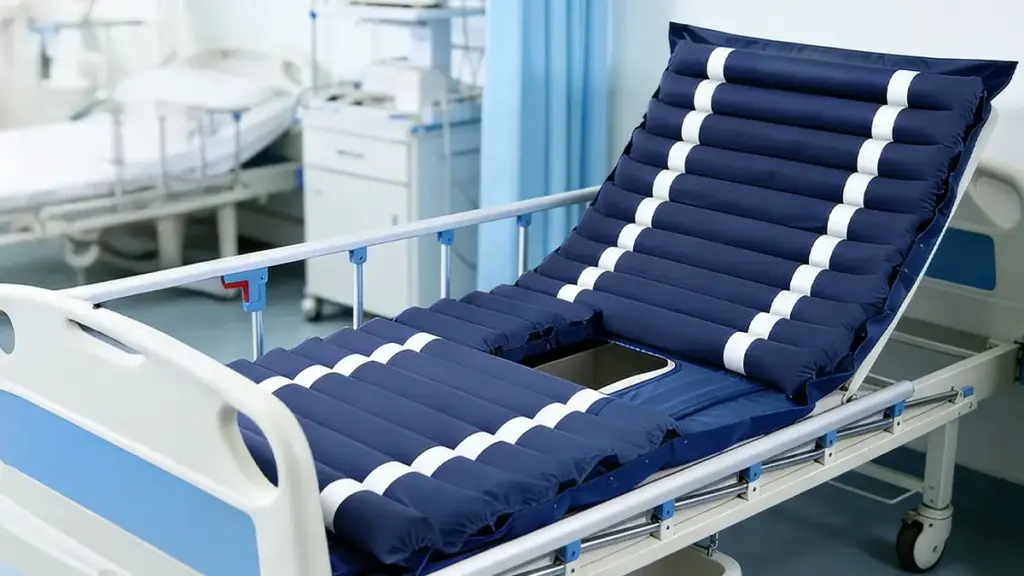
The international clinical guideline splits support surfaces into two families. Reactive surfaces, which includes pressure redistribution foam, static air mattresses and low air loss surfaces, apply a constant pressure to the skin and spread body weight over a wider area. Active surfaces, mainly alternating pressure air mattresses and large-celled ripple overlays, change the pressure under the body on a repeating cycle so no site stays loaded for long.
Static foam sits in the first family and needs no power. Low air loss also belongs to the reactive group even though a pump feeds it, because the cells rest against the body instead of cycling. Alternating pressure is the only one of the three that actively unloads tissue on a timer. Read the guideline chapter on support surfaces before you write a specification line; tender language that mixes these families gets answers from factories who did not read it.
| Attribute | Alternating Pressure | 低空気損失 | Static Foam |
|---|---|---|---|
| Power required | Yes, pump runs 24/7 | Yes, higher airflow duty | None |
| Guideline family | Active surface | Reactive surface | Reactive surface |
| Pressure under body | Cycles on a set period | Constant, with vented air at skin | Constant, set by foam density |
| Evidence against foam | 37% lower incidence (RR 0.63) | Reported inside reactive air results | Reference surface in the analysis |
| Main failure mode | Pump stop, cell leak, wrong setting | Firmness drift, blocked vents | Foam compression set |
How Pressure Redistribution Prevents Skin Breakdown
Hold interface pressure under 32 mmHg, and remember that no support surface replaces the two-hour repositioning round.
Capillary closing pressure, the figure quoted in the pressure care literature since Landis, runs near 32 mmHg. Above it, blood cannot push through the small vessels squeezed between bone and the support surface. Tissue downstream of that squeeze turns ischaemic, and after roughly two hours at 70 mmHg the changes become visible. Interface pressure below 32 mmHg is the working target for any surface you specify.
Foam reaches that target by widening contact area. A good high-density foam overlay spreads the ischial and sacral load so peak pressure falls, and it holds there. Alternating pressure reaches it a second way. Cells inflate and deflate on a timer, so the bone that rested five minutes ago now carries load, and its neighbour frees up. That alternating perfusion is the physiological argument for powered surfaces, and no foam overlay replicates it.
The trap is bottoming out. A 100 kg patient on a surface rated for 135 kg maximum working load still touches the bed deck if the pump cannot inflate cells against body weight. Our factory test protocol runs every mattress under 30 に 60 mmHg simulated body load for 24 時間. The 20-cell mute pump model may lose no more than 5 percent of that pressure at 135 kg. Ask any supplier for that number in writing.
One limit belongs in every protocol you write: a support surface does not replace repositioning. Clinical guidance keeps a 2-hour repositioning interval as the baseline, and the surface extends the time tissue tolerates load. It does not remove shear, moisture or nutrition from the equation.
Alternating Pressure Suits High Risk Patients
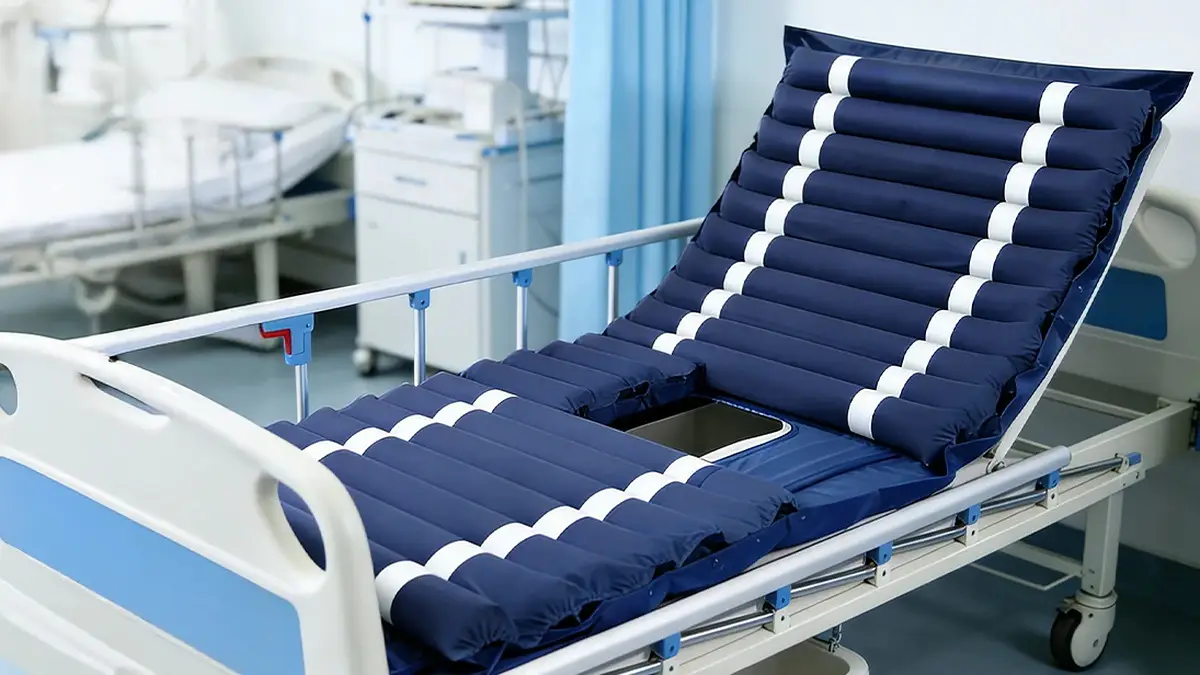
Bed-bound, high-risk patients need the cell cycle to unload each bony site before tissue starves, and Cochrane rates it the better value.
Specify an alternating pressure mattress for patients who stay in bed around the clock, who already show a Category 1 または 2 injury, or who arrive post-operative with limited sensation. The cycling does two jobs. It unloads the site that carried weight minutes ago, and it holds interface pressure under the capillary threshold long enough for perfusion to recover. On the procurement side it is also the surface with the strongest cost argument. Cochrane rates alternating pressure air surfaces as probably more cost-effective than foam for prevention, on moderate-certainty evidence, the highest grade in that overview.
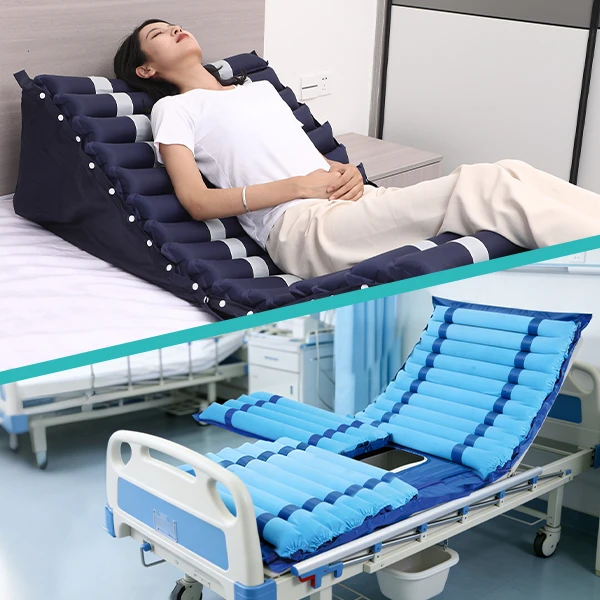
Cell layout is the specification line that separates products that look identical. A 22 tubular cell mattress with an A-B alternation runs the classic pattern: half the cells carry the patient while the other half rest, then they swap. An A-B-C layout holds three groups, which shortens the time any single site is loaded and suits higher-weight patients. Dingli’s bedsore air mattress range covers 20-cell and 22-cell tubular overlays, some with a commode opening cut into the centre section. A static head zone stops the patient rocking uphill when the backrest rises. Confirm which layout a quotation covers.
Cycle period is where buyers over-read the spec sheet. Published trials have studied cycle periods from 7.5 に 30 minutes, and current pump models expose 10, 15 または 20 minute settings. A shorter cycle is not automatically better; it changes how often tissue is reloaded and how much noise and heat a ward tolerates at night. Set the period, then verify interface pressure with a manometer or a pressure mapping sheet on the actual patient weight. Our medical-grade mattress selection guide walks that check in order.
Low Air Loss Fits Moisture and Wound Care
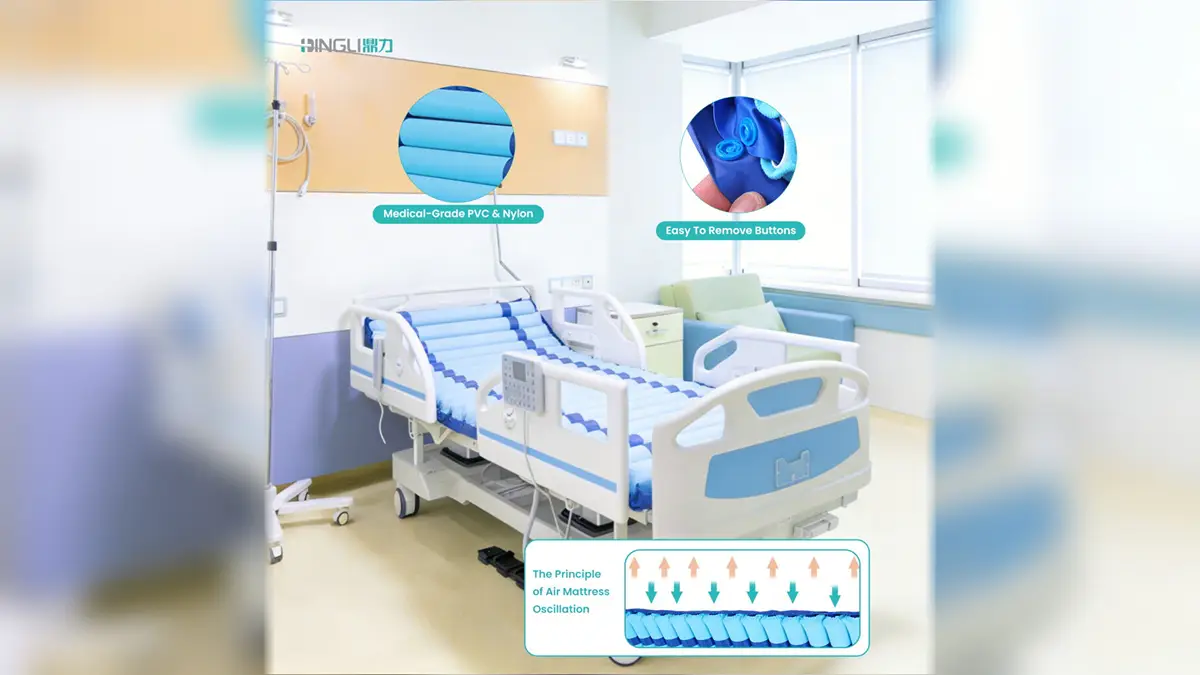
Vented air clears heat and moisture at the skin, so low air loss belongs where incontinence and open wounds set the risk.
A low air loss surface vents a controlled stream of air through the cells, so the microclimate at the skin changes. Heat and moisture escape instead of building a film over the sacrum. That matters for three patient groups a ward actually fights over: incontinent patients, patients with open wounds being dressed, and patients whose skin has already macerated. Macerated skin fails at lower pressure than dry skin, so moisture control is a pressure intervention by another route.
The trade-off is firmness. Air escaping under the body reduces peak pressure but makes the surface feel softer, and a patient who can reposition themselves may slide. Pump duty rises too, because the vents must keep flowing while the surface conforms. Set a low air loss overlay to the patient’s weight with the firmness control. Check that setting again after 24 hours of use, because the reading drifts as the material relaxes.
Buyers should treat low air loss as a ward-level decision rather than a per-bed default. Stock it where the wound care nurse works, and pair it with alternating pressure where prevention is the only job. That split keeps the tender specification honest and keeps your spare pump pool small.
Static Foam Is Sufficient for Lower-Risk Patients

Foam holds where patients still move and power is unreliable. Defend it on cost and resilience, never on prevention performance.
Static foam earns its place where power is unreliable, where a ward needs a surface that works during a pump failure, and for patients assessed below the high-risk band. Multi-layer high-density foam gives real pressure redistribution and no moving part to fail. It is also the surface a homecare distributor can ship without a battery or voltage conversation.
It loses two arguments. 初め, foam cannot unload a site once the patient settles into it. Compression set over months of service quietly raises interface pressure in the exact spot you meant to protect. 2番, most published trials test foam overlays against standard hospital foam rather than against a powered surface, so the evidence base compares reactive to reactive. When alternating pressure vs low air loss vs static foam comes up in a formulary meeting, foam should be defended on cost and resilience, not on prevention performance.
Foam also stays relevant as a hybrid layer. Bariatric surfaces combine high-density foam edges with dynamic air cells in the seating zone, which controls width and lateral stability while the air cells carry the pressure job. Specifying a ward of all-foam beds for long-term bed-bound patients is the one decision on this page that gets challenged in an audit.
Matching Mattress Type to Patient Risk Level
Decide by risk band, not brand: mobile wards need foam, bed-bound units need cycling, wound units need vented air.
Alternating pressure vs low air loss vs static foam is decided by risk bands more than by brand preference. A ward of patients who mobilise with assistance needs a different surface than a spinal unit where 20 percent of residents score in the highest risk band. Map the bands before you quote quantities, and the tender answer writes itself.
| Patient risk band | Recommended surface | Why this fit |
|---|---|---|
| Independent, mobile | Standard hospital foam | Self-repositioning breaks pressure cycles |
| Restricted, low risk | Static foam overlay | Wider contact area without pump duty |
| High risk, bed-bound | Alternating pressure overlay | Cycling unloads sites at the capillary threshold |
| Existing Category 1-2 injury | Alternating pressure or hybrid | Active relief plus edge stability |
| Stage 3-4 wound, moisture | Low air loss surface | Vented air manages maceration during dressing |
NPIAP and EPUAP classify pressure injuries into four categories plus unstageable and suspected deep tissue injury. Two details change how a distributor positions product. カテゴリ 2 includes intact blisters, so a wound-care tender can require a surface for skin that has not broken yet. A deep tissue injury on the heel or sacrum can advance fast. Keep a small pool of alternating pressure overlays in stores, so a bed can be upgraded within one shift.
Sizing follows the deck, not the mattress name. The ward standard is a 36 in wide by 80 in long by 6 in thick hospital bed mattress. Lengths of 84 in and 88 in cover taller patients, and an overlay must fit that deck without lifting off the frame. Our hospital bed mattress size guide lists the dimension bands; compatibility checks between deck, side rail and mattress thickness sit in the mattress compatibility article.
Pump Specifications Clinicians and Buyers Check
One datasheet, two reading chairs: clinicians check noise and alarm logic, buyers check load ceiling and spare-part supply.
In alternating pressure vs low air loss vs static foam procurement, the pump is the failure point. Clinicians and buyers read the same datasheet for different reasons. A nurse manager reads alarm logic and noise levels. A procurement officer reads cell count, load ceiling and spare-part supply. A page that serves both angles sells better than a blog written for one of them.
- Noise. Night-shift tolerance is the practical ceiling. Dingli’s published mute pump specification is 45 dB or lower, and its selection guidance points to about 30 dB for quiet wards. A pump that hums gets switched off by a caregiver, and prevention stops with it.
- Pressure range and adjustable settings. Ask for the adjustable pressure band and the maximum working load in kg, then check the overlay against the heaviest patient on the unit.
- Static mode. A pump with a static or nursing mode lets staff firm the surface for dressing changes, transfers, and chest compressions without stripping the mattress off the bed.
- CPR deflation valve. An inflated air surface is soft, which is a problem during resuscitation. A rapid-deflation valve is the standard answer and should be on your specification list, not an option buried in a manual.
- Alarms. A low-pressure or pump-failure alarm is worth more than an extra cell row, because a failed pump turns an active surface into a flat foam mat overnight.
- Warranty and duty cycle. Pumps are rated for continuous 24/7 running, and replacement pumps and cells are the recurring order a distributor should price into the first container.
One quality story cannot be claimed by every supplier in the category. Air mattresses made with stitched seams leak along the stitch line. High-frequency heat-sealing fuses the sheet instead, and Dingli’s line adds a 24-hour dynamic inflation and pressure-hold test on every mattress before packing. Ask for that leak test record per batch before signing a framework contract.
For the import side, verify three documents at model level: the certificate entity name, the certificate number, and target-market applicability. CE paperwork for an overlay sold into the EU and FDA registration for a US tender are separate conversations. Both markets quote from the same Cochrane evidence on support surfaces when they challenge your clinical case.
Three questions sort suppliers faster than a catalogue. Does the factory test each mattress under load for 24 hours and keep the record? Does the pump offer static mode, an alarm, and a CPR rapid-deflation valve? Can spare pumps, cells and overlays ship on the same production schedule as the beds? Alternating pressure vs low air loss vs static foam stops being a debate once the answer to those three is written down.
Bundling is also the procurement logic. A turning bed and an alternating pressure overlay are one clinical system. The bed changes posture, the surface manages interface pressure, and a mattress cut for a curved deck does not bridge when the seat elevates. Dingli manufactures both sides of that line, so a ward order consolidates beds, overlays, pumps and spare parts into one mixed 40HQ container instead of three vendor conversations.
Frequently Asked Questions About Pressure Relief Mattresses
Is low air loss better than alternating pressure for stage 3 wounds?
Choose low air loss when moisture control and dressing access drive the case; vented air manages maceration around an open wound. Choose alternating pressure when unloading tissue on a cycle is the priority. Wound units run low air loss for stage 3 そして 4 患者, alternating pressure for the prevention beds beside them.
Can you use a low air loss mattress on a regular bed frame?
Yes, on a flat deck matching the overlay size, typically 36 in by 80 で. Check three items. No rigid center bar for the cells to bridge. No crease in the air layer where the head section bends. Side rails must still close safely.
Are static foam mattresses enough for bedridden patients?
いいえ, not for patients who cannot reposition themselves. Foam redistributes load but never unloads a bony site once the patient settles in. High-risk dependent patients need an active surface or a hybrid. Repositioning stays on the care plan either way.
How long does alternating pressure therapy take to heal bedsores?
Expect weeks, not days, with nutrition, wound care and offloading carrying the rest. Cochrane found low-certainty evidence that more ulcers heal completely on reactive air surfaces than foam, and states that the best treatment stays uncertain.
How loud should an alternating pressure pump be at night?
Dingli specs its mute pumps at 45 dB or lower, and its selection guidance points to about 30 dB where sleep matters. A quiet library sits near 40 dB. A pump above 50 dB gets switched off by staff.
Can you put foam on top of an air mattress?
Avoid it on an alternating pressure surface. Foam dampens the cell cycle that does the work and adds heat at the skin. Foam under an air overlay as a base is different, and passes if total height clears the side-rail gap check.