Choosing the wrong home care bed can create unnecessary costs, increase installation challenges, and affect patient and caregiver safety. A mismatch between the bed’s specifications, the home environment, and daily care routines leads to failed deliveries and caregiver injuries, creating significant liability. For distributors and providers, these errors translate into warranty claims and damaged professional credibility.
This guide explains the key specifications and practical considerations distributors and care providers should evaluate before selecting a home care bed. We evaluate non-negotiable layout dimensions, like the 3-foot clearance for caregiver access, and safety metrics, such as the sub-120mm gap for entrapment prevention. These practical guidelines help distributors, caregivers, and healthcare providers evaluate bed specifications before installation and avoid common selection mistakes.
How Home Care Beds Differ from Ward Beds

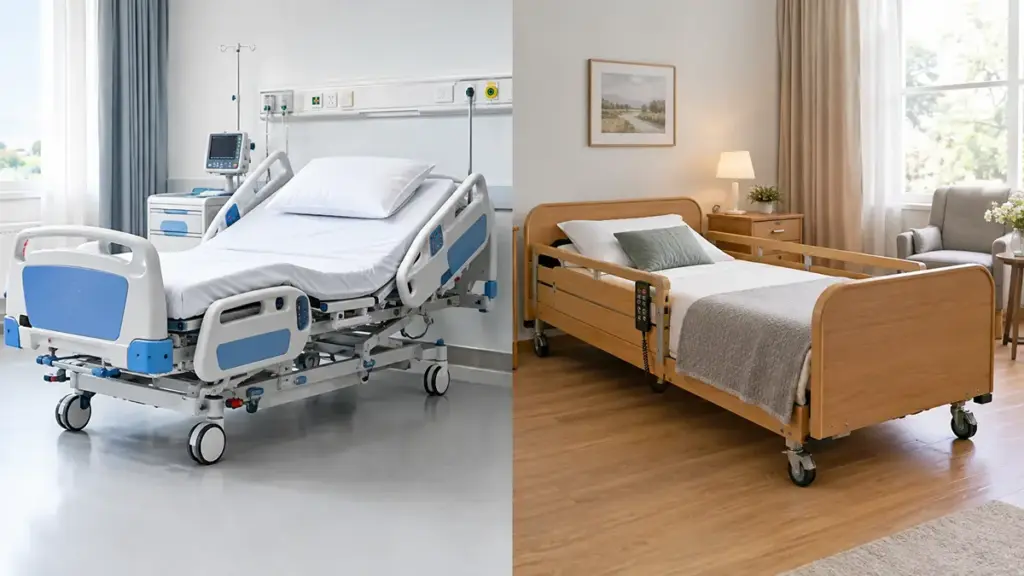
Home care beds blend into a domestic setting with furniture-like designs. Hospital beds are designed for clinical environments, where durability, medical functions, and infection control requirements are the main priorities.
Design Philosophy and Environment
The most obvious difference is visual. One is made to look like it belongs in a home, and the other is made to function in a hospital. This choice dictates everything from materials to aesthetics.
- Home care beds are designed to look like regular furniture. They often use wood finishes and softer aesthetics to blend into a domestic environment and reduce the institutional feel. Materials are selected to balance comfort, durabilidade, easy cleaning, and a less institutional appearance.
- Hospital beds have a clinical, utilitarian design focused on durability, cleaning requirements, and medical functionality. They are built with durable metals and plastics that prioritize function and infection control over style. The materials are specifically chosen to resist harsh, hospital-grade cleaning chemicals.
Clinical Functions and Caregiver Needs
The functional capabilities of these beds are tailored to completely different users and caregivers. Home care beds provide positioning support and daily care functions for long-term residential care and rehabilitation needs.
- A home care bed offers essential adjustments for comfort and mobility, like raising the head and legs. The controls are simple and designed for the patient or a family caregiver to use without training.
- Advanced hospital beds may include functions such as Trendelenburg positioning, CPR release mechanisms, and monitoring-related accessories depending on the care level. These functions are operated through nurse-controlled panels with safety lockouts and are intended for professional use in acute care situations.
- Ward beds are also built as part of a clinical system, featuring standardized attachment points for IV poles, monitors, and other medical equipment. Home care beds typically lack this level of integration.
Choosing a Home Care Bed Based on Care Requirements
The right bed isn’t about aesthetics. It’s about how well its features support the most demanding daily tasks, from repositioning schedules to caregiver ergonomics.
Choosing a bed starts with the day-to-day reality of care, not the product catalog. The choice depends entirely on how often the person must be turned, cleaned, transferred, or monitored. For long-term care situations, understanding the differences between semi-electric and full-electric models can help buyers select the right level of adjustment and caregiver support. A bed that fights the care routine creates risk and burns out caregivers. One that supports it makes the work safer and more efficient.
Assess Key Daily Care Tasks
Before you even think about bed models, you need a clear picture of the daily workload. The routine dictates the hardware. Get straight answers to these questions first, as they point directly to the necessary features.
- Repositioning Frequency: How often does the patient need to be turned? Is it every 1-2 horas, or just a few times per day?
- Transfer Independence: Can the patient get in and out of bed on their own, or do they require assistance from one or more caregivers?
- In-Bed Care Needs: Will feeding, bathing, wound care, or other skin inspections happen in the bed?
- Pressure Injury Risk: Is the patient at a high risk for developing pressure ulcers due to immobility or skin condition?
- Fall Risk: Is the patient prone to falling or attempting to get out of bed unsafely?
- Caregiver Profile: Will one person be providing most of the care, or is there a team? What are their physical capabilities?
Connect Routine Needs to Bed Features
Once you define the daily tasks, you can map them directly to specific bed functions. This isn’t about getting a bed with every possible feature, but one with the right tools for the job. If the routine includes frequent, demanding tasks, the bed must have features that reduce physical strain and support consistent care.
- Frequent Repositioning: This routine demands full electric adjustability. Quick changes to the head and leg sections with a simple remote are essential for maintaining a consistent turning schedule without exhausting the caregiver. For patients requiring frequent repositioning, an electric hospital bed can provide easier adjustment and reduce caregiver workload.
- Pressure Injury Prevention: The bed must support a pressure-relieving mattress and allow for precise position changes. Maintaining appropriate head elevation angles, often around 30 degrees when clinically suitable, can help reduce shear forces and support pressure injury prevention strategies.
- Transfers and Hygiene Care: An adjustable height (hi-low) feature is non-negotiable here. The bed must raise to a comfortable working height for the caregiver and lower significantly for safer patient entry and exit.
- Fall Risk Reduction: This points to a bed with a low-height setting. Keeping the bed close to the floor when care is not being performed minimizes the impact of a potential fall.
- Caregiver Ergonomics: If a single caregiver is doing most of the work, the bed must function as their partner. Electric height adjustment is the most critical feature for reducing the manual lifting that leads to back injuries.
Source Reliable OEM Home Care Beds Direct from Manufacturer
Home Care Bed Design Options for Residential Environments
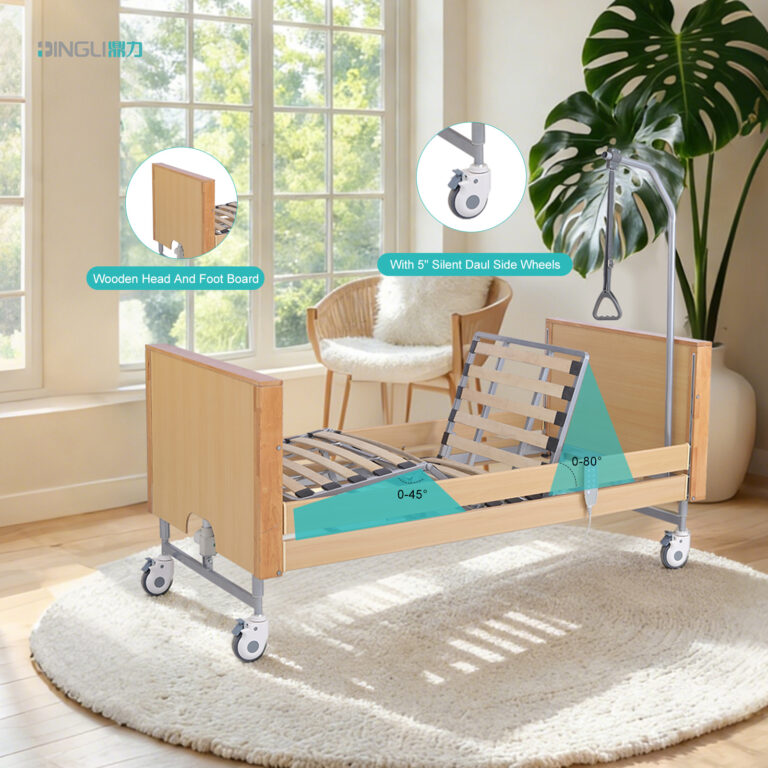
A home care bed’s residential feel comes from its headboard and footboard. These pieces use furniture-like styles, materials, and colors to make a clinical device blend in at home.
Aesthetic Styles and Material Options
The main strategy for making a home care bed look less institutional is to focus on the headboard and footboard. These are the parts people see first, and they are designed to make the bed look like a piece of bedroom furniture rather than a medical device.
Wood-look finishes are the most common choice. You’ll typically see options like laminate, composite, or MDF panels finished to look like walnut, mahogany, light oak, or beech. These warm wood tones help the bed fit into a traditional home setting.
For a softer look, many beds offer upholstered panels. Using fabric, vinyl, or imitation leather creates a more premium, hospitality-like feel. Bed manufacturers also provide a wide range of headboard shapes to match different decor styles.
- Traditional or classical
- Arched or curved
- Simple flush-panel or radius designs
- Angled or bow shapes
Practical Selection Factors
Choosing the right headboard isn’t just about aesthetics. There are practical factors to weigh, especially in a care environment.
- Match the Room: Select a finish, color, and shape that coordinates with the existing bedroom furniture to create a cohesive look.
- Cleanability: For infection control, choose durable surfaces that are easy to clean. Laminate, composite, and vinyl are practical choices. Upholstery should only be used if it meets the required cleaning protocols.
- Visibility and Safety: For users with cognitive or visual impairments, using color contrast between the headboard, walls, and bedding can help them better see and navigate the bed.
- Compatibility: Always confirm that the headboard and footboard are compatible with the bed’s frame type, largura, and mounting hardware before making a final selection. Many are modular, but you can’t assume a universal fit.
Home Care Bed Room Setup and Caregiver Access Requirements

Proper room layout is a core safety requirement. It prevents caregiver injury and allows safe patient transfers, equipment use, and daily care routines.
Setting up a home care bed isn’t just about finding a spot for it. The space around the bed directly impacts the safety and efficiency of daily care. Without adequate clearance, caregivers risk back injuries, and patients face a higher risk during transfers. The layout must accommodate not just the bed, but the entire ecosystem of care: the caregiver, the patient, and any mobility equipment.
Key Clearance and Layout Dimensions
While every home is different, certain benchmarks for clearance are non-negotiable for safe operation. These dimensions provide the working room needed for caregivers and equipment.
- Primary Caregiver Side: Aim for a minimum of 3 feet (36 polegadas) of clear space. This is the working side for most transfers and daily care. A more comfortable target is 3 para 4 feet.
- Opposite Side: Provide at least 18 para 24 polegadas. This allows for access to change linens and assist with turning, even if it isn’t the main transfer side.
- Foot of the Bed: Keep at least 3 feet clear. This space is needed to move equipment and navigate around the bed without obstruction.
- Wheelchair Access: If a wheelchair is used for transfers, the clearance on the transfer side should increase to about 5 feet. The room should also ideally accommodate a 5-foot diameter turning circle.
- Minimum Room Size: A 10×12 foot room is a practical minimum for a standard home care bed setup. Larger rooms are better, especially if two caregivers or bulky equipment like a patient lift are involved.
Functional Goals for Caregiver Access and Safety
“Good access” isn’t just about measurements; it’s about what those measurements allow you to do safely and effectively. The layout must support the core tasks of home care without creating hazards.
- Enable Safe Transfers: There must be enough room to bring a walker, wheelchair, or patient lift right to the bedside without awkward angles or obstacles.
- Reduce Caregiver Strain: Ample space allows caregivers to use proper body mechanics when turning, lifting, or assisting a patient, which prevents back and shoulder injuries.
- Support Daily Care Routines: The layout must allow caregivers to perform routine tasks like bathing, changing linens, and conducting skin checks without being obstructed by walls or furniture.
- Accommodate Equipment: Pathways must be kept clear for mobility aids and medical equipment like oxygen concentrators or IV poles. Power outlets should be reachable and not blocked by the bed.
- Ensure Emergency Egress: The bed placement should not block doorways or create a situation where emergency personnel cannot quickly access the patient and move them if needed.
Home Care Bed Delivery Requirements and Installation Challenges
Successful delivery isn’t about the bed’s size, but its packaged size versus your tightest doorways, turns, and elevators. Measure the entire route before ordering.
Key Physical Constraints in a Home Environment
Getting a home care bed into a bedroom is a game of inches. A residential layout, not designed for medical equipment, presents several predictable barriers that can stop a delivery cold.
- Doorways: The primary barrier. You have to measure the usable ‘clear opening’ largura, not the door itself. Trim and the open door can easily shrink the passage space below the 36+ inches a bed often requires.
- Hallways and Turns: Before ordering a home care bed, evaluate the complete delivery route, including hallways, corners, and entrance points. Narrow passages and sharp turns should be measured carefully, as clearance requirements vary depending on the bed design, packaging size, and installation method.
- Stairs: Stairs introduce multiple failure points: their width, overhead clearance, and the size of the landing. A long bed frame can be impossible to rotate on a small landing.
- Elevators: Elevators in residential buildings are rarely hospital-grade. They often lack the depth or have doors too narrow to fit a standard home care bed, making upper-floor delivery impossible.
Planning the Route to Avoid Delivery Failure
A successful delivery depends on a pre-delivery assessment. This means measuring the entire path from the delivery truck to the bedroom—every door, hallway, and potential pinch point. These real-world measurements must then be checked against the bed’s packaged dimensions, which are almost always larger than the assembled product.
When the path is too tight, there are a few common workarounds:
- Removing doors entirely from their hinges.
- Using an alternate entrance, like a patio or garage door.
- Ordering a model that is delivered in smaller pieces and assembled directly in the room.
Providers rely on this detailed route plan to prevent failed deliveries, which waste time and money. It allows them to schedule the right-sized crew and allocate enough time for a smooth, successful installation on the first try.
Home Care Bed Mattress and Side Rail Safety Compatibility

Compatibility involves more than simply matching mattress dimensions. True compatibility means the entire bed system—frame, colchão, and rails—meets strict dimensional rules to prevent patient entrapment and falls.
Key Safety Dimensions to Prevent Entrapment
Specific gaps are regulated to stop a patient’s head or neck from getting trapped. These aren’t suggestions; they are hard limits based on established safety standards like those from the FDA and IEC.
- The gap between the side rail and a compressed mattress must be less than 120 milímetros (4¾ inches). Anything larger creates a risk of head entrapment.
- The gap at the end of a side rail must be less than 60 milímetros (2⅜ inches). This smaller dimension is critical for preventing neck entrapment.
- For medical bed systems evaluated under relevant standards, side rails are commonly designed to provide sufficient height above the mattress surface, with IEC-based guidance referencing approximately 220 mm in certain conditions. This ensures the rail is a sufficient barrier to stop a patient from accidentally rolling out.
Verifying a Safe Bed System
A bed system is only safe if its components are designed to work together. Mixing and matching parts from different manufacturers without explicit approval is a common, and dangerous, mistake. Verification is an ongoing process, not a one-time check.
- Only use mattresses and side rails that are supplied or explicitly approved by the bed frame manufacturer. They test these combinations to ensure they meet safety standards.
- Check that the mattress thickness does not exceed the maximum depth specified for the rails. An overly thick mattress or overlay can reduce the effective rail height, making it useless as a fall barrier.
- You must measure all critical gaps after any component is changed. Adding a new mattress, a pressure-relief overlay, or even different rails requires a full re-assessment to confirm the system remains safe.
Electric Home Care Bed Features, Battery Backup and Emergency Functions
Home care beds use quiet, low-voltage motors. A basic battery backup ensures the bed can be flattened during an outage but doesn’t provide full functionality.
Electrical System and Noise Levels
Home care beds run on a low-voltage electric system that plugs into a standard wall outlet. They are designed for low energy consumption, so you can leave them plugged in without a second thought. Many home care beds use low-noise electric motors designed to minimize disturbance in residential environments. This means adjustments can be made anytime without disturbing the patient or the rest of the household. If you notice the motors getting louder over time, it’s a clear signal of mechanical wear and a sign that the bed needs an inspection.
Emergency Lowering and Battery Backup
Most electric home care beds are equipped with battery backup systems to provide limited operation during power interruptions. However, the backup function is designed for emergency situations rather than replacing the main power supply. The available functions vary depending on the bed model and manufacturer specifications.
- Emergency Operation: Battery backup typically allows essential adjustments, such as lowering the bed to a safe position during a power outage. It is not intended for continuous operation of all electric functions.
- Model-Specific Functions: When selecting a home care bed, distributors and care providers should confirm what functions remain available during a power interruption, as backup capabilities differ between models.
- Caregiver Training: Caregivers should understand how to use the emergency lowering function and follow the manufacturer’s instructions to ensure safe operation when power is unavailable.
Why Choose Dingli Medical for OEM Home Care Beds
When sourcing home care beds, choosing the right manufacturing partner is just as important as selecting the right specifications. Dingli Medical provides factory-direct home care bed solutions with strong OEM/ODM capabilities, supporting distributors and healthcare providers with customized designs, reliable production capacity, and flexible order requirements. With a 15,000㎡ manufacturing base, advanced production equipment, and a monthly capacity of 200,000 units, Dingli helps global partners maintain stable supply for different markets. Our home care bed range includes electric nursing beds, multifunctional care beds, and related accessories, supported by ISO13485, ISO9001, CE, and FDA certifications to meet international quality expectations.
Home Care Bed Procurement Checklist
A solid procurement checklist balances patient needs, safety compliance, and total cost. It’s the only way to avoid expensive, long-term mistakes with home care beds.
Buying a home care bed isn’t like buying furniture. It’s a critical piece of medical equipment that directly impacts patient safety and caregiver workload. A structured checklist removes guesswork and forces you to address the complete picture, from clinical specifications to lifecycle costs. We’ve broken it down into the two main areas you need to cover.
| Focus Area | Key Verification Points |
|---|---|
| Clinical Needs and Safety Specifications |
|
| Procurement and Lifecycle Management |
|
Perguntas frequentes
What type of home care bed is best for long-term care?
The best bed for home care is a full-electric model that offers head, foot, and height (hi-low) adjustments. This type is preferred for long-term use, especially if the person spends more than 15 hours a day in bed. The choice should match the user’s medical needs and mobility, the caregiver’s ability, and the space available in the home. A proper pressure-relief mattress and safety rails are also essential.
What is the difference between a home care bed and a hospital bed?
Home care beds are designed for long-term comfort and safety in a residential setting, often with a more home-like appearance. Hospital beds are built for intensive, short-term clinical use in hospitals, emphasizing durability, advanced medical functions, and strict hygiene standards for a high-turnover environment.
Should a home care bed be manual or electric?
An electric bed is generally better for home care, especially for long-term use. It allows both the user and caregiver to make adjustments easily, reducing physical strain and improving comfort. A manual bed, which uses hand cranks, can be a lower-cost option for short-term situations where adjustments are infrequent and the caregiver can safely operate it.
What features are most important for long-term bed care?
For long-term care, the most important features are: full-electric hi-low adjustment for safe transfers and caregiver access; a compatible pressure-relief mattress to prevent bedsores; sturdy side rails for fall prevention; and intuitive, easy-to-use controls. Advanced positioning, like auto-contour or Trendelenburg tilts, can be vital for complex medical needs.
How much space is needed around a home care bed?
You should plan for at least 3 feet of clear space on the main caregiver side and at the foot of the bed. If a wheelchair or patient lift is used, that side may need up to 5 feet of clearance. A room size of at least 10 by 12 feet is a practical minimum for a standard home care bed setup.
Will a home care bed fit through residential doorways?
Yes, most home care beds will fit because they are delivered in sections or folded. The individual components are designed to pass through standard residential doorways. Once assembled in the room, the bed will likely be too wide to move out without being taken apart again, so it’s important to measure your doors, hallways, and any elevators before ordering.
What information is needed before ordering a home care bed?
Before ordering, you need to know the user’s height, weight, and key medical conditions. You also need to assess their mobility, fall risk, and pressure sore risk. Measure the bedroom and all access routes like doorways and hallways. Finally, determine the necessary features, such as the level of electric adjustment, mattress type, and weight capacity.
Considerações Finais
Selecting a home care bed on price alone is a gamble with patient safety and operational efficiency. The standards for access, care routines, and system compatibility outlined here are your defense against failed deliveries, caregiver injuries, and compliance violations.
Your next step is to align this procurement checklist with a proven supply partner. Contact Dingli Medical to discuss your home care bed requirements, OEM/ODM customization options, and supply solutions for your target market.