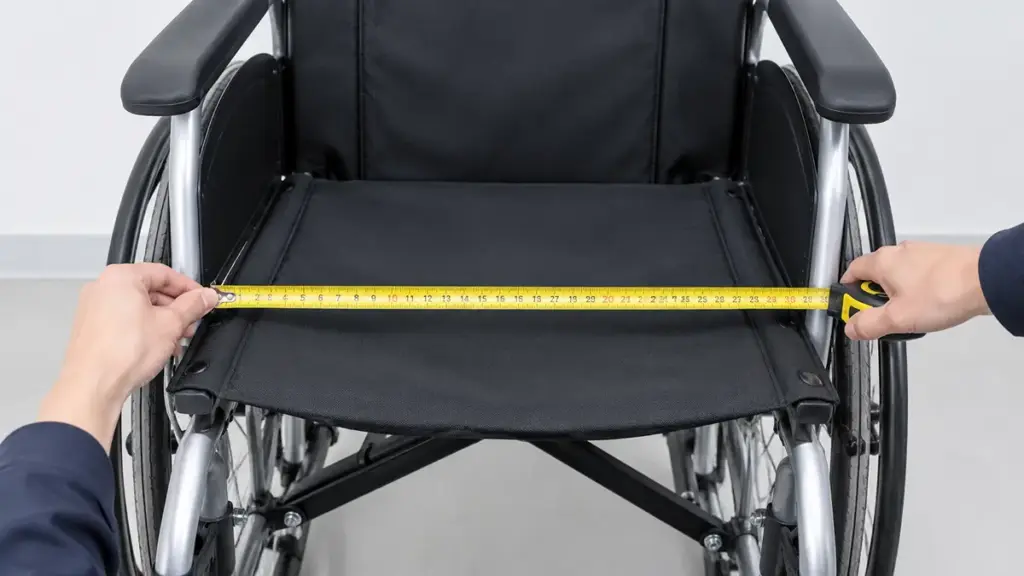
Navigating hospital bed safety standards is a direct challenge to managing liability and market access. Sourcing a bed certified only to the obsolete 2009 IEC edition creates immediate risk for patient entrapment incidents and disqualifies bids in markets that now mandate the IEC 80601-2-52:2026 update. This compliance gap can affect whether a hospital bed can enter certain markets, pass procurement reviews, and meet buyer documentation requirements.
This guide provides practical compliance information that buyers can use when evaluating hospital bed suppliers and technical documentation. We detail the specific dimensional limits for entrapment zones, such as the critical sub-120 mm gap between the rail and mattress, and outline the test reports needed to verify Safe Working Load (SWL) and electrical performance. Use this data to validate supplier documentation and secure equipment that meets current regulatory benchmarks.
Hospital Bed Safety Standards by Use and Market

Hospital bed standards aren’t one-size-fits-all. They are tailored to the specific risks of the care setting, patient type, and the unique regulations of each market.
Safety Requirements by Bed Application
Hospital bed safety requirements depend largely on the intended use environment, patient population, and clinical application. Different types of hospital beds are designed for specific care scenarios, which affects their safety requirements and applicable standards. When a bed is designed for medical purposes such as patient treatment, monitoring, or rehabilitation support, it is classified as a medical device and must meet applicable safety requirements. This classification means its safety requirements are built around its medical function. The international standard IEC 60601-2-52 organizes this by defining “application environments,” which directly link safety rules to the care setting.
For example, an acute care bed in a hospital operates in a high-acuity environment. It needs robust mechanical parts for frequent repositioning and must integrate safely with other medical electronics. A home-care bed has different risks. It must be simple enough for a lay caregiver to operate safely and compatible with household power. The risk profiles are completely different, so the standards set different expectations for safety and performance.
The intended patient is just as critical. Standards for adult beds, like IEC 60601-2-52, differ from those for pediatric beds, such as BS EN 50637. Children have smaller body dimensions and face a higher risk of entrapment in gaps or falling over rails. So, standards for pediatric beds demand much stricter dimensional limits for any openings in the bed system.
Regional Regulations and Compliance Differences
While IEC 60601-2-52 provides a widely recognized international baseline, it’s not the whole story. Individual countries and regions decide how to adopt and supplement this standard, creating a patchwork of compliance requirements. A manufacturer can’t just build to the IEC spec and sell everywhere.
In the United States, hospital beds are medical devices regulated by the FDA. While the FDA recognizes the IEC standard, it also publishes its own detailed guidance. A key example is its guidance on reducing entrapment, which defines seven specific zones of risk and the dimensional tests to address them. To sell in the U.S., a manufacturer must conform to both the IEC standard and this FDA-specific entrapment guidance.
The UK and Europe offer another example. They adopt the IEC standard directly, creating BS EN 60601-2-52. But they also have a separate, distinct standard for children’s beds (BS EN 50637). This creates a different regulatory path for pediatric products compared to the U.S. These market-specific rules determine which standards are binding, forcing manufacturers to adapt designs, testing, and even product labels to gain access to different jurisdictions.
IEC 80601-2-52:2026 Compliance Transition
The release of IEC 80601-2-52:2026 represents an important transition point for adult medical bed manufacturers. As regional regulators and certification bodies adopt the updated edition, manufacturers need to evaluate product compliance and prepare for future market requirements. This transition means manufacturers developing new adult medical beds need to evaluate the updated requirements, review existing designs, and prepare for possible re-testing or re-certification based on regional regulatory requirements.
Transition from IEC 60601-2-52:2009
This new version officially replaces the entire family of previous standards, establishing a single, current baseline for all new designs and certifications. The older 2009 edition is now a legacy standard, primarily relevant for historical documentation and equipment already in service.
Specifically, the 2026 edition supersedes:
- IEC 60601-2-52:2009
- Its 2015 amendment (AMD1:2015)
This alignment extends to regional adoptions, like EN IEC 80601-2-52, creating a harmonized standard across major markets and removing any ambiguity about which version applies to new products.
Impact on Certification and Market Entry
For medical bed manufacturers, this transition will influence future product certification, testing procedures, and procurement requirements in different markets. Any company looking to place new adult medical beds in key global regions must now demonstrate compliance with the 2026 edition. Sticking with the old standard is no longer a viable option for new product lines.
The practical consequences are straightforward:
- Design Updates: Product designs certified to the 2009 standard must be reviewed and updated to meet any new or revised requirements.
- Mandatory Re-certification: Re-testing and re-certification against IEC 80601-2-52:2026 are necessary to maintain market placement for any new products.
- Procurement Shifts: Hospital procurement departments and public tenders will progressively require compliance with the 2026 standard for all new bed purchases, making legacy compliance a commercial disadvantage.
Source Compliant Hospital Beds Directly
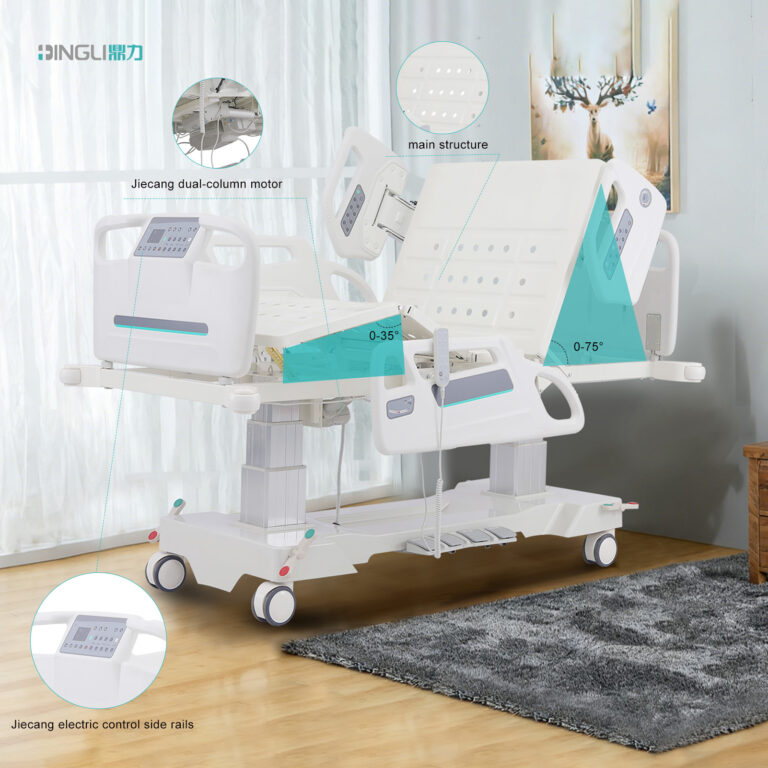
Mechanical Safety Risks in Hospital Beds
A hospital bed must be stable enough not to tip or collapse. At the same time, its moving parts and gaps can’t be allowed to create crush or entrapment risks.
Stability and Load Requirements
Hospital bed stability isn’t just about standing still. Standards like IEC 60601-2-52 demand that a bed remains stable even under clinically plausible, worst-case scenarios. This means it can’t tip or deform dangerously when loaded to its Safe Working Load (SWL) and put into extreme positions like maximum height or full Trendelenburg tilt. The entire structure, from the frame and joints to the lifting mechanisms, must withstand repeated use without bending or failing in a way that could compromise safety.
The Safe Working Load isn’t just the patient’s weight. It includes the patient, the mattress, and any accessories like IV poles or trapeze bars. Tests verify that the bed can handle this total weight, distributing the load safely to avoid localized stress that might cause a fracture. This is a critical check, especially with the rise of bariatric patients and heavier accessory loads. The bed’s braking system is also part of stability; brakes must be strong enough to hold the bed steady during patient transfers, even on slight inclines common in facilities. Faulty casters or weak brakes are a direct threat to stability.
Entrapment and Mechanical Hazard Controls
Mechanical hazards come from moving parts, structural gaps, and sharp edges. While pinch and crush injuries from actuators are a concern, the single most serious mechanical hazard is patient entrapment. This is when a patient gets caught or wedged in an opening, which can lead to severe injury or asphyxiation.
The FDA and other bodies have identified seven potential “zones of entrapment” in and around the bed system. Controlling these gaps is a non-negotiable part of modern bed design and facility management. It’s not about a single component; it’s about how the frame, mattress, and side rails interact. A properly designed bed frame may still create safety risks if it is used with an incompatible mattress or side rail system.
- Entrapment Hazards: These are controlled by enforcing strict dimensional limits on gaps, especially between the side rail and mattress, within the rail itself, and at the ends of the rail. The goal is to make gaps too small for a patient’s head to pass through.
- Movement Hazards: Articulating sections (head, knee, height) can create pinch, crush, or shear points. Controls include setting safe movement speeds, ensuring minimum clearances for feet and hands, and preventing unintended motion if power fails.
- Accessory Hazards: Adding components like IV poles or trapeze bars changes the bed’s mechanical profile. Each combination must be evaluated to ensure it doesn’t create new entrapment zones or compromise the bed’s stability and SWL.
Managing these hazards goes beyond manufacturing. Hospitals must conduct routine inspections, especially after changing a mattress or repairing a rail, to verify that critical gap dimensions remain within safe limits. Using non-approved parts or making unauthorized modifications can easily reintroduce risks that the original design eliminated.
Electrical Safety Requirements for Hospital Beds
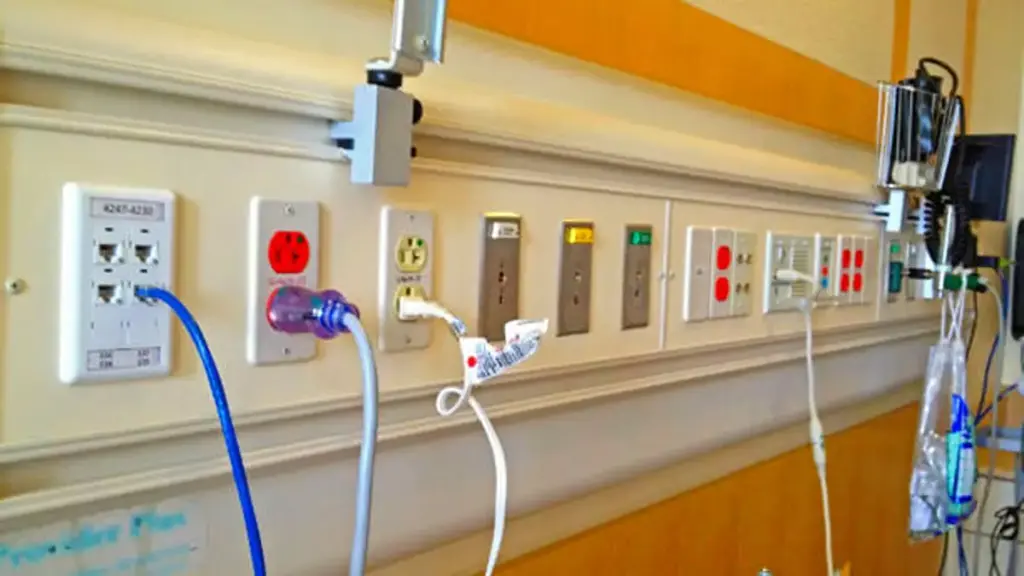
Electrical safety and essential performance ensure a powered bed won’t cause electrical harm and that its critical clinical functions will work reliably, even during a single fault.
For powered hospital beds, safety requirements cover not only mechanical durability but also electrical protection, electromagnetic compatibility, and reliable operation of essential functions such as height adjustment and backrest positioning. These concepts are defined by the IEC 60601 family of standards, with IEC 60601-1 providing the general rules and IEC 60601-2-52 (and its successor, 80601-2-52) adding specific requirements for beds.
Key Requirements for Electrical Hazard Protection
Protecting patients and staff from electrical hazards is non-negotiable. The standards establish a multi-layered defense system that manufacturers must build into every powered bed. It goes far beyond just using a grounded plug.
- Protection from Electric Shock: Live electrical parts must be inaccessible. The design must use proper insulation systems and limit leakage currents (tiny amounts of electricity that can flow to the patient or casing) to safe levels. The bed must remain safe even during a single-fault condition, like a broken protective earth wire.
- Power Supply and Wiring Safety: Cables and plugs must be hospital-grade and robust. Internal wiring needs to be routed away from pinch points in the bed’s moving frame. Good strain relief is mandatory to prevent wires from being pulled out or damaged.
- Overload and Fire Protection: Motors and actuators are tested to withstand their expected duty cycles without overheating. The design must include protective devices like fuses or thermal cut-outs to prevent an overload from causing a fire. Materials near electrical components also need to meet flammability standards.
- Electromagnetic Compatibility (EMC): A bed’s electronics cannot interfere with other critical medical equipment in the room. And it must be immune to interference from other devices. EMC testing ensures the bed functions correctly in an equipment-dense hospital environment.
Essential Performance of Powered Beds
“Essential performance” refers to any bed function whose failure could create an unacceptable risk for the patient. It’s about ensuring the bed doesn’t just fail passively but fails safely. This is where the interaction between electrical systems and mechanical movement is heavily scrutinized.
Powered adjustments for height, backrest angle, or Trendelenburg must operate reliably and predictably. The standards require that movement speeds are controlled to prevent sudden, jarring motions. The design must prevent crushing or shearing hazards in joints and scissor mechanisms during operation. If power is lost, there must be a way to get the patient to a safe position, like a manual CPR release that flattens the bed.
The user interface is also part of essential performance. Controls need to be clear and intuitive to prevent a nurse from making a mistake during an emergency. At the same time, they must be designed to prevent accidental activation by a patient. This is why many beds feature a nurse control panel with a lockout function that deactivates patient controls for potentially hazardous movements, like lowering the bed to an unsafe height.
Hospital Bed Entrapment and Mattress Compatibility
Entrapment risk comes from dangerous gaps created by mismatched mattresses and rails. The entire bed system—not just one component—must be assessed to ensure patient safety.
Entrapment Zones and Rail-Mattress Risks
Patient entrapment is a serious risk that happens when a person’s head, neck, or body gets caught in openings between the bed frame, side rails, and mattress. It’s not just a theoretical problem; it can lead to severe injury or death. The FDA provides the Hospital Bed System Dimensional and Assessment Guidance to Reduce Entrapment, which identifies potential entrapment areas and provides dimensional recommendations for evaluating bed systems.
Four of these zones are especially critical when you look at the fit between the side rails and the mattress. These are Zone 1 (within the rail itself), Zone 2 (under the rail), Zone 3 (the gap between the rail and mattress), and Zone 4 (at the end of the rail). A mattress that is too narrow for the frame, too soft, or simply the wrong size can create dangerous gaps in these zones. The risk gets worse when the patient’s own weight compresses the mattress, widening an already problematic opening.
A common mistake is assuming that mattresses and side rails are interchangeable. Using parts from different manufacturers often leads to an incompatible system. What looks fine on initial assembly can become a major hazard once a patient is in the bed.
Entrapment Zone Measurement Requirements
The goal is simple: keep any accessible gaps either too small for a body part to get stuck, or large enough for it to pass through freely without getting wedged. There are specific measurements that facilities need to know and check for.
- Critical entrapment zones are evaluated using specific dimensional tests. For example, gaps within the rail system and between the rail and mattress are assessed against recommended dimensional limits, with commonly referenced thresholds including approximately 120 mm for certain openings and 60 mm for specific rail-end areas.
- Gaps at the ends of the rail (Zone 4) must be strictly less than 60 mm (2.38 inches) to prevent neck entrapment. However, openings between the bars of the rail itself (Zone 1) should be less than 120 mm (4.75 inches).
Facility staff are responsible for assessing the complete bed system—frame, rails, and mattress—before it is used. This isn’t a one-time check. Any time a component is replaced, like a new mattress or different side rails, the entire system must be re-evaluated to confirm all gaps remain within safe limits.
Safe Working Load Requirements for Hospital Beds

Safe Working Load (SWL) is a bed’s total capacity, not just patient weight. Standards require both SWL and maximum patient weight to be clearly marked for clinical safety.
Understanding SWL and Patient Weight Limits
The Safe Working Load (SWL) defines the maximum total load that a medical bed is designed to support. It includes the patient’s weight, mattress, bedding, and any additional accessories such as IV poles or support devices. Operating beyond the specified SWL may affect the bed’s structural stability, adjustment functions, and overall safety performance.
SWL should be distinguished from the maximum patient weight. The maximum patient weight refers to the allowable weight of the patient after considering the weight of the mattress, bedding, and attached accessories included in the bed system. Since these additional components contribute to the total load, the maximum patient weight is normally lower than the bed’s overall SWL.
Medical bed standards may define load performance requirements based on the intended application environment, such as acute care or long-term care settings. Manufacturers must specify the applicable SWL and patient weight limits according to the product design and relevant regulatory requirements.
Load requirements vary depending on the bed type, intended use environment, and applicable standards. Buyers should verify both the manufacturer’s specified SWL and maximum patient weight to ensure the bed is suitable for the intended clinical application.
Exceeding the specified SWL may reduce mechanical reliability, affect powered functions such as height adjustment, and increase safety risks for both patients and caregivers.
Marking and Labeling Requirements
Medical bed standards require that both the maximum patient weight and the SWL are permanently marked on the bed. Having one without the other isn’t compliant. These markings have to be in a prominent place so clinical staff can easily see them before use.
Clear labeling helps staff quickly confirm that a bed is appropriate for a patient’s needs and is compatible with any additional equipment being attached. It’s a fundamental safety check. Any detachable parts over a certain weight also require their own mass markings to promote safe handling and assembly.
Hospital Bed Compliance Documents and Test Reports
Test reports provide objective data, labels communicate critical warnings, and the technical file is the complete compliance dossier. These three documents are the backbone of verified bed safety.
What Hospital Bed Test Reports Include
A test report is the objective evidence that a hospital bed conforms to specific safety and performance standards, like IEC 60601-2-52. It’s not marketing material; it’s a formal record from a testing laboratory that documents exactly what was tested and how the bed performed. Regulators, certification bodies, and informed buyers rely on these reports to verify claims about electrical, mechanical, and stability compliance.
A proper test report follows a consistent structure, usually based on an official format like an IECEE Test Report Form (TRF). This ensures all critical information is present and easy to find. Key sections typically include:
- Administrative and Device Data: The report number, testing lab, date, and precise identification of the bed model and configurations tested (including rails and accessories).
- Test Specification: The exact standards used, like “IEC 60601-2-52:2009 + A1:2015,” and the clauses being evaluated.
- Clause-by-Clause Results: This is the core of the report. It details the results for electrical safety, mechanical strength, stability, load capacity, and side rail integrity. It will show specific measurements and a “Pass/Fail” verdict for each test.
- Entrapment Zone Measurements: Specific reports or sections detail the gap measurements for the critical entrapment zones, using validated tools and methods to confirm compliance with dimensional limits (por exemplo, a head gap less than 120 mm).
- Documentation Review: A check that the bed’s labels, markings, and Instructions for Use (IFU) are complete, accurate, and durable enough for a hospital environment.
Ultimately, these reports are not just pass/fail documents. They provide the raw data that feeds into the manufacturer’s risk management and becomes the foundation of the bed’s technical file.
Technical Files and Required Product Labels
Labels and technical files are not afterthoughts; they are direct outputs of the testing and risk management process. The label communicates critical safety information at the point of use, while the technical file serves as the comprehensive evidence binder for regulators and auditors.
The general standard ISO 20417 sets the stage for information provided by the manufacturer, but the bed-specific standard IEC 60601-2-52 adds crucial requirements. For instance, manufacturers must explicitly warn about the dangers of using incompatible side rails and mattresses, as this is a known cause of entrapment. Other required markings include the safe working load (SWL) and a symbol indicating the bed is intended for adults.
The technical file is the master document. It’s the full story of the bed’s design, risks, and safety verification. Regulators use it for pre-market assessment and post-market investigations. A complete file contains:
- Device Description: Detailed specs of the bed, its intended use, and target patient groups.
- Risk Management File (ISO 14971): A full analysis of all potential hazards (entrapment, falls, electrical shock) and the design controls, warnings, or procedures used to mitigate them.
- Test Reports: The complete collection of electrical, mechanical, and stability test reports that prove the risk controls work.
- Design and Manufacturing Info: Drawings, material specifications, and key manufacturing processes.
- Information Supplied: Copies of all labels, the IFU, and service manuals.
These elements are all linked. The risk file identifies a hazard like entrapment, the design file shows a rail engineered to prevent it, the test report proves the rail’s dimensions are correct, and the IFU and labels warn users about mattress compatibility. This traceability is what demonstrates true compliance.
Choosing a Reliable Hospital Bed Manufacturer
When evaluating hospital bed suppliers, buyers should consider not only certification documents but also the manufacturer’s production capability and quality management system. As a professional medical equipment manufacturer, Dingli Medical integrates R&D, production, sales, and service with more than 10 years of manufacturing experience.
With ISO9001 and ISO13485 certified quality management systems, Dingli Medical supports international buyers with reliable hospital beds, including electric hospital beds, manual beds, homecare beds, and related accessories. The company operates a 15,000㎡ manufacturing base with automated production equipment and a strict inspection process covering raw materials, production procedures, and final products. Its OEM/ODM capability also allows customers to customize bed structures, accessories, and product solutions according to different market requirements.
Hospital Bed Compliance Checklist for Buyers
Paperwork is as critical as the hardware. This checklist covers the non-negotiable compliance documents you need to verify a medical bed’s safety and manage its lifecycle.
| Document Category | Key Files and Evidence |
|---|---|
| Technical and Regulatory Compliance Files |
|
| Operational and Lifecycle Management Documents |
|
Hospital Bed Safety Standards FAQ
What safety standards apply to hospital beds?
Hospital bed safety relies on two main pillars. The first is the international technical standard, IEC 80601-2-52, which sets requirements for the basic safety and essential performance of adult medical beds. The second is national regulatory guidance, like that from the U.S. FDA and UK MHRA, which provides specific dimensional criteria to prevent patient entrapment in gaps between the mattress, rails, and bed frame. Together, these standards govern mechanical and electrical safety, structural integrity, and the clinical use of bed rails.
What is IEC 80601-2-52?
IEC 80601-2-52 is the primary international standard that defines the safety and performance requirements for adult medical beds. It applies to both manual and electric hospital beds used in clinical settings, although their designs may differ in terms of adjustment mechanisms, power systems, and operational requirements. The standard establishes rules for mechanical strength, electrical safety, and usability. It also provides specific dimensional requirements for side rails and gaps in the bed system to prevent patient falls and entrapment.
Does IEC 80601-2-52 apply to manual hospital beds?
Yes, IEC 80601-2-52 explicitly applies to both electrically powered and manual (non-electrical) medical beds for adults. For manual beds, the standard’s requirements for mechanical safety, structural integrity, stability, and entrapment prevention are fully applicable. This ensures that manual beds provide the same level of protection against falls and entrapment as their powered counterparts.
What documents prove that a hospital bed was tested?
Proof of testing is typically a package of documents. The primary evidence is a formal Test Report from an accredited lab showing clause-by-clause results against a standard like IEC 80601-2-52. This is often supported by a CB Test Certificate or a similar national certification. The manufacturer also provides a Declaration of Conformity (DoC), which is a legal attestation of compliance. The bed’s Instructions for Use (IFU) and its Risk Management File also form part of the evidence.
Are hospital bed standards the same in every country?
Não, hospital bed standards are not identical everywhere, but they are highly harmonized. Most countries base their national standards on the international IEC 80601-2-52 for adult beds. This creates a common technical baseline for safety requirements like entrapment prevention and mechanical stability. Differences arise because countries adopt these standards at different speeds, may add their own national requirements like specific fire codes, and have different enforcement and inspection regimes.
Does a new IEC edition make every earlier test report immediately invalid?
Não, a new IEC edition does not automatically invalidate earlier test reports. An old report remains a valid record for products placed on the market when that edition was current. For new products, manufacturers must comply with the latest standard. They typically perform a “gap analysis” to identify new or changed requirements and conduct supplemental tests to prove full compliance. Regulators often provide a transition period where both editions are recognized.
Which standard edition should a buyer specify in a tender?
A buyer should specify the latest adopted standard, which is IEC 80601-2-52:2026 or its regional equivalent. This ensures the beds meet the most current safety and performance requirements. To account for market availability, a tender can specify the 2026 edition as the requirement while allowing suppliers to offer products compliant with the previous edition (IEC 60601-2-52:2009+A1:2015) during a defined transition period, giving preference to those meeting the latest standard.
Final Thoughts
Price is only one factor in hospital bed procurement. Compliance documentation, product reliability, and after-sales support are equally important considerations. Compliance with standards like IEC 80601-2-52 is not a feature—it is the only way to protect patients and your organization. The documentation proves the bed is safe; the bed itself just holds the mattress.
Don’t just trust a spec sheet; demand the technical file and test reports. This documentation is your only true guarantee of safety and compliance. Contact our team to review the full compliance package or to define the specifications for your next project.